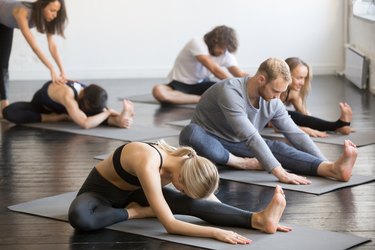
The gluteus medius, one of three muscles in the buttocks, works with your other hip muscles to move the leg away from the midline of your body. It also assists in both internal rotation and external rotation of the hip joint.
Because exercises that repetitively move your hip joints, such as running or dancing, can overwork this muscle and its surrounding muscles and tissues, it can become sore and tight. Stretching the gluteus medius can alleviate some of this tension and stiffness, restore efficient movement patterns and reduce pain.
Video of the Day
Video of the Day
Benefits of Glute Stretches
Stretching the gluteus medius with other muscles in your hips, legs and back reduces the stiffness in the hips that can cause hip, back and knee pain. By holding these glute stretches, you reduce the neural stimulation to the muscles, allowing them to relax and lengthen.
Because the hips are connected to your torso and legs via connective tissues and nerves, stretching the area can improve mobility in your spine and ankles as well. As an added benefit, stretching can help reduce glute pain.
Read more: Stretches for Tight Gluteus Muscles
Supine Hip Rotation Stretch
The supine hip rotation stretch targets the gluteus medius without placing pressure on your spine. You will feel a stretch radiating from your buttock and into your lower back.
- Lie on the floor on your back with your feet on the floor about hip-width apart.
- Cross your right ankle over your left knee near the kneecap.
- With your arms out to your sides, gradually turn your pelvis so that your outer left thigh and knee and your right foot touch the ground. This will stretch the gluteus medius and other hip muscles and lower back.
- Hold the stretch for six deep breaths.
- Repeat the exercise on the opposite hip by crossing your leg in the opposite direction.
Tabletop Hip Stretch
This exercise stretches your buttocks — including the gluteus medius — while maintaining your spinal posture. It also opens the nerve canal through which the sciatic nerve runs, reducing irritation and inflammation in the nerve and surrounding tissues.
- Stand in front of a flat platform, such as a table, that is as high as your pelvis.
- Put your right outer thigh and outer calf on top of the platform, with your right knee pointing forward.
- Keep your torso upright and your standing leg straight as you hold the stretch for five or six deep breaths.
- To increase this gluteus medius stretch, lean your torso forward at your waist slightly with each exhalation.
Massage Your Glutes
Massage can decrease glute medius pain and increase blood flow to the area prior to your glute stretches. Self-myofascial release (SMR) is a self-massage technique that releases trigger points and reduces sensitivity in your tissues and muscles.
You can use a foam roller to massage your hips by placing it on the floor and putting your buttocks on top of it. As you sit, shift your weight to your left buttock, and cross your left ankle over your right leg near your kneecap.
As you roll up and down on your buttock, you may find painful and sensitive spots. When you find one, gently rub the area up and down until the pain subsides. Breathe slowly and deeply to further relax your body. Consider using SMR before and after your workout to reduce muscle soreness and improve tissue mobility.
Warm It Up
Before doing a gluteus medius stretch, warm up your muscles with at least five minutes of light cardio or a hot bath. You should stretch all the major muscle groups in your body, including the gluteus medius, at least twice each week. If you are experiencing stiffness in the gluteus medius, daily stretch sessions would be more beneficial.
Read more: How to Warmup Before Stretches