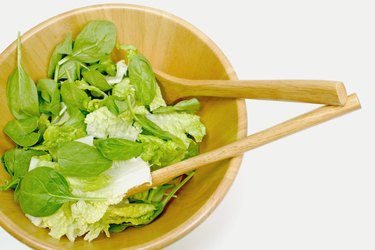
Whether you're watching your weight or want to add nutrient-dense food to your diet, lettuce and spinach are excellent choices. Lettuce and spinach are both favorite ingredients for salads and sandwiches, and both are naturally low in calories and provide fiber, vitamins and minerals.
Basic Nutrition
Video of the Day
Green leaf lettuce, which has more vitamins and minerals than iceberg lettuce, can be compared to spinach using a 1-cup serving size of each. The leaf lettuce has 5 calories, 0.49 grams protein and 0.05 grams of total fat, according to the United States Department of Agriculture Nutrient Database. The spinach has 7 calories, 0.86 grams of protein and 0.12 grams of fat. Lettuce has 0.5 grams of dietary fiber compared to 0.7 grams in spinach.
Video of the Day
Vitamins
Leaf lettuce and spinach are both great sources of vitamin A: Lettuce has 2,666 international units, and spinach has 2,813 international units. Based on recommendations from the Institute of Medicine, 1-cup of spinach provides roughly 100 percent of the suggested daily intake, and leaf lettuce provides over 80 percent. Lettuce and spinach both offer about 6 percent of the daily intake of thiamin, but spinach provides larger amounts of other vitamins. Leaf lettuce has 3.3 milligrams of vitamin C, along with small amounts of riboflavin, niacin and vitamin B-6. Spinach has twice the amount of each of those vitamins, with 8.4 milligrams, or roughly 10 percent, of the daily intake for vitamin C. Spinach has four to five times more folate and vitamin K than leaf lettuce.
Minerals
Spinach has almost three times more calcium, iron and potassium than leaf lettuce. Spinach has 30 milligrams of calcium, 0.81 milligrams of iron and 167 milligrams of potassium. Leaf lettuce has only 13 milligrams of calcium, 0.31 milligrams of iron and 70 milligrams of potassium. Spinach also has significantly more magnesium and sodium than lettuce.
Phytochemicals
Dark green leafy vegetables are a good source of plant-based compounds called carotenoids. Spinach and green leaf lettuce contain two important carotenoids called lutein and zeaxanthin, which are the only antioxidants found in the eye. Lutein and zeaxanthin protect your eyes from blue light and have been associated with a lower risk of age-related cataracts and macular degeneration, according to the Linus Pauling Institute. Spinach has significantly more -- almost 10 times the amount -- of lutein and zeaxanthin than lettuce.