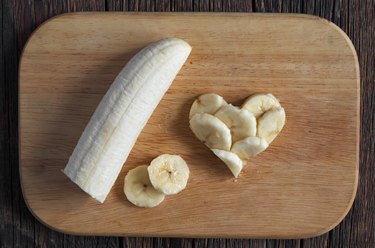
Bananas are sweet and satisfying, and the perfect food when you need a little boost of easily digestible energy. However, eating too many bananas isn't healthy. It could cause weight gain and an imbalance in your nutrients.
Tip
Eating too many bananas can lead to weight gain and nutrient imbalances.
Video of the Day
Calories in Bananas
One medium banana contains 105 calories, according to the USDA. That's not a lot of calories if you only eat one. However, if you eat more than one in a day, those calories can really add up.
Video of the Day
For example, eating five bananas a day would amount to 525 extra calories. If you eat 10 bananas a day, that's an extra 1,050 calories. Depending on what other foods you eat, too many bananas could cause you to exceed your calorie needs for the day.
How Many Calories You Need
To put in perspective what eating five bananas a day could do to your waistline, it's helpful to know how many total calories you should be consuming. According to the Dietary Guidelines for Americans, the average moderately active woman between the ages of 26 and 50 needs 2,000 calories per day. Moderately active men in the same age range need 2,400 to 2,600 calories daily.
If a 35-year-old woman ate five bananas each day, that would make up 26 percent of her daily calorie needs. Eating 10 bananas a day would provide more than half her calories.
Calorie Surplus and Weight Gain
Your body needs a certain amount of calories each day to support physiological function, such as digestion and respiration, as well as the physical activity you engage in each day. Any calories that your body doesn't need, it stores as fat. Over time, your fat stores increase, which is what causes weight gain.
According to the Mayo Clinic, 3,500 calories equals 1 pound of fat. Theoretically, that means that if you eat 3,500 calories above what your body needs for energy, you'll gain a pound of fat. Eating 500 extra calories from bananas each day could cause you to gain a pound of fat each week.
Sugar in Bananas
Fruit contains natural sugars from fructose, sucrose and glucose. One medium banana contains almost 15 grams of sugar, each gram of which contains 4 calories. That means that the sugars in a banana constitute more than half of the fruit's total calories.
The sugar in fruit isn't necessarily bad; it's certainly not as unhealthy for you as the processed sugar in sweets and soda. Fruit comes packed with other nutrients that offset the sugars and protect your health. But eating too much of it isn't good for you.
Bananas and Blood Sugar
Bananas and other tropical fruits, such as pineapples, contain more sugars and carbohydrates than other fruits. This means they are not the best choice for blood sugar control, which is especially important for diabetics.
Because bananas vary greatly in size, it's also hard to gauge how many carbs you're eating. An extra-large banana has 35 grams of carbs and almost 20 grams of sugar.
If you have problems controlling your blood sugar, it's all the more important to stick to a recommended serving size. According to the Mayo Clinic, you should stick to a serving of banana containing no more than 15 grams of carbohydrate.
Read more: The Many Benefits of Eating Bananas
Crowding Out Other Healthy Foods
Let's say you didn't eat more calories than you need; instead, you cut out other foods to fit five bananas into your daily diet. For example, instead of eating chicken breast, brown rice and spinach with olive oil for dinner, you eat bananas instead. Doing this every once in a while isn't going to make a big difference in your nutrient intake. However, doing it every day could.
Bananas contain scant amounts of protein and fat, both of which you need in a healthy diet. The average adult needs 46 to 56 grams of protein each day, and 20 to 35 percent of the diet should be comprised of fats, according to the National Academy of Medicine.
You need adequate protein for building muscles and other tissues, and for immune system health. Fat, especially heart-healthy polyunsaturated and monounsaturated fats, are crucial for nutrient absorption and hormone production. If you replace other healthy foods, such as lean protein and plant fats, with bananas, you may miss out on the important macronutrients you need for good health.
Eating Too Many Bananas Can't Kill You
Maybe you heard a rumor that eating more than six bananas can kill you. This urban legend comes from the TV series "An Idiot Abroad," starring Ricky Gervais and Karl Pilkington. In one episode, Pilkington tells Gervais, "If you eat more than six, it can kill you," apparently as an explanation of why bananas aren't sold in bunches greater than six.
The alleged cause of death is potassium poisoning. Bananas are a rich source of the mineral, with one medium fruit containing 422 milligrams. According to the Linus Pauling Institute, adults need 4,700 milligrams of potassium each day, so you'd have to eat more than 10 bananas just to get to the recommended daily intake.
However, you'd have to consume much more potassium than that to risk potassium poisoning. The Linus Pauling Institute reports that ingesting 18 grams or more of potassium at one time could cause dangerously high blood levels of potassium, but that would require consuming 171 medium bananas in one sitting.
Benefits of Bananas
Bananas are definitely worth eating on a regular basis. They're rich in fiber, with 3 grams per medium fruit. Dietary fiber is the part of plant foods that your body can only minimally digest. It moves through your digestive system mostly intact, improving your digestion and also providing other benefits, including lowering cholesterol.
Fiber also helps to slow down the absorption of sugar into your bloodstream, and it has been shown to aid weight loss because it can help control appetite and energy intake, according to a 2017 study in Nutrients.
Bananas are also rich in many vitamins and minerals you need for good health, including vitamin B-6, vitamin C and manganese. They also contain the disease-fighting antioxidants dopamine and catechins, according to Healthline.
Fitting Bananas Into a Healthy Diet
Of course, there is too much of a good thing. As with any food, bananas should be eaten in moderation, and they should not take the place of other healthy foods in your diet. When you do decide to snack on a banana, stick to a healthy serving size, which the USDA says is a single medium-size fruit.
Read more: Top Ten Health Benefits of Bananas
- USDA: Basic Report: 09040, Bananas, Raw
- Dietary Guidelines for Americans: Appendix 2. Estimated Calorie Needs per Day, by Age, Sex, and Physical Activity Level
- Mayo Clinic: Counting Calories: Get Back to Weight-Loss Basics
- Mayo Clinic: Diabetes Diet: Should I avoid Sweet Fruits?
- National Academy of Medicine: Dietary Reference Intakes: Macronutrients
- MedlinePlus: Dietary Proteins
- Snopes: Will Eating Too Many Bananas Kill You?
- Oregon State University: Linus Pauling Institute: Potassium
- Mayo Clinic: Dietary Fiber: Essential for a Healthy Diet
- Nutrients: Effect of Fibre Supplementation on Body Weight and Composition, Frequency of Eating and Dietary Choice in Overweight Individuals
- Healthline: 11 Evidence-Based Health Benefits of Bananas