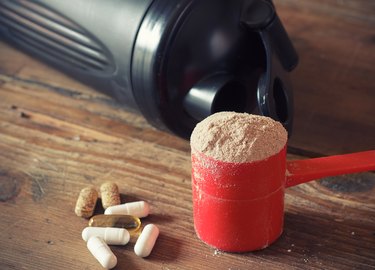
There are protein shakes that are chalky and hard to stomach, and then there are some that are downright delicious. That can be problematic for people who think that drinking protein shakes without working out is OK because they are a "health food."
Packed with protein, and often with decadent ingredients like peanut butter and chocolate, protein shakes can be surprisingly high in calories. If you're not exercising, and those protein shakes are adding a lot of extra calories to your diet, that could lead to weight gain.
Video of the Day
Video of the Day
Tip
Drinking protein shakes without exercising can cause you to exceed your daily calorie needs and lead to weight gain.
Protein Shakes Without Working Out
The average protein shake provides about 30 grams of protein — a third of the amount a 150-pound person eating a high-protein diet needs daily. But those 30 grams are easy to get through whole foods. For example, 3.5 ounces of chicken breast has 31 grams of protein, according to the USDA. It also has only 165 calories. Chicken is an excellent source of lean protein for a calorie-controlled, weight-loss diet.
Chances are, a chicken breast is also going to satisfy you more than a liquid shake. According to an article in Trends in Food Science & Technology in February 2015, liquid calories have a weaker effect on satiety and can therefore lead to excess calorie intake.
Whole foods, such as whole grains and vegetables, are also a better source of fiber, another highly satiating nutrient that slows digestion and can delay the release of an appetite-stimulating hormone called ghrelin, according to a review article in Journal of Nutrition and Metabolism in January 2019.
In reality, only a small fraction of the population may benefit from protein shakes — people who are very active, older people and people with illness. People who are going to the gym six days a week may need a lot of extra protein for muscle repair and recovery, and they may find it challenging to get everything they need through a healthy diet.
Older people and those who have illness often have decreased appetites but potentially higher protein needs due to illness may often benefit from the effects of protein shakes without exercise — especially as they can be more palatable than solid foods, per the Illinois Department on Aging.
For everyone else, they're more of a "want to have" instead of a "need to have." If you've experimented with your diet and find that having a protein shake as a meal replacement helps you effectively reduce your calorie intake without causing you to feel hungry, then this might be a bonafide strategy. If you want one every once in a while as a treat, just make sure that you reduce your overall calorie intake for the day to compensate.
Either way, avoid shakes that have added sugar and other unhealthy ingredients. Otherwise, you should just call that protein shake what it is — a dessert.
Pack them with fruits, vegetables, lean protein and healthy fats, and only drink one 8-ounce serving. When you're done, think about starting an exercise program, which will not only allow you to enjoy an extra protein shake now and then but will also help you more easily lose weight and improve your overall health.
Protein Shakes Aren't Always Healthy
Protein shakes come in many varieties. Sometimes, products called "protein shakes" are really just milkshakes in disguise. They may contain hundreds of calories, sugar, cream — even ice cream. Health foods, these are not.
Others fall somewhere in between. Chocolate-peanut butter protein shakes are a popular example. When made with healthy ingredients, such as raw cocoa powder or high-quality, chocolate protein powder, they can be nutritious if they fit into a well-planned diet. However, even these very often contain a lot of sugar, because no one wants a savory protein shake.
Then, there is the small proportion of protein shakes that really are a boon to a healthy diet. They often include veggies like kale, clean protein from nuts, seeds or high-quality protein powder and natural sweetness from fresh fruit.
They can be made higher in calories with the addition of healthy fats for those who need extra calories, or lower in calories for people who don't. If you're going to drink protein shakes without working out, this is the category you want to stay in.
Benefits of Protein Shakes
There are two main reasons people drink protein shakes: to build muscle and to lose weight.
Getting enough protein is crucial for adding mass because it's the building block of muscle. The stress of resistance training damages the muscle fibers — after training, the body repairs the damage and builds new muscle, per the American Council on Exercise. A protein-packed, post-gym shake can kick start that process.
But if you're not exercising, you're probably not trying to build muscle — at least not successfully. But maybe you've heard that protein shakes without working out will help you lose weight. That's just snake oil. Drinking protein shakes won't help you lose weight unless they are part of an overall healthy, calorie-controlled diet (and preferably, an exercise program).
Protein itself — in any form — may aid weight loss, however. Of the three macronutrients — carbohydrate, protein and fats — protein is the most satiating nutrient. According to a review article published in Annual Review of Nutrition in July 2016, a higher protein intake can reduce hunger to help control calorie intake.
In a study published in June 2017 in Obesity Facts, participants with metabolic syndrome who adhered to a high-protein diet lost significantly more weight than those who ate a standard-protein diet.
How Much Protein You Need
So, increasing your protein intake may help you lose weight even if you don't work out. But how much of an increase?
The recommended daily intake for protein determined by the Food and Nutrition Board of the National Academies of Medicine is 46 grams per day for women and 56 grams per day for men. That's not much. If you eat three square meals, that's about 15 to 19 grams at each meal.
However, some experts think the protein RDI is too low. At the Protein Summit 2.0 held in Washington, D.C. in October 2013, over 60 nutrition scientists came together to discuss research on protein and its effects on human health. According to a summary published in the American Journal of Clinical Nutrition in June 2015, the general consensus was that a higher protein intake would benefit not only weight-management but also metabolic health and aging.
In the 2017 Obesity Facts study, the standard protein group ate about 0.8 grams per kilogram per day — equivalent to the RDI. The high-protein group consumed 1.34 grams per kilogram of body weight per day. As an example, a 150-pound person eating a standard-protein diet would need 54 grams of protein per day, while a 150-person eating the high-protein diet would need 91 grams daily.
Related Reading
- ACE: "9 Things to Know About How the Body Uses Protein to Repair Muscle Tissue"
- Annual Review of Nutrition: "The Macronutrients, Appetite and Energy Intake"
- Obesity Facts: "Effect of a High-Protein Diet Versus Standard-Protein Diet on Weight Loss and Biomarkers of Metabolic Syndrome: A Randomized Clinical Trial"
- National Academies of Medicine: "Summary Tables Dietary Reference Intakes"
- American Journal of Clinical Nutrition: "Introduction to Protein Summit 2.0: Continued Exploration of the Impact of High-Quality Protein on Optimal Health"
- USDA: "Basic Report: 05064, Chicken, Broilers or Fryers, Breast, Meat Only, Cooked, Roasted"
- Trends in Food Science & Technology: "Optimising Foods for Satiety"
- Journal of Nutrition and Metabolism: "The Role of Fiber in Energy Balance"
- Illinois Department on Aging: "Aging Healthfully"