












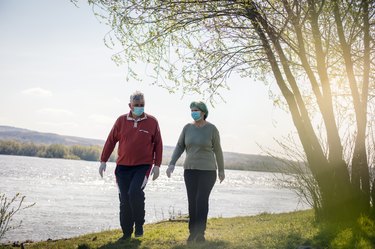
























































The exercise desaturation test is commonly done to evaluate lung conditions. “Saturation” refers to the amount of oxygen that is being carried in the blood. Oxygen is carried in the blood by hemoglobin, an iron-containing molecule found in red blood cells. In some lung diseases, the amount of oxygen being carried in the blood may fall with exertion. During exercise desaturation testing, patients are asked to walk on a treadmill at a comfortable pace for a maximum of 6 minutes.
Chronic Obstructive Pulmonary Disease
Chronic obstructive pulmonary disease, or COPD, is a lung disease commonly seen in chronic, long-time smokers. The disease is caused by gradual damage to the elastic tissue of the lung, called emyphysema, and repeated episodes of coughing and mucus production, called chronic bronchitis. Symptoms of COPD include cough, fatigue, frequent respiratory infections, wheezing and breathlessness. COPD commonly produces exercise induced desaturation. According to a paper published in “COPD” in 2009, exercised induced desaturation in COPD may indicate a poor prognosis in these patients.
Asthma
Asthma is the other common obstructive lung condition. Asthma usually starts at a young age, but also has symptoms of breathlessness, wheezing and cough. Asthma may also cause a mild exercise induced desaturation; however, the effect is very mild. This is because of the limited damage to the alveoli, which are the parts of the lung that allow for gas exchange with the blood.
Interstitial Lung Diseases
The term “interstitial lung diseases,” or ILD, includes a large variety of respiratory conditions in which the lungs slowly become scarred. The pneumoconiosis are a type of ILD in which scarring of lung occurs due to occupational exposures to asbestos, carbon, silica and other dusts. Sarcoidosis is another type of ILD which frequently affects women of African ethnicity. Other types or ILD may occur following exposure to radiation or drugs. All of the interstitial lung diseases can cause a low concentrations of arterial oxygen. This may become worsened following exercise.
Pneumocystis Jiroveci Pneumonia
Pneumocystis jiroveci, sometimes called P. carinii, is a type of fungus that causes an exceptionally common pneumonia in individuals with poor immune systems. Those affected by the acquired immunodeficiency syndrome are most at risk. Exercise induced desaturation is a common finding in pneumocystis pneumonia. The fungus can cause a severe lung disease that can be fatal if not promptly treated. It does not respond to usual antifungal medications, though fortunately it does respond to other therapies. Individuals with HIV and low blood counts are often advised to take daily medication to prevent this infection from occurring.
References
- National Jewish Health: Exercise Tolerance Test and Exercise for Desaturation Test; June 2006
- "COPD"; Exertional Desaturation in Patients with Chronic Obstructive Pulmonary Disease; R.J. Panos; December 2009
- "Thorax"; Pulmonary Gas Exchange During Exercise in Young Asthmatic Patients; K.A. Feisal; June 1979
- "Journal of Cardiopulmonary Rehabilitation and Prevention"; Interstitial Lung Disease and Pulmonary Rehabilitation; C. Garvey; May-June 2010
- "Davidson's Principles and Practice of Medicine"; Nicki R. Colledge, et. al; 2010
- PubMed Health: Chronic Obstructive Pulmonary Disease; 5/1/2011
- MayoClinic.com: Interstitial Lung Disease; June 9, 2011


