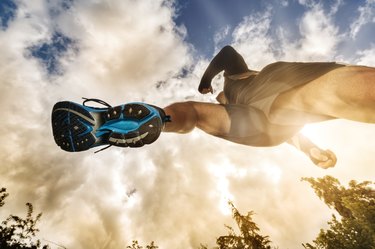
Nothing can take the pep out of your stride when running like a muscle injury. Pain in your adductor muscles, or groin area, during or after a run can indicate a strained groin and can stop you in your tracks. Your groin usually becomes strained when you overtrain or don't stretch properly, as the adductor muscles in your inner thighs need to be flexible and warmed up to effectively draw your legs together during a run. While a strained, or pulled, groin is a common injury, it can be extremely painful and cause long-term problems. However, with stretching, proper running form and ample recovery time between workouts, you can reduce your chances of straining this muscle group.
Adductor Muscles
Video of the Day
The adductor muscle group is made up of five muscles that run along the inside of your thigh. The pectineus, adductor brevis and adductor longus go from your pubic bone to your mid-thigh and are known as the short adductors, while the gracilis and adductor magnus go from your pelvis to your inner knee and are known as the long adductors. The adductor muscles are responsible for drawing your legs together to control the swinging of your legs while walking and running, and they also help stabilize your stride.
Video of the Day
Injuring Adductors While Running
Injuring your adductor muscles while running most commonly occurs when you sprint, hurdle, start or stop suddenly, quickly change directions or run with side-to-side movements. This is because the adductors have to work harder to pull your legs back together while keeping you balanced when you move forcefully or at high speeds, and they can become strained under this pressure. Overtraining can also lead to a strained groin if your muscles do not have adequate time to recover and are too weak or fatigued to carry out their movement of your legs successfully. In addition, if you fail to warm up properly before you engage in running, you increase your chances of injuring your adductors. There are three levels of groin strains ranging from uncomfortable to extremely painful. A mild, "grade 1" strain occurs when the adductor muscle has been stretched too much; overstretching may cause little pain and may not limit mild physical activity. A moderate, "grade 2" strain is a tear in the adductor muscle and can prevent activities that include running and jumping. A severe, "grade 3" strain is a complete rupture of the adductor muscle and can result in severe pain, swelling, bruising, muscle spasms and the inability to move your leg.
Injury Prevention
To prevent a groin strain and possibly weeks of missing out on your favorite physical activities, it is important to warm up adequately before exercising. Begin your warm-up with five to 10 minutes of light cardio to get blood flowing to your muscles. Next, do dynamic stretching, or stretching while moving, before your run. This takes your joints, ligaments and muscles through the range of motion used during exercise to prepare them for your workout. Perform the side-lunge, touching-heel dynamic stretch by lunging to the right, bending down and touching your right foot with your left hand. Lunge back and forth, switching sides each time you lunge. Touch your foot with the opposite elbow to get a deeper groin stretch. You can also warm up the adductor muscles with other dynamic stretches like gentle leg swings and walking leg cradles. Cool down after your run with short adductor stretches and long adductor stretches. Running with proper form can also help you avoid a pulled groin. When running, keep your body aligned and centered. Relax your upper-body so muscle tension in the upper body doesn't draw blood away from the muscles in the legs and avoid heel striking so the force of each step doesn't land on your heels. Also, take short, quick strides rather than really long strides to avoid overextending your adductor muscles. Finally, avoid overtraining by allowing your muscles ample time to recover between workouts. Take at least two to three days off from training each week and increase the amount of exercise you do gradually, not rapidly.
Injury Treatment
If you do strain your adductor muscles, it is important to treat the injury right away to speed up the recovery process and prevent further injury. Apply ice and compression directly to your inner thigh as soon as possible after the injury, regardless of the injury's severity. Reapply ice every 15 to 20 minutes, three to four times a day for the first day to reduce swelling. Rest and refrain from both stretching and exercise for five to seven days so you can evaluate your injury. Grade 1 symptoms usually subside in about a week, grade 2 symptoms are normally gone in two to three weeks and grade 3 symptoms typically last six to eight weeks or longer. A mild groin strain usually doesn't require medical attention. However, if the strain is moderate or severe, or if the pain takes longer to subside, it is important to get evaluated by your physician. He or she can determine the best course of action for rehabilitation, which may include massage, stretching and exercise. After the pain subsides, you can gradually resume normal physical activity.