





































Any part of the eye can be affected by degenerative changes that decrease vision and interfere with activities of daily living. Some degenerative changes occur because of aging; others are related to heredity factors. Having regular eye exams and seeing the eye doctor whenever new symptoms occur can help minimize vision loss.
Age-Related Macular Degeneration
Age-related macular degeneration, also known as AMD, affects over 10 million people in the United States and is a leading cause of blindness, according to the University of Maryland Medical Center. There are actually two types of macular degeneration: dry macular degeneration, which affects about 85 percent of the population with AMD, and wet AMD, which affects only 15 percent but causes the most serious vision loss. AMD, which can affect one or both eyes, occurs when the retinal pigment epithelium (RPE), a layer of the retina that supplies oxygen to tissue in the macula, the area responsible for central vision, begins to thin. Waste that would normally be removed builds up in the macula, nutrients can't be delivered, and new blood vessels form under the macula, possibly to compensate for the loss of nutrients in the macula. The new vessels, known as choroidal neovascularization, leak and swell, interfering with central vision. Treatment is an intravitreal injection into the white part of the eye, the sclera, with drugs that stop the growth of new abnormal blood vessels. Heredity, smoking history and light colored eyes all are factors that increase the risk of AMD.
Lattice Degeneration
Lattice degeneration is a thinning of the blood vessels at the periphery of the retina. Because the damage is done at the sides of the visual field instead of the center, little vision is lost. Lattice degeneration often starts in the twenties and progresses slowly; often both eyes are affected, Gordon K. Klintworth, M.D., Professor of Pathology at Duke University states. No treatment is necessary unless complications such as retinal detachment occur. There's a family tendency toward lattice degeneration; the disease is also more common in people with myopia, or nearsightedness.
Myopic Degeneration
Myopic degeneration, like AMD, can result in choroidal neovascularization. Myopic degeneration occurs in people with high myopia, -6 diopters or more, and is caused by the retina being stretched more than normal by the elongated eyeball found in people with myopia, Schepens Eye Institute explains. Treatment is the same as for AMD, intravitreal injections to decrease new blood vessel growth. Since nearsightedness is a hereditary trait, the disease may run in families.
Keratoconus
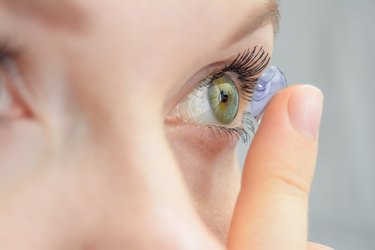
Keratoconus is a degenerative disease of the cornea, the thin dome-shaped membrane found in front of the iris and pupil. Keratoconus is more common in women and usually begins in puberty, according to the University of Illinois at Chicago. The cornea begins to thin out and sags, so that it looks cone shaped, which gives the disease its name. The cornea may also wrinkle, scar or swell. The change in the shape of the cornea leads to vision distortion, blurring, nearsightedness that worsens over time, and the feeling of looking through dirty glass. Keratoconus may worsen over several decades. Only 1 in 10 cases of keratoconus have a relative with the disease. Contacts help smooth the surface of the cornea and improve vision. In severe cases, a corneal transplant may be necessary.


