Almost everyone will get lower back pain at some point, according to the American Academy of Orthopaedic Surgeons (AAOS). It can come on suddenly and range from mild to severe. A common cause is overusing your back muscles. Muscle pain may cause lower back spasms, making it hard to move.
"People describe acute lower back pain as throwing out their back or having a back spasm. In most cases, you don't really throw your back out of place, but muscle spasms are a common symptom of low back pain," says Chris A. Cornett, MD, associate professor for spine surgery and medical director of physical and occupational therapy at the University of Nebraska Medical Center, Omaha.
Video of the Day
Video of the Day
Read more: Muscle Spasms After a Workout
What Causes Back Spasms?
"The most common cause is a strained muscle in your back. A sore muscle can go into spasms," Dr. Cornett says. "Another cause in older adults is wear-and-tear arthritis of the spine that causes tiny tears in the outer parts of the discs that separate the spinal bones. These tears can be very painful. Your back muscles can become fatigued and go into spasms trying to guard against the pain."
The National Institute of Neurological Disorders and Stroke (NINDS) notes that most low back pain is acute low back pain. That means it tends to get better on its own within several days, without any long-term symptoms. Back pain that lasts more than 12 weeks is called chronic back pain and is more likely to require treatment from a health care provider.
What to Do at Home
Acute low back pain caused by muscle strain is usually due to overexercising your back, especially if the activity is strenuous or new, according to AAOS. But also, "People with wear-and-tear arthritis and a worn-out disc may get acute lower back pain from sleeping the wrong way in bed or without any obvious cause," Dr. Cornett says.
In any case, most acute low back pain can be managed at home. Dr. Cornett suggests that you:
- Rest your back until the muscle spasms go away and the pain has eased.
- Avoid prolonged rest. Once you can move, start some gentle stretching and try to get up and moving. Avoid strenuous exercise or any activity that makes back pain worse.
- Use an ice pack on your back early and alternate ice and heat afterwards, depending on what works best for you.
- Take an over-the-counter pain medication, either a non-steroidal anti-inflammatory drug (known as an NSAID) like ibuprofen or another type of pain reliever like acetaminophen.
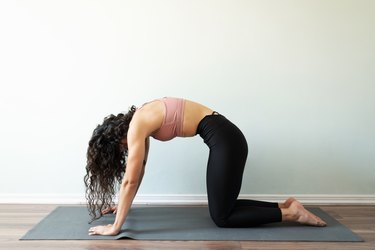
When you're ready for stretching, the Mayo Clinic recommends several stretches for back pain, including the cat stretch. For this stretch:
- Get down on your hands and knees.
- Slowly arch your back upwards and then slowly relax and let your back sag down toward the floor.
- Repeat this stretch three to four times.
"There are no natural muscle relaxants that can relieve a muscle spasm, but an over-the-counter cream that produces the sensation of heat can distract from the pain. Once the spasms have subsided, a massage or a visit to the chiropractor may be helpful," Dr. Cornett says.
Read more: Exercises for Muscle Spasms in Your Back
When Should You Call Your Doctor?
"Acute back pain with a muscle spasm should not last more than eight to 12 hours. If you are still having persistent, severe pain or spasms after 12 hours, call your doctor. You should also call if you have pain with weakness or numbness or any loss of bowel or bladder control," Dr. Cornett says.
The AAOS recommends that you call your doctor if you have residual back pain that has not gone away in a few weeks. Small disc tears that occur with aging can last for weeks or months. Discs can also shrink and collapse, called disc degeneration, or protrude out between the spinal bones, called disk herniation. A herniated disc can cause pressure on your sciatic nerve with pain, weakness or numbness shooting down your leg to your foot.
How Do Doctors Treat Back Pain?
"Doctors may start you on physical therapy to strengthen the muscles that support your back. In some cases, we may use a steroid medication to reduce swelling," Dr. Cornett says.
Chronic back pain is typically treated by starting with simple, low-cost treatments and moving toward more aggressive interventions as needed, NINDS explains. There are a number of complementary and alternative treatments that may be recommended, from acupuncture and various relaxation techniques to transcutaneous electrical nerve stimulation and spinal manipulation. Surgery might be considered if other options fail.
"If imaging studies show a long-term disc problem, we may recommend surgery in some cases," Dr. Cornett says.
- American Academy of Orthopaedic Surgeons: “Low Back Pain”
- Chris A. Cornett, MD, associate professor for adult spine surgery, medical director of physical and occupational therapy, Department of Orthopaedic Surgery and Rehabilitation, University of Nebraska Medical Center, Omaha
- National Institute of Neurological Disorders and Stroke: “Low Back Pain Fact Sheet”
- Mayo Clinic: “Back Exercises”
Is this an emergency? If you are experiencing serious medical symptoms, please see the National Library of Medicine’s list of signs you need emergency medical attention or call 911.