

























































If you're considering beginning an exercise routine, good for you: Exercise, along with a healthy diet, is one of the best ways to stay healthy for life. However, if you have a "leaky" heart valve -- caused by any number of valvular heart diseases...
Heart valves ensure that blood flows in the right direction through the heart. Disorders that cause leaky heart valves, also known as mitral valve prolapse, are a serious medical condition. Fully repairing heart valves requires surgery; however,...
The valves in the heart are located between the four chambers and keep the blood flowing in the right direction. These valves can be damaged from heart disease, congenital defect, injury or from infection. These types of damage can lead to...
A leaky valve in the heart, called valvular insufficiency or regurgitation, occurs when one of the valves becomes weak. This allows blood to flow backward instead of forward. According to Jeffrey R. Bender, M.D., congestive heart failure is a...
The heart is made up of four chambers: the right and left atria and the right and left ventricles. Blood enters the heart in the right atrium and travels to the right ventricle, then to the lungs (via the pulmonary artery). Blood re-enters the...
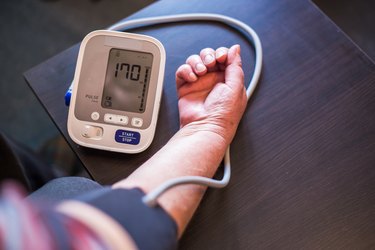
The American Academy of Family Physicians says that patients older than 55 tend to experience lowering diastolic pressure and increasing systolic pressure due to aging blood vessels. This condition, called isolated systolic hypertension, is...
Your heart consists of four chambers. Two upper atrium and two lower ventricles. Blood returning to the heart after delivering oxygen to the body enters the right atrium. It is then pushed through the left ventricle and into the lungs to be...
The heart is divided into four chambers. Each of these chambers is separated by a valve that keeps blood flowing through the heart in one direction. The aortic, pulmonic, tricuspid and mitral valves can become diseased. The most common diseases...
It's not unusual for you to feel your heart beat during a workout -- a fast, pounding heart rate usually indicates that you're exercising hard enough for you to improve your level of fitness. But if you feel random heart tremors while you...
Your heart is composed of four chambers: a left and right ventricle and a left and right atria. Each valve contains flaps of tissue, called cusps, which help control the movement of blood into, through and out of the heart and surrounding blood...
The heart contains four valves---the mitral valve, the tricuspid valve, the aortic valve and the pulmonary valve---that direct the flow of blood through the four chambers of the heart. The valves consist of leaflets, or cusps, connected to fibrous...
Leaking valves of the heart are referred to as having insufficiency or regurgitation. The most common valves to be affected are the aortic and mitral valves. Leaking valves are caused by several conditions, including myxomatous degeneration,...
Mitral valve prolapse, also known as MVP, occurs in up to 5 percent of the general population and in 10 percent of young women, according to "Current Medical Diagnosis and Treatment." It affects the valve that helps the blood flow in the left side...
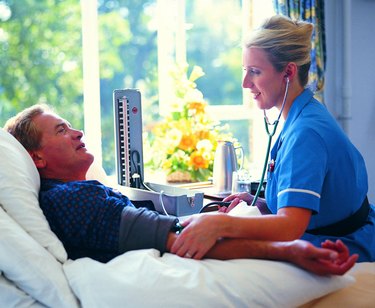
According to the National Heart, Lung and Blood Institute, blood pressure is the force of blood acting on the walls of your arteries as the pumping action of your heart circulates blood throughout your body. A blood pressure reading is given in...
Blood pressure is the force of blood acting on the walls of the arteries as the pumping action of the heart circulates blood throughout the body. A blood pressure reading uses millimeters of mercury units, or mmHg, and has a systolic component as...
Heart disease is the number-one killer in the United States today and is responsible for more than 40 percent of all deaths, according to the Mayo Clinic. The phrase heart disease (cardiovascular disease) is used to describe a wide array of...
Chronic heart disease, the number one killer in the United States, is responsible for more than 40 percent of all deaths, according to the Mayo Clinic. Chronic heart disease, or cardiovascular disease, describes a wide array of diseases that...
An echocardiogram uses sound waves to assess the heart's function and structures in a noninvasive way. A trained sonographer places a transducer on the chest at certain locations and angles, which sends ultrasonic sound waves through the skin and...
When trying to lose weight quickly diet pills may seem like a good option. Some weight loss medications prescribed by physicians that are generally considered safe, but there are also many prescription and over the counter pills that may cause...
The heart is the central organ in the cardiovascular system and is a muscular pump that helps distribute blood throughout a vast network of vessels. According to the Mayo Clinic, a healthy adult heart beats 62-100 times per minute when a person is...
The symptoms of fatigue, shortness of breath, and dizziness can seem harmless when they present as individual symptoms. Everyone will feel one or more of these symptoms at some point in their lives. When these symptoms occur together, however,...
Heart disease is a general term used to describe any problem with the heart muscle, its valves or the blood vessels that carry blood and oxygen through the body. This includes coronary artery disease, high blood pressure, heart failure, leaky...
Atrial fibrillation is an abnormal heart rhythm in which the upper heart chambers, or atria, quiver in a disorganized, chaotic fashion. This makes the heart pump inefficiently, which in turn increases the risk of blood clots. The rhythm tends to...
The heart's job is to pump blood through a vast network of blood vessels to the tissues, supplying them with oxygen and other nutrients. Under normal circumstances, the heart beats regularly and consistently, but there are many things that can...
The heart pumps blood, nutrients and oxygen throughout the body. The sinus node, a group of specialized cells in the top right chamber of the heart, generates electrical impulses that travel through the heart muscle causing it to contract. The...
Shortness of breath and dizziness are known as non-specific symptoms. This means a diagnosis cannot be established from their presence alone: A further medical history, physical exam and tests should be performed. However, dizziness and shortness...