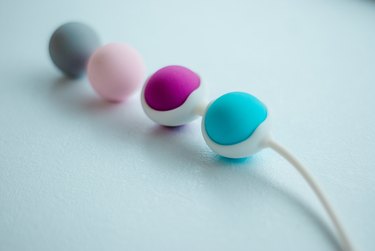
Ah, the almighty Kegel. Touted as the best exercise women can do to improve their sex life (and overall vaginal health). Though many women begin doing Kegel exercises without props, some move on to using vaginal balls to increase resistance and make the exercises more challenging.
Other women use Kegel balls for vaginal stimulation or to increase arousal. But since they're inserted into your vagina, it's important to know how to use Kegel balls before you begin. Here are four basic steps to get you started as well as five Kegel variations you can do while they're inserted.
Video of the Day
Video of the Day
What Are Kegel Balls?
Kegel balls, also called Ben Wa balls, Geisha balls or Kegel eggs, are small weighted devices that can help strengthen a woman's vaginal and pelvic floor muscles. Strong pelvic floor muscles help prevent urinary and fecal incontinence.
Though many swear by Kegel balls or vaginal eggs (Gwenyth Paltrow, most famously), they're not magical eggs that work for everything. Some experts recommend using Kegel balls to help strengthen your pelvic floor muscles, while other people swear by their ability to increase sexual arousal, both for you and your partner.
You need to do a little bit of research to find the balls that work best for you. Remember, you can't just stick any small ball in your vagina and be safe. You need to purchase a product that's made specifically for this type of use. Since the balls are available in a variety of weights, you can control the comfort and intensity of the exercises. Ideally, you will want to start with a lighter weight and move up as you become familiar with the balls.
One nice feature of some Kegel balls is they come in a set that includes a range of weights (like the set in the picture). If your new to this product or your pelvic muscles are weak, you may want to start with the smallest ball (which is the lightest in weight) and then progress through the different weights.
Cultural sexologist, Carol Queen, Ph.D., says there are three main things to consider when choosing to use something to exercise these muscles:
- The material the item is made of. Most of these have body-safe, non-porous silicone coatings, which is among the safest kind of material for internal use.
- Related but slightly different, is the item made of a breakable material? Sharp/scratchy/breakable is a no-no (because, ouch!).
- Can the user remove them easily when done exercising/playing with them? Most of these have silicone "strings" to make this easy, unlike items like ben wa balls.
Read more: 13 Things That Should Never Go Near Your Cooch

How to Use Kegel Balls
Step 1: Learn to Control Your PC Muscle
Isolate your pubococcygeus (PC) muscle. This is the muscle your Kegel ball exercises will work. Move as if you were trying to stop your urine mid-stream. The muscle you contract is the PC muscle.
This is the motion you'll be making as you perform the exercises. It feels like squeezing or pulling the pelvic floor muscles up toward the lower back. Alternately, you can find this muscle by placing a finger in your vagina and squeezing down until you feel the PC muscle tighten.
Step 2: Insert the Kegel Balls
Find a comfortable, relaxed position, such as sitting, standing or lying down, and gently push the Kegel ball into your vaginal opening. Stop just as it's completely in; don't press them to the back of the vagina or up near the cervix. And make sure you can still access the string or handle to pull them back out. Close your legs to help keep them in place as you position yourself for your exercises.
Step 3: Use for Kegels or Foreplay
If you're using the balls strictly for Kegel exercises, you can insert one or more of the Kegel balls into your vagina, and begin tightening and releasing your pelvic floor muscles. Using the balls is recommended after you are familiar with regular Kegels (without the balls). Consider the balls an advanced tool for your Kegel exercises.
If you're using Kegel balls for sexual pleasure, you can insert the balls a few hours before you anticipate seeing your partner. This can help increase your arousal for foreplay. You can also ask your partner to insert the balls for you as part of foreplay. To get maximum benefit, leave them in for a while before removing them for penetrative sex.
Step 4: Remove the Kegel Balls
Remove the Kegel balls by sweeping a finger into the vagina, behind the first ball and gently pulling downward. Alternatively, you can tug gently on the cord to pull them out. Just make sure that you're fully relaxed and not tensing any of your pelvic muscles.
Once you're done with your Kegel balls, wash with warm water and very mild soap. Rinse well, making sure to remove all soap residue as soap can irritate the delicate vaginal tissues.
Read more: 9 After-Sex Hygiene Habits You Should Never Skip
Kegel Exercises for Women
Kegels are an exercise that doctors suggest to women to help strengthen their pelvic floor muscles both during and after pregnancy. To do a Kegel exercise, you first want to identify your pelvic floor muscles. The next time you go to the bathroom, stop urination midstream. The muscles you're using are your pelvic floor muscles.
Jen Gunter, M.D., OB/GYN and author of The Vagina Bible, says pelvic floor exercises can treat incontinence and pelvic organ prolapse. "Some women find contracting their pelvic floor purposely can help turn them on (sexually), so if you have a better conscious control of your pelvic floor that may be helpful, but otherwise these exercises are not going to magically transform your sex life."
Gunter also says that women don't needs pelvic floor weights, which are the medical term for Kegel balls. "They are one way to strengthen the pelvic floor, but they do not perform better than pelvic floor exercises (Kegel exercises)," she explains.
Once you know how to tighten your pelvic floor muscles, you can do Kegel exercises just about anywhere and any time. To start, tighten and hold your pelvic floor for five seconds, then release. You can repeat this as many times as you like.
One tip that saves a lot of women time is to do your Kegels while in line at the store or sitting at a stop light. If you choose to use Kegel balls, here are five exercises you can try once you have the balls inserted.
1. Kegels While Lying Down
If you choose to use Kegel balls while lying down, it's important to remember that sitting or standing is a more effective way to use the balls. That said, if you're lying down, insert the balls and then proceed to hold the balls inside of you by tensing your leg muscles or doing Kegel exercises.
2. Sitting Kegel Contraction
Sit with your legs still closed. Isolate the PC muscle and use it to try to move the balls back and forth. If initially you can't move the balls back and forth, focus on squeezing the balls and holding it for a few seconds, then relaxing for a few seconds. Perform these Kegel exercises 10 times, three times per day.
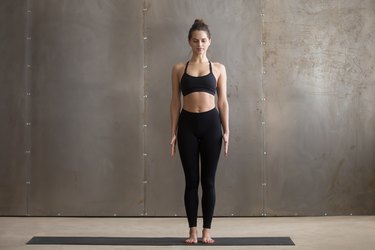
3. Standing Kegel Exercise
Perform the standing exercise. The standing exercise uses the weight of the balls and the force of gravity to make you work your PC muscle. Stand and position your feet shoulder-width apart.
Use your PC muscle to hold the balls in your vagina. If you stop contracting your PC muscle, the balls will fall out. Perform this exercise three times per day, working each time to hold the balls in place longer.
4. Kegels With a Squat
Perform the squatting exercise. The squatting exercise combines elements of both the sitting and standing exercises. Place your feet as wide apart as you can. Bend your knees slightly to move into an easy squat.
Use your PC muscle to both hold the Kegel balls in place and move them back and forth. Move into a deeper squat to make the exercise more challenging.
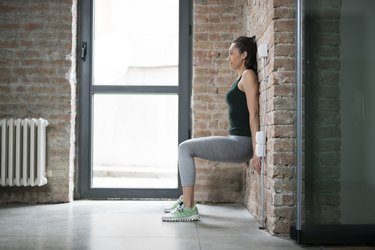
5. Kegel Exercises on the Go
Use the balls during routine activities. This is similar to the standing exercise. Use your PC muscle to hold the balls in place while you do housework, go for a brief walk or take a shower. Make sure you're strong enough to hold the balls in place so they don't fall out at potentially embarrassing moments.
Kegel Exercises Benefits
1. Supports Other Parts of Your Body
When done properly and consistently, Kegels support the uterus, bladder, small intestine and rectum.

2. Strengthens the Pelvic Floor During Pregnancy
Doing Kegel exercises while you're pregnant helps keep your pelvic floor muscles strong. This may lead to an easier childbirth. Plus, performing them consistently during pregnancy can help decrease bladder control problems and hemorrhoids.
3. Strengthens the Pelvic Floor After Childbirth
Your pelvic floor muscles take a beating during pregnancy and childbirth. Including Kegel exercises in your post-pregnancy exercise program can help speed up the process to return strength to these muscles. This can help promote perineal healing and increase bladder control.
4. May Help Improve Sexual Health
Kegel exercises may help spice up your sexual health. If you experience any pain during intercourse, practicing Kegels can help relax the vaginal muscles, increase blood flow to the vagina and increase vaginal tone and lubrication. Since they help with vaginal tone, you may also notice an increase in your sexual arousal or orgasm.
- University of Maryland Medical Center: Kegel Exercise Overview
- Kegels: Kegel Balls Easy How To Choose Guide
- Dr. Sherry: Your Beginner's Guide to Ben Wa Balls
- The Mayo Clinic: Kegel exercises: A how-to guide for women
- Healthline: How to Use Kegel Balls
- American College of Obstetricians and Gynecologists: Exercise after Pregnancy
Is this an emergency? If you are experiencing serious medical symptoms, please see the National Library of Medicine’s list of signs you need emergency medical attention or call 911.