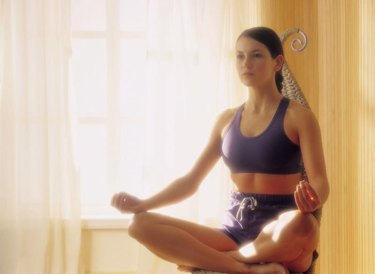
Whether you're a new teacher or want to establish a home practice, it helps to know how to put together a yoga class so it makes sense in the body. How you set up the class depends somewhat on what style of yoga you plan to practice. A Yin or Restorative class will look quite different than a more active practice.
Most active classes start with a gentle engagement of the breath and warming of the muscles and joints. You'll then move into dynamic poses that eventually wind down into long stretches. Every yoga class ends with Savanasa, or final relaxation for self contemplation and meditation.
Video of the Day
Video of the Day
Each yoga teacher has a slightly different approach, but a good solid start might include the following.
Opening Your Practice
Use the first 3 to 5 minutes of class to prepare your body for yoga. Spend just a few minutes staying still in a simple posture — such as Corpse pose, Easy pose or Child's pose — to clear and center your mind. As you sit in the pose, start to engage your breath.
A classic breath to use for yoga is the Ujjayi breath, in which you seal your lips and inhale and exhale through your nose. This breath builds heat and keeps you focused during practice. The breath can take time to master, so be patient with yourself as you learn.
Marrying Breath and Movement
From your resting posture, get into all fours and breath through several rounds of Cow and Cat to awaken your spine. You might add side bends, Spine Balance and neck rotations to get more kinks out.
Alternative ways to wake up your body are with modest twists in Easy pose. Inhale while you sit and lengthen your spine; exhale as you twist. Repeat several times to create a rhythm and begin to build warmth.
Eventually, you'll move to a standing position. You could visit Downward-Facing Dog on the way, or simply come to an gentle Forward Fold at the front of your mat and roll up slowly until you're standing in Mountain pose. As this is the first Forward Fold of your practice, bend your knees generously to keep your hamstrings from overstretching.
You'll be 10 to 15 minutes into practice by time you arrive at the front of your mat, ready for more dynamic poses.
Read More: List of Poses for One Hour of Hatha Yoga
Start to Move
To further warm your body, perform five to 10 rounds of Sun Salutation A. To do this sequence:
- Stand in Mountain pose and reach your arms up overhead.
- Bend forward from your hips and touch your feet or the floor.
- Lift halfway, hands braced on your shins or the front of your mat, as you flatten your back.
- Fold forward, plant your hands and step back into a Plank.
- Bend your elbows to hover just above the floor, use your knees for support if needed.
- Slide to the tops of your feet as you lift your chest and look up in a pose called Upward-Facing Dog.
- Exhale and tuck your toes. Push your buttocks up to the ceiling to get into Downward-Facing Dog.
- Step forward, halfway lift and rise up to complete one salute.
You may optionally add in three to five Sun Salutation B sequences,beginning each salute with Chair pose and inserting a Warrior I on the right and left side.
At this point, you're warmed up and about 20 minutes into practice.
Dynamic Poses
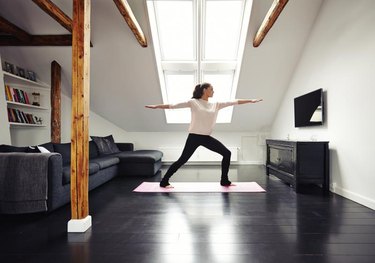
For the next 20 to 30 minutes, perform dynamic standing poses. Start with standing hip openers such as Crescent Lunge, Warrior I, Warrior II and Triangle. Twisting poses, including Twisted Lunge, Revolved Side Angle, Revolved Triangle and Twisted Chair, might come next. Spend five to 10 breaths in each pose.
Following these standard poses is the time to insert balancing poses, such as Tree, Balancing Half-Moon and Standing Splits. It's a good time to add arm balances and core strengthening poses, too. Crow and Firefly are examples of arm balances; Boat and Reverse Plank challenge your core. Dynamic inversions, such as handstand, could be practiced here, too.
Read More: Most Difficult Yoga Poses
Winding Down
After you've completed your standing postures and any balance, it's time to come closer to the mat. In these last 10 to 15 minutes, lower yourself to the floor. You might start belly-first and do Locust and Bow to strengthen your spine.
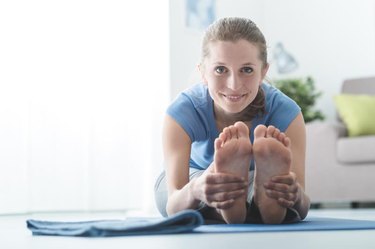
Open your hips with Pigeon or Seated Bound Angle. Seated forward folds with your legs straight in front of you or spread into a wide V-shape are also options to target your hamstrings and lower back.
Recline onto your back, hug your knees into your chest and perform a Supine Twist in each direction, holding for 10 to 20 breaths per side.
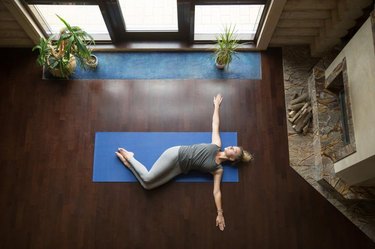
End in Corpse pose with a focus on your breath. Remember to give yourself plenty of time here — 5 to 10 minutes — to truly benefit.