


















































The elbow is a complex joint made up the ulna, the radius, and the humerus bones, which work together to provide both hinge and pivot motions. Although the elbow is considered a relatively stable joint, it is still susceptible to sports injuries. The American Academy of Family Physicians notes that patients frequently present with overuse injuries of the elbow.
Tennis Elbow
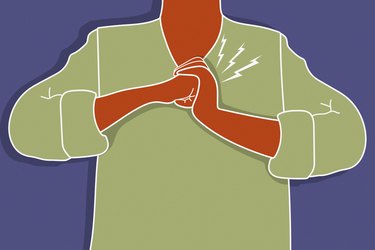
Tennis elbow, or lateral epicondylitis, is the general term for an overuse injury to the extensor muscles of the forearm. The forearm extensors both extend the hand and help grip objects, and the tendons of these muscles attach to a bony protuberance on the outside of the elbow known as the lateral epicondyle. When these tendons become inflamed, it causes pain on the outside of the elbow. According to the Nicholas Institute of Sports Medicine, common causes include improper backhand, forehand and serving technique while playing tennis, but suggest lateral epicondylitis can also be triggered by pitching and rowing motions in other sports.
Golfer's Elbow
Golfer's elbow is similar to tennis elbow, except it affects the medial epicondyle of the elbow. This injury occurs from excessive flexion or rotation of the elbow, and pain is located on the inside of the elbow. While this condition is commonly caused by improper golfing technique, the Nicholas Institute of Sports Medicine associates medial epicondylitis with tennis players, baseball players and swimmers as well.
Elbow Sprains
Like all joints, the elbow is susceptible to sprains while playing certain sports. Elbow hyperextension sprains occur when the elbow is forcibly straightened past it's normal range of motion. According to Men's Health, this type of sprain happens most frequently in contact sports and in martial arts. The American Academy of Family Physicians explains that ulnar collateral ligament sprains are common in throwing sports, such as the javelin.
Elbow Dislocation
Elbow dislocations occur when either the radius or ulna or both are forced out of the joint capsule. Most elbow dislocations occur posteriorly. The elbow joint is stable, so it takes quite a bit of force to cause a dislocation. However, a hard fall on an outstretched hand while the elbow is flexing and twisting, such as in football, can cause this type of injury.
Tendonitis
Tendonitis, or inflammation of the rope-like part of the muscle that attaches to bone, of both the triceps and biceps tendons typically leads to pain at the elbow joint. The American Academy of Family Physicians explains that posterior elbow pain that worsens with elbow extension is associated with triceps tendonitis, while anterior elbow pain that worsens with repeated elbow flexion may indicate biceps tendonitis.


Member Comments