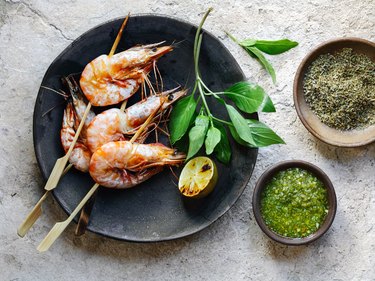
When someone talks about prawns, you may automatically think of shrimp, but prawns and shrimp are actually two different creatures. Prawns are shellfish that look a lot like large shrimp but have an extra set of claws on their feet. Although they resemble one another in flavor and can be used to make similar dishes, prawns nutrition is slightly different from that of shrimp. These crustaceans are a good source of protein, selenium, phosphorus and vitamins B12 and E.
Read more: The 9 Safest Seafood Options
Video of the Day
Video of the Day
Prawns Dietary Information
Prawns are a healthy type of seafood. They're known for being low in fat, rich in antioxidants and a good source of healthy omega-3 fatty acids. Many people avoid seafood products because they're concerned about mercury poisoning. Like shrimp, prawns are a particularly healthy choice of seafood as they're very low in mercury and rich in nutrients.
One hundred grams of raw prawns, which are equal to about four to five medium to large peeled prawns, contain several vitamins:
- 4 to 5 percent of your recommended dietary allowance (RDA) for thiamin (vitamin B1)
- 47 percent of your RDA for vitamin B12
- 71 to 95 percent of your RDA for vitamin E, depending on whether you're a man or woman
One hundred grams of prawns also contain:
- 11 percent of your RDA for calcium
- 11 to 18 percent of your RDA for iron, depending on whether you're a man or woman
- 33 percent of your RDA for phosphorus
- 9 percent of your RDA for potassium
- 16 to 21 percent of your RDA for zinc, depending on whether you're a man or woman
- 12 percent of your RDA for copper
- 21 to 27 percent of your RDA for selenium, depending on whether you're a man or woman
Many different types of prawns are produced and consumed worldwide, so freshwater and saltwater varieties are both popular. The foods prawns have eaten, where they've lived and whether they're wild or farmed can influence their nutrition. Based on such factors, essential nutrients can differ dramatically.
For instance, the protein content of a cold-water prawn and a giant freshwater prawn can range from 16 percent to over 21 percent, respectively. Despite this variation, a 100-gram serving of prawns meets about 32 to 39 percent of the RDA for protein, depending on whether you're a man or a woman. Regardless of such nutritional differences, the calories in prawns are low, with approximately 68 to 76 calories per 100 grams.
Prawns in Your Diet
One of the reasons shrimp and prawns are often confused is because they taste similar and can be cooked in the same ways. You're about as likely to find Louisiana Creole-style shrimp as you are Creole prawns. Prawns can be used in the same dumplings, stir-fries, soups and curries as shrimp. However, since they're typically larger than shrimp, prawns are a little bit easier to fry in a breaded crust or tempura batter.
It's important to consume protein from varied sources. Prawns nutrition makes them a great source of protein as they have less saturated fat and more vitamins than other protein sources. For instance, prawns have almost 22 times as much vitamin E as beef and 19 times as much as chicken.
The Dietary Guidelines for Americans recommends that people consume about 8 ounces (227 grams) of seafood per week, while the Harvard T.H. Chan School of Public Health recommends up to 12 ounces (about 340 grams). Regular consumption of shellfish like prawns is important because of their healthy fats. Marine animals such as prawns have omega-3 fatty acids that are hard to obtain from other protein sources.
Omega-3 Fatty Acids in Prawns
Omega-3 fatty acids are essential fats that can be found in many foods. Fatty fish, like salmon, are well-known sources of these fatty acids. However, you can also obtain these healthy omega-3 fats from foods like seaweed, shrimp and prawns.
You should know that not all omega-3 fats are the same. Plants with omega-3s usually have alpha-linolenic acid (ALA). In contrast, marine animals tend to be rich in different omega-3 fatty acids: EPA (eicosapentaenoic acid) and DHA (docosahexaenoic acid). EPA and DHA are the healthy omega fats that are considered clinically useful as they've been used to counteract and mediate various health issues. They're also important for the health of developing infants.
Omega-3 fatty acids are consumed naturally in your food. The recommended 8 ounces of seafood per week results in the equivalent of 250 milligrams of EPA and DHA per day.
These fatty acids are associated with many health benefits. They can reduce inflammation, help counteract neuropsychological issues and improve cardiovascular health. According to a 2018 study in the journal Circulation, omega-3 fatty acids can help reduce the chance of heart problems like heart disease, stroke and heart failure.
Prawns vs. Shrimp
It's not unusual to consume shrimp and prawns, and these two terms are often used interchangeably and incorrectly. Prawns and shrimp are both 10-footed crustaceans. Both of these sea creatures live in freshwater and saltwater environments. If you're not looking closely, you might think shrimp are just baby prawns since shrimp are small and prawns are big.
If you live in the United States, you're a lot more likely to encounter shrimp than prawns. In fact, shrimp is the most popular type of seafood eaten in North America. Americans don't eat too much seafood, but when they do, shrimp accounts for half of the seafood products they eat.
Prawns are more popular in the United Kingdom and Australia. Just as prawns are sometimes called shrimp in the United States, people in England and Australia often call shrimp prawns. This confusion is exacerbated by the fact that a lot of shrimp and prawn products are mislabeled.
If you're confused about whether the shellfish you're eating is a shrimp or a prawn, the easiest way to differentiate between the two (besides comparing size) is by looking at their claws. Shrimp have just two sets of claws, but prawns have three. You might also notice that shrimp and prawns have a slightly different body shape, which means that the bodies of prawns aren't as flexible as those of shrimp.
- A Framework for Assessing Effects of the Food System: Dietary Recommendations For Fish Consumption
- Oceana.org: Shrimp: Oceana Reveals Misrepresentation of America’s Favorite Seafood
- New World Encyclopedia: Shrimp
- Circulation: Seafood Long-Chain n-3 Polyunsaturated Fatty Acids and Cardiovascular Disease: A Science Advisory From the American Heart Association
- National Institutes of Health: Office of Dietary Supplements: Omega-3 Fatty Acids
- Seafoodnutrition.org: Seafood Recommendations From the Dietary Guidelines
- Current Opinion in Clinical Nutrition & Metabolic Care: Omega-3 Fatty Acids and Cardiovascular Outcomes: An Update
- Harvard T.H. Chan School of Public Health: The Nutrition Source: Fish: Friend or Foe?
- Health.gov: Dietary Guidelines for Americans 2015-2020
- Comprehensive Reviews in Food Science and Food Safety: Shellfish: Nutritive Value, Health Benefits, and Consumer Safety
- Shellfish.org.uk: The Nutritional and Healthy Facts About Shellfish: Prawns
- NHS: Eat Well: Fish and Shellfish