














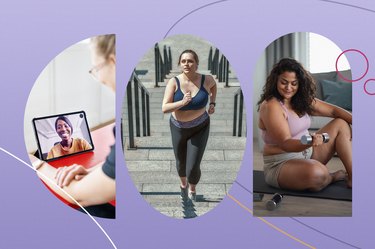







































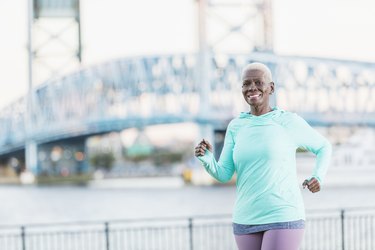








Walking is a great way to lose weight, and you can walk almost anywhere at any time. All you need to begin is a supportive pair of shoes that fit well and provide cushioning. Walking is a low-impact form of exercise that is gentle on your ankles, knees and hips. It has the added benefit of fighting osteoporosis by increasing bone density. Check with your doctor before beginning any exercise program.
Power Walking
Power walking is a vigorous form of walking that uses the entire body to burn calories at a higher rate than a moderate stroll. Always begin a power walk with three to five minutes at a slower pace to warm up your muscles. Once you are warmed up, begin to pick up your pace, and focus on powerful swinging movements with your arms. Keep your elbows bent and your hands open with your palms facing inward. Move your hands up to shoulder level on the forward swing and back by your hip on the backward swing. Focus on landing mid-foot and rolling off your toes with each foot stroke. You should be sweating withing five or 10 minutes and working at an intensity level of 7 or 8 on a scale of 1 to ten.
Speed Interval Walking
Speed interval walking is an effective way to burn some extra calories during your walking workout and boost your metabolism so you burn more calories during and after your walk. Use landmarks; for example, if you are outside, use light posts, houses or mailboxes as your landmarks. After a brief warm-up walk, pick up your pace to a comfortably moderate pace at a work level of approximately a 6 on the 1-to-10 scale. Walk for the length of four landmarks, then increase your pace to a work level of 8 to 9 for two landmarks. Alternate between these two intensities for the length of your walk. When you are working at the higher intensity, you should get slightly out of breath, and it should be challenging to try to have a conversation.
Strength Interval Walking
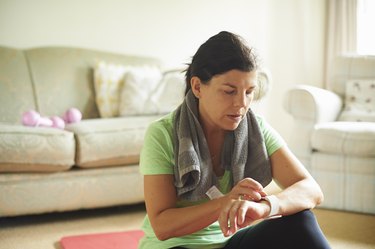
Strength interval walking alternates between periods of moderate intensity walking and segments of strength training. You can do this workout using a treadmill and assorted weights, or you can do this outside using body weight for your strength intervals. This type of workout works well using timed intervals, so have a watch that is easy to read. Walk for three minutes at moderate or higher intensity, approximately 7 to 9 on the scale of 1 to 10. Then perform 90 seconds to two minutes of strength training. If you are outside, you can do walking lunges, squats, incline push-ups and tricep dips using a park bench, and heel raises off of a curb. Pick one exercise for each strength interval, and work out for a minimum of 30 minutes.
Walking to Jogging
Walking to jogging is another way to increase the calorie burn of your weight-loss workout. Alternate between intervals of walking and jogging, using either time intervals or landmarks to determine your distance. The jogging intervals do not have to be far or fast; any bit of jogging burns more calories and increases the intensity of your workout. If you are going to do generally small bits of jogging, you can keep your walking shoes; however, if you decide to increase the length and amount of jogging intervals, you might want to switch to running shoes.
Stretch
Stretch at the end of your walking workout to prevent tightness and injuries. Use a step or curb to gently press your heels down, stretching your heels and ankles. Next, with straight legs, lean forward from your hips as you reach toward your toes to stretch your hamstrings and lower back. Finally, with your hands on your lower back, engage your glutes and gently press your hips forward to open your hip flexors. Hold each stretch at least 30 seconds, and take deep breaths to help recover your heart rate and relax your muscles.
References
- "The Personal Trainer's Handbook"; Teri S. O'Brien, MS; 1997
- "The Y's Way to Physical Fitness"; YMCA of the USA; 2005


Member Comments
rudyespinosa September 28
These are great tips to keep in mind and get some exercise into an activity that I never considered a form of exercise. Thanks!
rosita333 September 28
Great information!
carriebeeler December 28
I love this article and since March I have lost 66 lbs and am now a size 6 by doing exactly that paired with a low carb diet. I walk to the grocery at lunch time and cary back my lunch and sometimes dinner for me and the kids. sometimes I have 25-35lbs of groceries so I curl the bags as i walk. My arms and legs look great!
Ann1947 December 28
Very good article! Not only did she review methods of "walking"...but she incorporated exercises at various intervals of walking. She mentioned the importance of having the correct shoes. (I have seen 'walkers' wearing sandals/flip flops on a 1 mile nature trail near my home!!!)
She finalized with 'stretching'....and WHY you should stretch after completing your walk.......really enjoyed reading!!
wheatgrass4 December 29
Good Post. Check out www.OlasChallenge.com In order to get into the site they will ask for a referring person (Barb Hall) This is an interesting site and the man doing the coaching is a body builder who began the health process 5 years ago and has placed 2nd in open competition (all ages). He is competing this year in the Mr.USA Competition. This 63 year old is an inspiration. Body builders know how to lose fat and not muscle.
g595055 January 3
I have been on a aggressive "walking only" program (Averaging 5-6 miles a day) for 16 months along with a 1500 Calorie diet for the first 12 months and lost 90 lbs. I then had Vertical Sleeve Gastrectomy in Aug. 2010 and lost another 57 lbs by walking while being on a 1000 Calorie Hi Protein diet.