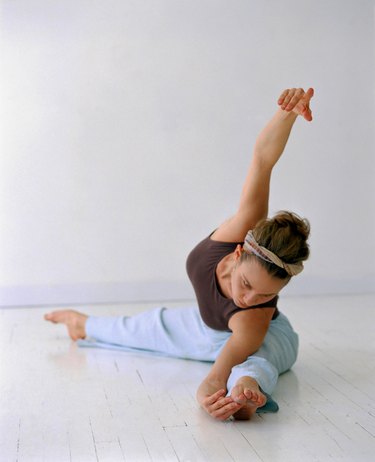
Range of motion, or ROM, refers to how far a joint moves during exercise and physical therapy. Muscle strength and flexibility are the key components to movement. Lack of activity due to injury or disease lead to a decline in these two vital functions. Range of motion helps maintain movement by stretching the muscles and moving the joints. The terms active and passive define the energy behind the movement. Active range of motion is exercises you do on your own. Passive means someone does the work for you.
Definitions
Video of the Day
Active range of motion exercises are for people trying to increase or maintain flexibility on their own. They require no assistance to perform simple movements, such as arm circles or flexing of fingers. Passive range of motion refers to someone physically moving a part of your body for you. This requires no effort on the part of the patient. For instance, a therapist may grasp your arm gently and move it in a circular motion. For active, you move the arm; for passive, someone else moves it.
Video of the Day
Importance
ROM exercises are vital whether passive or active. Range of motion helps maintain mobility. Without ROM, some patients lose the flexibility in their joints. For those able to move on their own, active range of motion keeps muscles supple and functioning as well as increasing joint flexibility. Passive ROM prevents bed-ridden or immobile people from developing muscle atrophy, or shortening. Without any ROM, joints eventually lock.
Selection
The decision to use active or passive range of motion is dependent on a number of factors. Some people are incapacitated by injury or illness. For these people, passive is the only form of exercise available. Passive ROM is sometimes a testing tool to determine how far a joint can flex. Joints often have better range of motion passively then actively. A person with muscle or nerve damage may benefit from passive ROM even if he can move on his own, because joints can flex further. Active exercise is necessary to build up muscles.
Differences
Active range of motion helps build muscle strength. This means improving the fitness of the muscles and joints at the same time. If a person is able to fully move the limb, active exercises are better to improve toning and strength. Passive ROM only keeps joints flexible. Drugs.com reports that muscles don't break down from passive ROM exercises. Therefore, they don't get stronger. Passive exercise provides just enough movement to maintain joint flexibility.
Is this an emergency? If you are experiencing serious medical symptoms, please see the National Library of Medicine’s list of signs you need emergency medical attention or call 911.