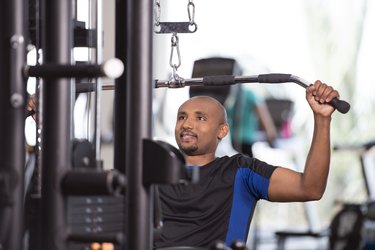
You've probably seen the lat pulldown machine at your gym. It's a freestanding machine or an attachment on a cable complex featuring a padded seat, thigh supports and a long bar hanging from an upper rod. You sit on the seat, hook your thighs under the support pads and pull the bar down to your neck or chest.
What you might now know is that the lat pulldown is one of the best machines for building a strong, muscular back, specifically the latissimus dorsi. This muscle is responsible for pulling your arms down and toward your body, which is important for many daily activities like lifting objects or reaching for something above your head.
Video of the Day
The lat pulldown machine's versatility — such as the ability to use different handle bar attachments and easily change weights — makes it ideal for people of all fitness and ability levels.
Ahead, we break down the lat pulldown machine's many benefits and share our top form tips so you can get the most out of this awesome exercise.
How to Do a Lat Pulldown With Proper Form
- Adjust the thigh supports so they press gently on top of your legs when seated. Attach the handle you want to use to the pulley hook at the top of the machine.
- Grab onto the bar and sit down with your feet flat on the floor. Your arms should be fully extended overhead and you should feel a stretch in your upper and middle back.
- Initiate the movement by pulling your shoulder blades down away from your ears. Drive your elbows down toward your ribs in a controlled manner. Lean back slightly (keep a neutral spine) without excessively arching your back.
- Keep pulling until the bar touches your chest, or until your elbows are touching your sides.
- Finish the movement by raising your arms back overhead in a controlled manner until they are fully extended and you feel a stretch in your upper and middle back.
Tip
You want to remain stationary in this exercise. If you find yourself rocking back and forth the weight you are using may be too heavy.
Lat Pulldown Muscles Worked
What muscles does a lat pulldown machine use? Allow us to explain.
1. Lats
As the name suggests, the lat pulldown machine is great for targeting your latissimus dorsi (lats). One of the great things about the lat pulldown is that it is a compound exercise, meaning that it works multiple muscle groups at once. The lats run across the muscles in the upper back, including the trapezius and rhomboids, the large muscle also connects your pelvis, ribs and shoulder blades to your upper arms (biceps and forearms).
So, how do you target your lats on a lat pulldown machine? Pulling the bar down in front of your face and neck is most effective in activating the lats as opposed to pulling the bar behind the neck, and it's also a safer way to do the exercise because it places less stress on your shoulders and neck, according to the National Academy of Sports Medicine (NASM).
No need to worry too much about how widely you grip the bar, though. A narrow, wide and medium grip all seemed to activate the lats, according to an April 2014 study in the Journal of Strength and Conditioning Research. While a medium grip did offer a slight increase in muscle activation in most of the muscles used for the lat pulldown, this stimulation wasn't so much greater than other grips as to really matter when you're trying to build your back.
Related Reading
2. Biceps
The biceps muscles on the front of your arms act as a secondary pulling muscle when using a neutral (palms in) grip. You might choose to use a neutral grip on a lat pulldown due to shoulder issues, as this position tends to feel a lot better for cranky shoulders. Or, you might use a neutral grip because you specifically want more biceps involvement in the movement.
3. Other Upper-Back Muscles
The lats are the primary movers in the lat pulldown. The secondary movers are the deltoids. While your lats are contracting, your deltoids are relaxing and stretching. Other secondary muscles used in the lat pulldown are your rhomboids, trapezius, teres major and the rotator cuff muscles.
4. Forearm Flexors
Your forearm flexors are responsible for holding onto the bar when performing lat pulldowns. Stronger forearm flexors contribute to a stronger grip, which you'll need to build if you want to keep increasing the weights on your lat pulldowns.
4 Benefits of the Lat Pulldown Machine
Is the lat pulldown machine effective? In a word, yes. Below, we explain three major advantages of the lat pulldown machine.
1. It Builds a Stronger Back and Arms
You can use the lat pulldown machine to build a seriously strong back. Focus first on using good form and a full range of motion, then gradually perform more repetitions and use heavier weights.
2. It Corrects Posture
In addition to its strength and muscle-building benefits, the lat pulldown also helps to improve posture. Many people who spend a lot of time sitting or hunched over a computer can develop a rounded back. The lat pulldown helps to strengthen the muscles in the upper back, which can help to correct this posture and reduce the risk of back pain.
3. It Builds a Stronger Grip
Heavy lat pulldowns pose a serious challenge to your grip strength. If you're primarily interested in building muscle, you may want to use straps so that grip doesn't limit your ability to challenge stronger muscles.
For everyone else, however, it's best to embrace the grip-building benefits of lat pulldowns. That's because a strong grip is correlated with numerous positive health markers in older adults, according to an August 2019 review in Clinical Interventions in Aging.
4. It's Accessible for Most People
Pull-ups and chin-ups are often touted as the gold standard of vertical pulling strength. Unfortunately, these movements aren't always accessible for beginners or those in larger bodies because they require a high degree of relative strength (your ability to move your own body weight.)
The lat pulldown machine allows you to build vertical pulling strength independent of relative strength. Building strength on the lat pulldown machine can also help you eventually work toward your first pull-up or chin-up, if that's your goal.
4 Common Lat Pulldown Mistakes (and How to Fix Them)
1. You Rely Too Much on Momentum
Lots of people try to muscle their way through their lat pulldowns by aggressively heaving their body weight backward as they pull. You won't build much strength or muscle performing your pulldowns this way, and it can place excessive force on your low back and shoulder joints.
Always perform your lat pulldowns in a controlled manner. When in doubt, slow down and lower the weight.
2. You Shrug Your Shoulders
It's very common for folks to shrug their shoulders when performing pulling exercises. Many of us spend much of the day sitting in front of a computer in this very position which causes us to hold tension in our traps and neck. Unfortunately, bringing this tension into the gym can negatively affect your workouts.
If you find yourself shrugging when performing pulldowns, concentrate on pulling your shoulder blades down away from your ears before you start pulling down the bar. It's sometimes helpful to step away from the machine, take a deep breath and allow your shoulders to relax fully on the exhale before returning to your set.
3. You Don't Use Full Range of Motion
You won't get the most out of your lat pulldowns if you use an incomplete range of motion. This applies both to how far you pull down at the bottom and how high you extend your arms at the top.
Most people should aim to pull the bar down to their chest with each rep. However, folks with broader backs may find that they run out of room because their arms run into their ribs. If this is you, complete range of motion looks like touching your elbows to your sides — even if the bar remains an inch or two off your chest. Note that you'll probably be able to use a larger range of motion with a neutral grip versus a pronated grip.
Always allow your arms to extend fully overhead at the top of the rep. It's OK to let the weight of the bar pull you into a slight shoulder shrug here, so long as you immediately pull your shoulders back down when you begin the next rep. Getting this loaded stretch at the top of the pulldown can help you build more muscle in your back.
4. You Pull the Bar Too Far Out in Front of Your Body
Some people pull the bar so far out in front of their body that it turns into a triceps pushdown. Fix this mistake by always pulling the bar toward your chest and driving your elbows down toward your ribs.