








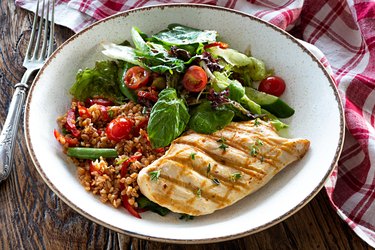













































Nutrition and performance are highly correlated and, according to the American College of Sports Medicine, it is difficult to improve performance without optimal nutritional intake. There are six classes of nutrients: carbohydrates, proteins, fats, vitamins, minerals and water. The important thing to remember when selecting a diet is balance. No one nutrient is more important than the others. Rather, a balanced diet with plenty of fresh fruits and vegetables will provide the athlete with the nutrients she needs for optimal sport performance.
The Energy Nutrients
Energy nutrients are responsible for providing the fuel the body needs for tissue repair and development. The American College of Sports Medicine designates three "energy nutrients": carbohydrates, proteins and fats. Because exercise increases the rate at which the body burns energy, with the fact that fluids are lost as sweat, it is essential to both replenish the body's fuel at the right time and to replace fluids. The National Strength and Conditioning Association recommends that 65 percent of total calorie consumption come from carbohydrates, 15 percent from protein, and 20 to 35 percent from fat. Because of the increased energy requirements of high physical activity, athletes are recommended to consume around eight to ten grams of carbohydrate per kilogram of body weight to replenish depleted glycogen stores.
Vitamins and Minerals
Vitamins are organic substances that help facilitate normal body functions and cannot be produced by the body. Minerals, on the other hand, are inorganic substances that are involved in many metabolic bodily functions. The American College of Sports Medicine reports that the best strategy for optimal vitamin and mineral intake is to eat a wide variety of foods and to consume plenty of fresh fruits and vegetables. Vitamin supplements are only recommended if there is a known deficiency.
Fluids
According to the American College of Sports Medicine, approximately 70 percent of lean tissue is composed of water, while 60 percent of total body weight is water. A failure to replenish water leads to death more quickly than with any other nutrient. Weight loss immediately following exercise is primarily due to a loss of water, and, according to the National Strength and Conditioning Association, as little as a 2 percent decrease in weight can lead to performance decrements. Therefore, it is recommended that athletes consume at least 16 ounces of water two hours before a training session, 6 to 8 ounces every fifteen minutes during a training session and one pint for every pound of body weight lost following a training session.
Supplements
Vitamin and mineral supplements, as well as other ergogenic aids such as creatine are a huge source of income to the fitness industry. However, the American College of Sports Medicine asserts that only two aids have consistently been shown to enhance performance: carbohydrates and water. There is little evidence that other substances have substantial ergogenic effects. Further, vitamin and mineral supplements are generally only recommended when there are known deficiencies. Excess intake of certain vitamins and minerals can lead to toxicity and sometimes dangerous health consequences.
The Pre-Competition Meal
One key area of interest for athletes is the pre-competition meal. The University of Missouri Extension reports that pre-competition meals serve to maintain optimal blood sugar levels, alleviate excess gastric juices and provide the extra fuel needed to perform. Carbohydrates are a wise choice because they are quickly digested and converted to usable energy. Carbohydrate-based meals should be consumed two to three hours before competition, followed by a light snack about one to two hours prior to competition.
References
- "ACSM's Resources for the Personal Trainer"; Walter R. Thompson (Ed.); 2006
- "Essentials of Strength and Conditioning"; Thomas R. Baechle and Roger W. Earle (Eds.); 2008
- University of Missouri Extension: Pre-Competition Meals for Athletes


Member Comments