
































































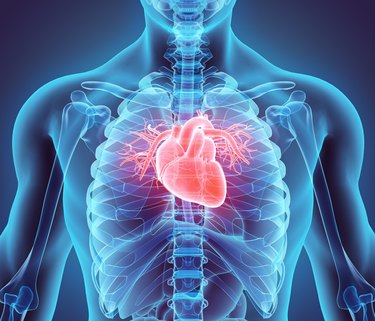
A leaky valve in the heart, called valvular insufficiency or regurgitation, occurs when one of the valves becomes weak. This allows blood to flow backward instead of forward. According to Jeffrey R. Bender, M.D., congestive heart failure is a serious complication of valvular disease. When the heart is in congestive heart failure, it can't pump enough blood efficiently, causing a backup of blood in the heart. This leads to congestion in the lungs, causing shortness of breath and fatigue.
Conservative Valvular Insufficiency Treatments
Valve disease can be inherited or acquired later on in life. Mitral valve prolapse is the most common type of valvular insufficiency. Causes of valve disease include coronary artery disease and high blood pressure. According to the Texas Heart Institute, if valve disease is not severe, it can be treated with conservative measures. Depending on the cause of valve disease, some medications used to treat it include digitalis, which eases the workload on the heart; anti-arrhythmia medications to control heart rhythm; blood pressure medications--either beta blockers or calcium channel blockers--to lower blood pressure; anti-platelet or anti-coagulant medication to prevent clots; and diuretics to reduce the fluid around the heart. Following a low-sodium diet is also recommended.
Conservative Congestive Heart Failure Treatments
Congestive heart failure can be a direct result of valvular insufficiency. According to the American Heart Association, as the heart fails it keeps working, but not as efficiently. Blood backs up into the lungs, causing congestion and shortness of breath. Lung congestion then causes fatigue and swelling, or edema, of the lower legs, ankles and feet. Congestive heart failure can be treated early with rest, medication and a heart-healthy diet. Medications used to treat congestive heart failure include nitroglycerin and ACE inhibitors to help keep blood vessels open to improve flow; calcium channel blockers and beta blockers to lower blood pressure and improve efficiency; digitalis to strengthen the heart's pumping action; and diuretics to rid the body of excess fluid. Lifestyle changes include quitting smoking and limiting liquids.
Percutaneous Intervention and Surgical Treatments
A percutaneous intervention refers to any procedure that allows access to underlying tissues and organs through a needle puncture into the skin. According to the Texas Heart Institute, percutaneous procedures that are performed for congestive heart failure include balloon angioplasty to open blocked arteries, possibly along with placing a tube called a stent into a blocked artery to hold it open, and ionotropic drug therapy placed directly into an artery though a catheter. In the same manner, balloon valvuloplasty is used to open narrowed heart valves.
Surgical procedures for advanced congestive heart failure include a pacemaker to control heartbeat; coronary artery bypass to improve blood flow to the heart; and in extreme cases, a heart transplant. Surgical procedures for a leaky heart valve include removing calcium deposits that build up on the valves to improve their function, and heart valve replacement with a prosthetic heart valve. The valve can be made from mechanical or biological components.


