

























































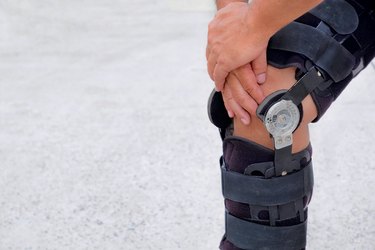


Shoulder injuries can be very painful and can affect daily activities and quality of life. Shoulder injuries can occur with trauma or repetitive injury. According to the textbook "Orthopedic Physical Assessment," shoulder injuries are common because of the many structures that are located in the area and because of the amount of movement that the shoulder must go through on a daily basis.
The history of how the pain started and where it is located helps in determining the cause of the pain. One area that is commonly injured is the acromio-clavicular joint. Pain in this area is usually felt on the top of the shoulder.
Anatomy of the Shoulder
The shoulder is a complex of joints and is made up of three bones--the clavicle, scapula, and humerus--muscles, ligaments, and is responsible for multi-axial movement.
The shoulder has five joints, two of which are physiological and three of which are true joints. The three true joints are the gleno-humeral joint, the sterno-clavicular joint, and the acromio-clavicular joint.
The AC joint, or acromio-clavicular joint, is formed where the clavicle meets the acromion process of the scapula. The joint is located on the top of the shoulder. It is attached by ligaments and is surrounded by muscles, nerves, blood vessels, bursae, and other structures.
What is a Bursa
According to the textbook "Anatomy and Human Movement," a bursa is a fluid filled sac-like dilation that contains synovial fluid. Bursa are found anywhere a muscle or tendon passes around the edge of a bone. These bursa function to reduce friction during movement.
The AC bursa lies beneath the AC joint and above the muscles of the rotator cuff. The bursa allows the supraspinatus muscle to move freely within the space under the AC joint.
Symptoms of Bursitis
According to "Sports Medicine A Comprehensive Approach," the development of bursitis is very common and involves the inflammation of the bursa surrounding the bony edges of joints. This condition is caused by friction from overuse or trauma after a blow to the area that results in a inflammatory response.
People with bursitis feel pain that increases with motion and tenderness in the area of the joint. Motion is also reduced and if not resolved a chronic audible snapping may develop in the area.
Other Injuries Associated with the AC Joint
If a fall or blow to the shoulder resulted in pain in the AC joint it is possible that a AC separation has occurred. This is where the joint has been spread apart by the trauma and results in extreme pain. If this is suspected it is advised to consult a professional for management of the injury.
Management
According to "Sports Medicine A Comprehensive Approach," management of acromion bursitis is like other soft tissue injuries. This includes conservative treatments like ice and rest. In addition NSAID medications, such as ibuprofen or naproxen, and aspiration of the bursa are also commonly performed if symptoms persist.
References
- "Orthopedic Physical Assessment Fifth Edition"; D.J. Magee; 2008.
- "Sports Medicine A Comprehensive Approach Second Edition"; G.R. Scuderi, P.D. McCann: 2005.
- "Anatomy and Human Movement Structure and Function"; N. Palastanga, D.Field, R. Soames: 2006.


