





























































According to "Anatomy and Human Movement: Structure and Function," the inter-vertebral disc is an essential component of the structure of the human spine. There are at least 24 discs in the human spine with six in the cervical spine, 12 in the thoracic spine, five in the lumbar spine and one between the lowest lumbar and the sacrum. The function of the inter-vertebral disc is to act as a shock absorber distributing and absorbing some of the load applied to the spine, to hold the vertebrae together and allow movement between bones, to separate the vertebra as part of a functional segment and by separating the vertebrae allow the free passage of the nerve roots from the spinal cord out through the inter-vertebral foramen (hole where nerves pass through on sides of vertebra). The disc can become injured and damaged, which may lead to pain and neurological dysfunction.
Anatomy of the Disc
The structure of the disc consists of two parts, the nucleus pulposus (NP) and the annulus fibrosus (AF). The disc is composed of fibrocartilage and is separated by a layer of hyaline cartilage on the vertebra above and below. The nucleus pulposus is the center of the disc and can be thought of as a gelatinous ball surrounded by rings that strengthen the disc called the annulus fibrosis.
Movement of the Disc
The disc is strong and allows movement to occur. According to "The Physiology of the Joints," the disc can be thought of as a billiard ball placed between two planes, which gives it a swivel type movement. Possible movements are flexion, extension, lateral flexion and rotation.
Disc Injury
According to "Orthopedic Physical Assessment," if there is injury to the disc, four types of problems can result, which can cause symptoms. The four types of disc herniation are protrusion, prolapse, extrusion and sequestration.
Four Types of Herniated and Bulging Discs
A protrusion occurs when the disc bulges to the posterior (back), but does not rupture the annulus fibrosis. A prolapse is when the nucleus pulposus is bulged into the annulus fibrosis and only contained by the outer layer of the annulus fibrosis. An extrusion occurs when a prolapsed disc ruptures all the layers of the annulus fibrosis and the discal material is in the epidural (area around spinal cord) space. Finally, a sequestration occurs when the discal material in the epidural space breaks free and free nuclear material is outside of the disc proper (free floating).
Symptoms and Treatment
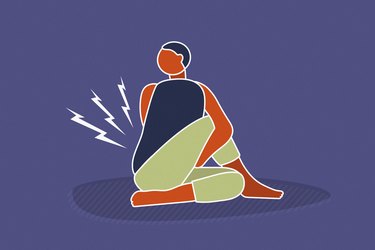
All of these injuries can cause symptoms, but not all do. In fact, much of the population is walking around with bulging (protruding) discs each day and have no pain or symptoms. Symptoms can be low back pain, leg pain, numbness, tingling and burning pain. In serious cases, disc injury can affect bowel and bladder function. Treatment ranges from conservative care such as chiropractic, spinal decompression and physical therapy to more invasive forms such as medications and surgery.
Expert Insight
Seek a professional if your back pain does not improve---especially if you have trouble with your bowel or bladder function.
References
- "Anatomy of Human Movement: Structure and Function Fifth Ed."; Palastanga N, Field D, Soames R.; 2006
- "Orthopedic Physical Assessment Fifth Edition"; Magee DJ; 2008
- "The Physiology of the Joints: Volume Three The Spinal Column Pelvic Girdle and Head, 6th ed."; Kapandji, A.I.; 2008


