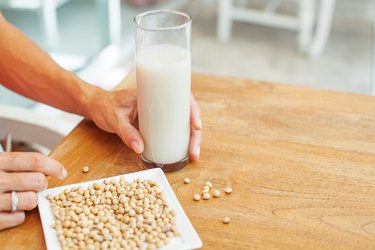
Soy milk and cow's milk provide similar amounts of protein; however, several nutritional differences exist between soy milk and cow's milk. Soy milk contains 3 grams of fiber, generally has fewer calories and less fat and cholesterol than cow's milk. Soy milk fortified with nutrients such as calcium, riboflavin, and vitamins A, D and B12, provides an alternative to cow's milk for people with lactose intolerance or those who want to avoid animal proteins, according to Oregon State University. However, cow's milk contains more vitamin A, zinc, vitamin B12, folate and calcium than soy milk.
Protein and Fat
Video of the Day
Soy milk provides a complete plant-based protein, which contains much less fat than cow's milk -- an animal-based protein source. Eight ounces of regular soy milk gives you 9 grams of protein, 5 grams total fat and no saturated fat or cholesterol. Eight ounces of plain, calcium-fortified soy milk contains 7 grams of protein and about 4 grams total fat, which includes half a gram of saturated fat, but no cholesterol, according to the University of Illinois National Soybean Research Laboratory.
Video of the Day
Cow's milk contains whey and casein, which provide complete proteins. Eight ounces of whole cow's milk provides 8 grams of protein, 8 grams total fat, 5 grams of saturated fat and 24 milligrams of cholesterol. Eight ounces of skim cow's milk has 8 grams protein, no fat, but 5 milligrams of cholesterol.
Amino Acids
The two types of amino acids, also called the building blocks of protein, include essential amino acids, which you get from your diet, and non-essential amino acids produced by your body. While soy milk contains every type of essential amino acid, cow's milk provides a better source, and contains slightly more essential amino acids than does soy milk.
Soy Protein Reduces LDL
An 8-week German study reported in the March/April issue of "Advances in Therapy," compared the effect on total cholesterol levels in 120 patients given 25 grams of protein per day. Study participants received non-denatured soy protein -- protein not changed by heat or chemical reactions -- isolated soy protein or a placebo. At the start of the study, the patients had total cholesterol levels ranging between 201 milligrams per deciliter to 302 milligrams per deciliter. After eight weeks, the non-denatured soy protein group had a 10.7 percent reduction in total cholesterol and a 9.4 percent reduction in low-density lipoprotein levels, also called LDL, the "bad" cholesterol. The isolated soy protein group reduced their total cholesterol levels by 5.8 percent and LDL cholesterol by 4.9 percent.
Protein Allergies
Allergies usually occur from your immune system's reaction to food proteins, which your body cannot break down during the digestive process. Among the eight major food allergens identified by the United States Food and Drug Administration, milk ranks number one and soybeans hold the eight position. These major food allergens cause 90 percent of allergic reactions to food. When consumed, milk and soy proteins contain cause the release of chemicals that trigger your allergic symptoms. Though they contain a comparable amount of protein, if you have a milk protein allergy, you might not necessarily have a soy protein allergy as well.
Animal Protein, Plant Protein and Diabetes
While animal sources of protein give your body more of the amino acids it needs, a study published in the July 2012 issue of "Cold Spring Harbor Perspectives in Medicine" reports cow's milk can increase the risk of type 1 diabetes, previously called juvenile diabetes. The February 2008 issue of the "American Journal of Clinical Nutrition" included a study on type 2 diabetes risk in women. Study results suggest diets low in carbohydrates that include higher intake of vegetable fat and vegetable protein may reduce the risk.
- Oregon State University: Milk and Milk Alternatives: How Do They Compare?
- Advances in Therapy: Cholesterol-Lowering Effects of a New Isolated Soy Protein With High Levels of Nondenaturated Protein in Hypercholesterolemic Patients
- United States Food and Drug Administration: Food Assergies: What You Need to Know
- Health Services at Columbia University: Nutritional Differences Between Soy- and Cow's Milk
- Cold Spring Harbor Perspectives in Medicine: Environmental Triggers of Type 1 Diabetes
- American Journal of Clinical Nutrition: Low-Carbohydrate-Diet Score and Risk of Type 2 Diabetes in Women
- NYU Langone Medical Center: "Milk" -- Not Just from Cows
- University of Maryland Medical Center: Soy