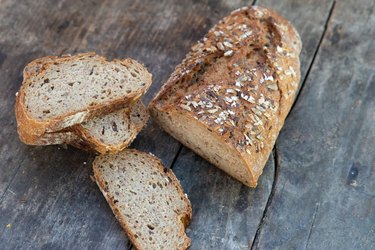
The glycemic index of bread is higher than that of other carbohydrate-containing foods. Thankfully, not all bread varieties are the same. Whole-grain varieties contain more fiber and nutrients and typically have a lower glycemic index compared to their processed counterparts.
What Is the Glycemic Index?
Video of the Day
Not all carbohydrates are created equal. Some are digested faster than others, which changes the speed at which sugar is absorbed into your bloodstream. Faster digesting carbs cause blood sugar spikes, which can be worrisome if you're dealing with a condition like diabetes.
Video of the Day
According to the American Diabetes Association, the total amount of carbs you eat during the day has the biggest effect on blood sugar control. After that, the glycemic index (GI) is the most important.
The glycemic index is based on a 0 to 100 scale, with 100 being the score of pure glucose. Low-GI foods have a score of 55 or less. Medium GI is between 56 and 69, while a high GI is 70 and above.
The glycemic load is a different number that measures how much the food will raise your blood sugar levels. The glycemic index of a particular food might be high, but if it doesn't contain many carbohydrates, then it will have a low glycemic load score, according to Harvard Health Publishing.
The glycemic index of a food is based on a calculation that assumes you're eating that food alone — not as part of a meal. You can reduce the GI of a food by combining it with something with a lower score, states the U.S. National Library of Medicine.
Read more: Glycemic Index of Brown Rice vs. White Rice
Glycemic Index of Bread
According to Harvard Health Publishing, white bread has the highest GI of all foods. This isn't surprising, considering that it's the most processed type of bread. By removing part of the grain in the manufacturing process, some of the fiber and other nutrients are stripped away.
Fiber can help slow down the digestion of glucose, notes the Linus Pauling Institute. The longer it takes to digest, the lower the glycemic index of bread. If you're looking for low-GI bread, you choose whole-grain loaves that contain more fiber.
The Queensland Government ranked several common foods by their glycemic index. In the mid-GI range, there's pita, rye and wholemeal bread. These are all heartier forms of bread that tend to have a strong flavor.
On the low end of the spectrum, with a GI below 55, you'll find mixed-grain and oat-bran bread. USDA's ChooseMyPlate offers a recipe for mixed-grain bread, which explains what goes into making this low-GI carbohydrate food.
By combining rye, cornmeal, whole wheat flour and regular flour, you create a mixture of grains for low-GI bread. One slice contains 103 calories, 20 grams of carbs, 2 grams of fat, 2 grams of protein and 1 gram of fiber.
Opt for Whole-Grain Bread
Look for bread varieties labeled "whole grain," not necessarily "whole wheat." The Whole Grains Council explains that whole wheat is a type of whole grain, but there are other varieties as well. When your bread is made from whole grains, it means that it's unprocessed or minimally processed.
Removing part of the grain makes it refined. However, that also removes some of the fiber, protein and nutrients from your food. By taking out these key nutrients, the glycemic index of your bread may increase. Try to opt for whole-grain bread as often as you can.
High-fiber bread, such as whole wheat bread, takes longer to digest, which can explain why it would have a lower GI score. The downside is that you may experience stomach pain after eating it, especially if you don't typically consume a lot of fiber.
The type of bread you eat isn't the only thing that affects the GI score of your meal. What you have on your bread can be just as important. For example, if you toast your bread and spread jam on top, it can significantly increase its sugar content and glycemic index. Just 1 tablespoon of jelly has 13 grams of sugar, according to the USDA.
Putting sugary spreads on your whole-grain bread can raise the GI score, but the opposite is also true. Topping white bread with lettuce, tomatoes and cheese may help lower its glycemic index.
Importance of GI Score
Carefully selecting your bread and crafting each meal based on the glycemic index of certain ingredients may seem tedious. There's conflicting scientific evidence over the importance of using such a scale to measure the carbs you consume.
For example, a September 2018 review published in Nutrients reviewed 73 studies related to the glycemic index and disease risk. Researchers have found that overall there was a weak link between the total GI score of a diet and the risk of disease. Other factors, such as your intake of fiber and whole grains, are more important.
This would make sense, considering that extra fiber and whole-grain intake can slow down carbohydrate digestion and lower the GI score. The above findings show that you don't necessarily need to focus on how quickly the bread is digested — you should rather check how much fiber and whole grain it contains.
While many studies show no correlation between GI score and disease, there is a significant amount of evidence on the contrary. An October 2016 study featured in the Canadian Journal of Dietetic Practice and Research suggests that high-GI diets may increase the risk of developing Type 2 diabetes.
Type 2 diabetes is problematic worldwide. In 2016, it caused 1.6 million deaths, according to the World Health Organization. Switching to a low-GI diet that includes whole-grain or multi-grain bread and other high-fiber carbohydrates could help prevent the spread of this metabolic disorder.
Read more: The Glycemic Index for Sweet Potatoes
Whole-Grain, Not White Bread
While you may not need to find low-GI bread, you should try to avoid some types of baked goods. For example, an October 2014 study published in BioMed Central Public Health has found that white bread, in particular, was associated with weight gain.
Researchers studied a healthy population of Mediterranean adults following a diet rich in fruits and vegetables. They concluded that people who ate more white bread had a greater risk of having overweight or obesity.
Interestingly, the same study has found no association between dietary high glycemic index and glycemic load and weight gain. While the types of carbohydrates you eat are still probably important, using the GI scores might not be the best way to measure them. However, if you're going to eat bread, opt for whole-grain and fibrous sources over more processed alternatives.
A June 2016 study published in Circulation showed that adding whole grains to a diet may lower the risk of death from diseases like cancer and cardiovascular disease. As the researchers note, eating at least three servings of whole grains per day is enough to reap the benefits.
Based on these findings, it makes sense to switch to whole-grain bread, even if the glycemic index isn't your main concern. There are other health benefits that are hard to ignore.
- Circulation: "Whole Grain Intake and Mortality From All Causes, Cardiovascular Disease, and Cancer"
- BioMed Central Public Health: "Glycemic Load, Glycemic Index, Bread and Incidence of Overweight/Obesity in a Mediterranean Cohort: The Sun Project"
- World Health Organization: "Diabetes"
- USDA FoodData Central: "Jelly"
- USDA ChooseMyPlate: "Mixed Grain Bread"
- Queensland Government: "Glycaemic Index of Foods"
- Harvard Health Publishing: "Glycemic Index for 60+ Foods"
- U.S. National Library of Medicine: "Glycemic Index and Diabetes"
- Harvard Health Publishing: "The Lowdown on Glycemic Index and Glycemic Load"
- American Diabetes Association: "Glycemic Index and Diabetes"
- Linus Pauling Institute: "Glycemic Index and Glycemic Load"
- Canadian Journal of Dietetic Practice and Research: "Examining Diet-Related Care Practices Among Adults With Type 2 Diabetes: A Focus on Glycemic Index Choices"
- Whole Grains Council: "What's a Whole Grain? A Refined Grain?"
- Nutrients: "Relevance of the Glycemic Index and Glycemic Load for Body Weight, Diabetes, and Cardiovascular Disease"