








































How Do Organic Foods Help You Lose Weight?

How Do Organic Foods Help You Lose Weight?
Photo Credit dutch cow image by Robert Soen from Fotolia.com

The best way to lose weight is to adopt healthy eating habits. Consuming organic and whole foods, instead of processed snacks or junk foods, delivers the highest nutritional content. As a rule of thumb, the closer the food to its original form, the better it is for your health. Furthermore, as part of a weight loss program, avoiding non-organic foods is essential as these often contain chemical additives that can lead to weight gain.

Pesticides and Herbicides

The chemicals in non-organic foods can disrupt the endocrine system. One type of chemical called obesogens disrupts the function of human hormonal systems, leading to weight gain. Obesogens are derived from a variety of sources ---hormones administered to animals, plastics in some food and drink packaging, ingredients added to processed foods as well as pesticides, herbicides and fungicides sprayed on produce. In addition, these chemicals are phytoestrogenic and xenoestrogenic, meaning they mimic estrogen in the body. Estrogen is produced by fat cells, so excessive estrogen causes the body to become more insulin-resistant and create more fat cells. Cyclically, the fat cells produce more estrogen, causing the body to become more estrogen dominant.

Atrazine is one of the most common pesticides used on crops, especially corn. Atrazine not only mimics estrogen, but it disrupts the male hormones, testosterone and androgen. A 2009 study from Seoul National University College of Medicine reported, "There is an apparent overlap between areas in the USA where the herbicide, atrazine (ATZ), is heavily used and obesity-prevalence maps of people with a BMI over 30." Along with atrazine, pesticides and herbicides are typically used on non-organic genetically-modified crops such as corn, canola and soy to create processed foods. These same crops are also the basis for animal feed that is fed to factory farmed meats and farm raised fish. These chemicals increase food cravings, cause water retention, and ultimately cause weight gain.

Antibiotics and Hormones

Besides pesticide-sprayed animal feed, antibiotics and hormones are provided to animals on Concentrated Animal Feeding Operations, or CAFOs, the source of non-organic meats. The hormones that make the animals gain weight faster can also make people gain weight. These hormones are fed to animals to help reduce the waiting time and the amount of feed eaten by the animal before slaughter. The different kinds of steroid hormones that are currently used in food production in the United States include estradiol, progesterone, testosterone, trenbolone acetate, melengestrol acetate and zeranol, a commercial form of zearalenone, a Fusarium fungal toxin. In dairy cows, hormones such as the genetically engineered recombinant bovine growth hormone (rBHG) are used to increase milk production. Low-level feeding of antibiotics also promotes faster weight gain in animals raised for meat. Over a dozen antimicrobials are approved for farm animal growth promotion in the United States, including antibiotics that are utilized for treating human disease, such as penicillin, tetracycline and erythromycin.

Identification

Organic farmers do not use conventional methods to fertilize, control weeds, pests, and molds, or to promote rapid livestock growth and prophylactically treat livestock disease. The U.S. Department of Agriculture has an organic certification program that requires all organic foods to meet strict government standards. In order for a product to be "100 percent organic," it must be made of all organic ingredients. "Organic" products are made with at least 95 percent organic ingredients. While products that contain at least 70 percent organic ingredients are labeled, "made with organic ingredients." These products cannot have the USDA organic seal on their packaging.

Benefits

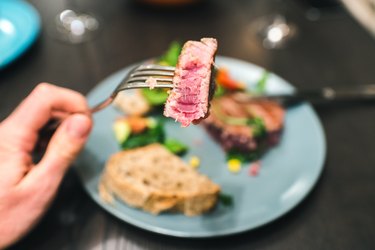
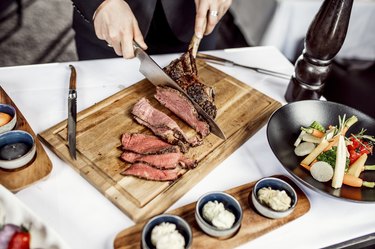
Cows were made to graze on grass, to exercise in pastures and to stay away from drugs. In fact, eating the meat of grass-fed animals can actually help decrease weight. Grass-fed beef is an excellent source of healthy omega-3 fatty acids and conjugated linoleic acid (CLA). CLA reduces body weight and fat deposition. In 2010, the "Journal of Nutrition and Biochemistry" reported, "Conjugated linoleic acid modulates body composition, especially by reducing fat (adipose tissue)." As with grass-fed cattle, organic chickens do not contain the hormones and antibiotics as conventional chickens. In addition, organic wild fish are able to swim and eat foods naturally found in their environment compared to farm-raised fish, which are fed a diet of corn and kept in small tanks. The result, again, is an excellent source of healthy omega-3 fatty acids and fish oils. In addition to consuming organic meats, there are numerous health benefits from eating organic produce. Organic produce are rich in vitamins, minerals and other nutrients. Organic produce also contains more phytonutrients than non-organic produce including carotenoids, flavonoids and other polyphenols.

Warning

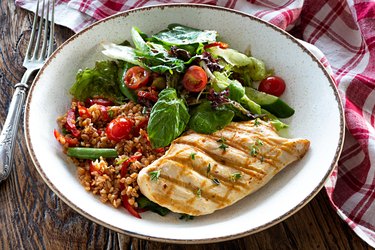
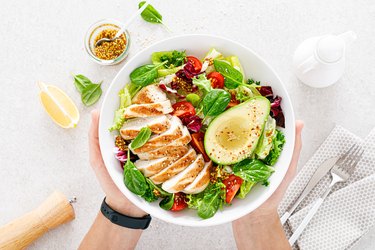
Not all organic foods will help with weight loss. A potato chip cooked in organic corn oil is still a potato chip cooked in corn oil. Saturated fat is unhealthy no matter the source. In the same way, organic soda is still soda. To maintain a healthy weight, avoiding all foods high in saturated fats is recommended, be it organic or not. Organic lean meats, protein, fiber, vegetables, fruits and teas are recommended for healthy weight loss.

References

Article reviewed by MER Last updated on: Oct 6, 2010

Must see: Photo Galleries

Member Comments