


























































About Restless Leg Syndrome and Anxiety

About Restless Leg Syndrome and Anxiety
Photo Credit looking down at legs image by Sean Gladwell from Fotolia.com

Restless leg syndrome was first identified medically in 1861, and termed "anxietas tibiarum," or a combination of leg movement disorder with depression or anxiety. This is the essential description of RLS, a disorder that causes a person to frequently move her legs, especially at night. The anxiety that often accompanying such leg movements continues to raise questions in the medical community as to whether or not the anxiety itself causes the leg movements or vice versa. According to the Restless Legs Syndrome Foundation, RLS affects up to 10 percent of people in the United States.

Physical Symptoms

Restless leg syndrome is now considered a neurological disorder. Persons with RLS often want to move their legs, sometimes because their legs are uncomfortable. Often, this discomfort is described as crawly feelings in the legs or a strong urge to move. These symptoms may begin or get worse when the person is lying down or sitting, especially at night. Movement relieves the sensation, at least temporarily. For some individuals, the discomfort may move up into the arms or trunk of the body. The diagnosis of RLS does not require the presence of psychological symptoms.

Sleep Disorder

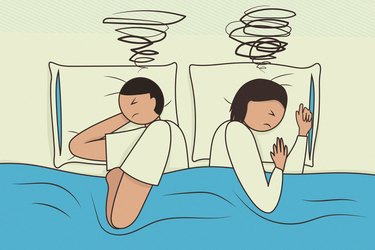
RLS is now recognized as a variety of sleep disorder, because it often causes poor, nonrestorative sleep. According to Philip Becker's article about biopsychosocial effects of RLS, published in 2006 in "Neuropsychiatric Disease and Treatment," 60 to 80 percent of RLS sufferers claim sleep disturbance from RLS as their worst symptom. A total of 80 to 90 percent of RLS sufferers have "periodic leg movements," episodes of leg jerking during sleep that cause additional sleep problems.

Which Comes First?

When patients present with depression or anxiety, the clinician checks whether poor or changed sleep is concurrent with the mood disorder symptoms. This issue is not entirely clear. A clinician checking psychological symptoms may easily know nothing about RLS. A medical doctor treating RLS may easily think that the poor sleep structure of RLS causes the patient to feel worse, which causes him or her to ignore anxiety as a mental disorder. Most people who seek medical help for sleep problems report having a poor quality of life. Even though sleep disturbance may account for symptoms of anxiety, clinicians like J. Winkelman, M.D. and R. Lieb, Ph.D, authors or a study published in "The Journal of Neurology" in 2006, indicate that RLS causes the anxiety.

RLS Precedes Anxiety

In a research study published in 2006, Dr. Winkelmann and associates at the Max Planck Institute of Psychiatry in Germany found that people with RLS have an increased risk for anxiety and other mood disorders. Specific anxiety disorders, including panic and generalized anxiety disorder, were found to be significantly higher in RLS sufferers. By tracking the temporal relationship between the RLS and anxiety symptoms, the research revealed it is likely that the RLS condition appears before the anxiety. Similarly, research by Dr. Sevim and associates, reported in 2004, showed a strong relationship between sufferers of RLS with anxiety and mood disorders---significantly stronger than these mood disorders with the general population control group.

Making the Connection

There is still no general agreement for medical doctors and psychiatrists concerning whether RLS causes anxiety or other mood disorders. In both anxiety and RLS, there is evidence of a hereditary factor emerging from some data now available regarding family patterns of RLS. However, because of differences in methodology and ways of identifying and measuring symptoms between studies, more research is necessary to clarify the causal question.

References

  • "Journal of Neurology": "Anxietas Tibiarum"; J. Winkelmann, M.D., M. Prager, M.D., R. Lieb, Ph.D, et al.; 2005
  • Restless Legs Syndrome Foundation: About RLS; 2010
  • NIH MedlinePlus: Restless Leg Syndrome; 2010
  • "Neuropsychiatric Disease and Treament": The Biopsychosocial Effects of Restless Legs Syndrome (RLS); Philip M. Becker, M.D.; 2006
  • "Journal of Neurological Surgery and Psychiatry": Correlation of Anxiety and Depression Symptoms in Patients With Restless Legs Syndrome; 2004
  • "Movement Disorders": No Evidence for Cognitive Dysfunction or Depression in Patients with Mild Restless Legs Syndrome; Erika Driver-Dunckley, M.D., Donald Connor, Ph.D, Joe Hentz, M.S., et al.; September 15, 2009

Article reviewed by Ellen Parson Last updated on: Apr 26, 2011

Must see: Photo Galleries