
















































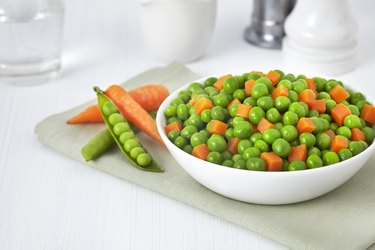
If you are trying to eat healthy and consume the recommended five servings per day of vegetables, you might feel overwhelmed by the amount of time it takes to maintain a supply of fresh vegetables at your home on a daily basis. Frozen vegetables can be much easier. Frozen vegetables count toward your recommended servings, but they might have a slightly different nutritional makeup.
Effects of Freezing
According to the European Food Information Council, freezing, if done properly, does not have much effect on the nutrient content of vegetables. In fact, vegetables frozen immediately after harvesting at the peak of season might have even more nutrients than fresh. Fresh produce loses vitamin C at a rate of approximately 15 percent each day at room temperature. Flash freezing offers the highest level of nutrient maintenance.
Frozen Mixed Vegetables
Once boiled and drained, with salt added for taste, frozen mixed vegetables are a healthy choice. A half-cup serving yields 55 calories, only 1 of which is from fat. It has 12 grams of total carbohydrates, including 4 from fiber. That is 16 percent of the daily recommended dosage of fiber, which is lacking in many American diets. A serving of mixed vegetables has 3 grams of protein, 247 mg of sodium and no cholesterol. Frozen mixed vegetables are rich in riboflavin, vitamin A, vitamin K and manganese.
Calories of Individual Vegetables
A 1-cup serving of frozen cauliflower has only 32 calories. Broccoli and Brussels sprouts have 41 and 53 calories per serving, respectively. Frozen peas have 111 calories in each cup, butternut squash has 148, and baby lima beans pack 217 calories into each 1-cup serving.
Fat, Carbohydrates and Protein
Frozen cauliflower has 0.36 grams of fat, mostly unsaturated, as well as 6 grams of carbohydrates and 3 grams of protein in each 1-cup serving. Broccoli has 0.45 grams of fat, mostly unsaturated, as well as 7.5 grams of carbohydrates and nearly 4.5 grams of protein per cup. With 1 gram of fat, 18 grams of carbohydrates and 9 grams of protein per serving, Brussels sprouts are another healthy choice. For an added bonus, all three of these vegetables get approximately half of their carbohydrates from dietary fiber.
Vitamins and Minerals
Packed with vitamins A and C, frozen vegetables can help keep your immune system in check. Green vegetables such as Brussels sprouts and broccoli are bursting with vitamin C, providing 140 and 147 percent, respectively, of the daily recommended value. Frozen butternut squash and baby lima beans offer high levels of potassium.


Member Comments