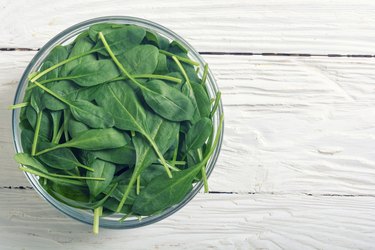
If you're looking for vegetables to add to your healthy diet, take a close-up look at leafy greens. Spinach calories are negligible. With numerous vitamins and minerals, a high-fiber content and antioxidants, this versatile food benefits your health and can complement many dishes.
Snapshot of Spinach Nutrition
Video of the Day
In focusing a spotlight on spinach nutrition, it helps to know a few things about this versatile food. Technically, it's a non-starchy vegetable, along with three dozen other types of healthy veggies, states the University of Michigan.
Video of the Day
For most vegetables in this well-populated category, one cup of raw veggies or one-half cup of cooked veggies equals one serving and has only 25 calories. However, the spinach results are even better. The USDA notes that one cup of raw spinach has only 7 calories. In other words, spinach has its place in any diet.
Besides being known as a nutritious vegetable, can spinach be considered a carbohydrate or a protein? The USDA says that with 1 gram of carbs and under 1 gram of protein, this green leafy vegetable is on both categories' low side.
Spinach is available in several different forms, making it adaptable to different lifestyles and storage facilities. Maybe you enjoy dining on a fresh, crisp spinach salad with other colorful veggies and healthy garnishes. If keeping the spinach fresh is an issue, or you'd like to keep some on hand for soups or casseroles, the canned form makes more sense. Regardless of how you eat it, you'll benefit from great spinach nutrition.
Let's say you want to incorporate fresh spinach into your healthy lifestyle, but you're also keeping an eye on those spinach calories. Here's some good news: a 2018 North Carolina Public Schools fact sheet states that raw spinach is extremely low in calories. In fact, a one-cup serving only has 7 calories, while a half-cup serving of cooked spinach has 21 calories.
Spinach also provides a host of nutrients that benefit your health. Besides vitamins A, C and K, it packs beta-carotene, calcium, folate, iron and manganese into each bright green leaf. These vitamins and nutrients nourish your body's cells, organs, bones and blood.
Essential vitamins and nutrients also help to convert food into energy, support optimum brain health and promote good immune system function. This impressive list of nutrients, plus the low number of calories, make spinach a "must-have" food for any healthy diet.
Does Cooked Spinach Lose Nutrients?
You plan to incorporate both raw and cooked spinach into your diet, but you'd like to know if you'll receive different nutritional benefits from each form of the vegetable. Fortunately, Alice H. Lichtenstein, DSc, executive editor of the Tufts University Health & Nutrition Letter, has an answer that gets right to the point.
She states that whether you prefer your spinach raw or cooked, your body will generally receive the same valuable nutrients. However, there are two notable exceptions to this rule.
First, spinach's carotenoids tend to become more bioavailable after you cook this leafy vegetable. On the flip side, cooking the spinach does result in a decrease in its vitamin C content, which is negatively affected by the heat. However, other nutrients aren't impacted by the cooking process.
In fact, you can actually get more calcium from the spinach if you boil it for a minute and then drain the cooking water. Since this leafy green contains oxalic acid, which effectively blocks your body from absorbing the vegetable's calcium, discarding the boiled water appears to largely remove that obstacle.
Read more: 6 Reasons to Avoid Eating Too Much Spinach
Enjoy Spinach’s Varied Health Benefits
Spinach's trove of vitamins and minerals sets the stage for some impressive health benefits. Registered dietitian Jacqueline Beatty, of the University of Rhode Island, stresses the importance of vitamin C in helping to maintain a strong immune system.
Next, beta carotene, which is synthesized into vitamin A, promotes good eye health. Vitamin K assists in regulating your blood calcium levels.
Folate does triple duty, helping increase red blood cells while also playing a role in adequate nervous system growth. This essential vitamin also acts as a catalyst that helps to transform amino acids into other useful chemical substances.
Spinach contains calcium, potassium and magnesium, all of which contribute to your body's energy metabolism. Spinach is also very low in sodium. Taken together, these nutritional pluses make this nutrient-dense leafy green vegetable a key player in your weight loss program.
If you're searching for vegetables that will help you meet your daily fiber goal, look no further than fiber-rich spinach. You'll receive more than 4 grams of fiber in only one cup of cooked spinach. Fiber recommendations state that men should consume 38 grams daily, while women should include 25 grams of fiber in their daily diets.
So, what are the benefits of a high-fiber diet? High fiber consumption has been linked to reduced body weight. Sufficient fiber intake is also vital to achieving good heart and digestive health. Finally, adopting a higher-fiber diet helps to decrease the risk of chronic diseases such as cardiovascular disease, type II diabetes and certain cancers.
Spinach’s Role in Weight Loss
Maybe you're ready to begin a weight loss program, or you're committed to getting your current effort back on track. The Centers for Disease Control and Prevention offers a useful perspective that can help you to focus on the big picture.
Simply put, to accomplish your weight loss goal, you must consume fewer calories than your body burns every day. However, this certainly doesn't mean that you'll eat less food. In fact, you'll have plenty of nutritious foods from which to choose.
Vegetables and fruits should be a key component of your weight loss program. They're generally low in calories and fat and contain plenty of fiber and water. These attributes help add volume to your meals, so you can consume the same amount of food while taking in fewer calories.
If you can't bear to give up a favorite dish, replace high-calorie ingredients with reduced-calorie vegetables and/or fruits. This provides the best of both worlds, as you'll enjoy the dish's great taste while treating your body to better nutrition and reaching your weight loss goals.
Importance of High-Fiber Diets
Keeping spinach's high fiber content in mind, you might wonder if a high-fiber diet really makes the difference in reaching your weight loss goal. Researchers behind a 240-person study, published in the February 2015 edition of the Annals of Internal Medicine, had the same question.
Scientists wanted to compare the comprehensive American Heart Association (AHA) diet with an eating plan that kept the focus on higher fiber consumption. This randomized and controlled trial took place from 2009 to 2014 in Worcester, Massachusetts.
The trial involved 240 adults who had been diagnosed with metabolic syndrome. Besides following one of the two diets, participants attended individual and group interactive sessions throughout the study's duration. After 12 months had elapsed, researchers recorded participants' weight changes.
At the study's conclusion, the AHA diet participants had lost a little more weight than the high-fiber diet subjects. Several participants had dropped out of each study group, and eight subjects were diagnosed with diabetes (one person in the AHA group and seven in the high-fiber group). The study didn't assess participants' weight loss maintenance after the study ended.
Researchers concluded that although the multi-component AHA diet group lost slightly more weight, the high-fiber diet group demonstrated almost equal results. This simplified method would offer a reasonable option for people who found it difficult to stick to more complex diet plans.
Dr. Frank Hu, a professor at Harvard Medical School and the Harvard School of Public Health, underscores the importance of sufficient dietary fiber. Dr. Hu notes that a higher-fiber diet aids in weight management.
Dr. Hu also emphasizes that consuming a higher-fiber diet can help stave off cardiovascular disease and type II diabetes. However, he stressed that you should obtain fiber from your food (including higher-fiber spinach), not from fiber supplements.
Kale Calories and Nutrition
If you'd like to add another leafy green vegetable to your diet, consider nutrient-rich kale, which combines a bold, earthy flavor with lots of vitamins and minerals. Even better, your kale calories intake will be minimal. When you consume two cups of raw kale, you'll receive 2 grams of fiber and only 16 calories, notes the U.S. National Library of Medicine.
Kale supplies your body with valuable vitamin A, vitamin C, calcium and vitamin K. However, note that if you currently take blood-thinning medication, you may need to consume fewer vitamin K-containing foods. Vitamin K can limit the effectiveness of these medicines. Your physician can provide you with guidance on this issue.
In addition, kale contains a substantial amount of fiber, which helps promote regular bowel movements. The nutrients in this leafy green vegetable contribute to good heart and eye health and help foster a strong immune system. Kale's valuable antioxidants block harmful cell damage and may also offer some protection against cancer.
- University of Michigan Comprehensive Diabetes Center: “Non-Starchy Vegetables/Protein/Fat”
- North Carolina Public Schools: “Spinach”
- Tufts University: “Do Raw and Cooked Spinach Provide the Same Nutritional Benefits?”
- University of Rhode Island: “Make Like Popeye: The Powerful Benefits of Spinach”
- Centers for Disease Control and Prevention: “How to Use Fruits and Vegetables to Help Manage Your Weight”
- Annals of Internal Medicine: “Single-Component Versus Multicomponent Dietary Goals for the Metabolic Syndrome: A Randomized Trial”
- Harvard Health Publishing: “Making One Change – Getting More Fiber – Can Help With Weight Loss”
- U.S. National Library of Medicine: “Healthy Food Trends: Kale”
- United States Department of Agriculture: "Basic Report: Spinach, Raw"