

















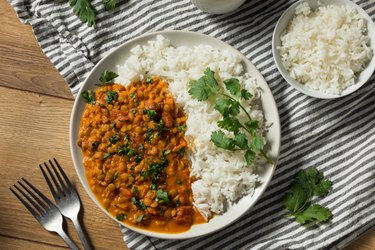











































Coconut consumption has increased with the growing popularity of southeast Asian and Indian cooking. With a subtle flavor that is the perfect foil for intense spices and a rich creamy texture, coconut milk is the basis of rich curries and vegetable dishes served in Indian and Thai restaurants. Since consumption of this food has grown so much, it is ever more important to consider the nutrient content of this food.
Calories and Fat
According to the U.S. Department of Agriculture, 0.5 cup of canned coconut milk has 223 calories and 24.10 g fat. These figures suggest that coconut milk is a splurge food. One might think of using it in cooking the same way you use butter: sparingly. Furthermore, 21.374 of these fat grams are from saturated fats. The World's Healthiest Foods web site explains that most of these saturated fats are from medium-chain fatty acids, rather than long-chain fatty acids.
Fiber
The U.S Department of Agriculture does not have values for the fiber content of canned coconut milk or dried creamed coconut meat. However, it does report that there are 4.6 g fiber in one ounce dried, desiccated unsweetened coconut. and 5.3 g fiber in one cup of raw coconut milk.
Minerals
The U.S. Department of Agriculture says there are 20 mg calcium, 3.73 mg iron, 52 mg magnesium, 0.63 mg zinc, 0.25 mg copper and 0.8 mg manganese in one half cup of canned coconut milk. These numbers suggest that while coconut milk may be a high calorie food, these are far from empty calories.
Vitamins
Canned coconut milk is not a great source of vitamins. The U.S. Department of Agriculture states one half cup has no vitamin A, D or E and only a trace of vitamin C. With respect to the B vitamins, it has 0.03 mg B-6, 0.17 mg pantothenic acid. 0.7 mg niacin and 0.02 mg thiamin.
Benefits
The U.S. Department of Agriculture reports that one half cup of canned coconut milk has 108 mg phosphorus and 249 mg potassium. These numbers suggest that while coconut milk is a good source of these minerals for healthy people, patients with advanced kidney disease and others who need to restrict their potassium and phosphorus may want to indulge in this food sparingly.


Member Comments