













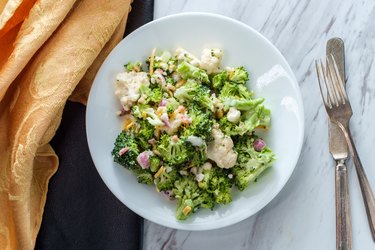





























Pumpkin seeds, or pepitas, are flat seeds that are usually enclosed in a pale yellow husk. They can be either bought as seeds or you can extract them from a pumpkin yourself and leave them to dry. Pumpkin seeds are a healthy snack, given the essential minerals and nutrients they contain and their low levels of saturated fat and sugar. Many people prefer to roast pumpkin seeds, as this improves their taste; however roasting for too long results in a loss of nutrients. Pumpkin seeds can either be enjoyed on their own or added to other dishes, such as salads.
Protein, Minerals and Vitamins
A handful of pumpkin seeds, or around 35 grams, provide 9 grams of protein and 52 percent of the daily value for manganese, 46 percent of DV for magnesium, 28.7 percent of DV for iron and 17 percent of DV for zinc. Pumpkin seeds are also a rich source of the B vitamins, particularly niacin. Manganese and zinc are important components of enzymes, magnesium plays important roles in DNA synthesis, iron is essential for healthy blood and the B vitamins are needed to convert the food we eat to energy.
Phytosterols
Phytosterols are compounds found in plants that are similar in structure to cholesterol. When present in the foods we eat, phytosterols inhibit the absorption of cholesterol from the intestines and thus lower blood cholesterol levels. Many margarines and spreads are being fortified with phytosterols and marketed as an aid to lower cholesterol. In a study published in the Journal of Agricultural and Food Chemistry, of all the seeds typically consumed, pumpkin, together with sesame seeds, pistachios and sunflower seeds, contain the highest amounts of phytosterols.
Anti-inflammatory
A study reported in Pharmacological Research, found that arthritic rats given pumpkin seed oil showed a reduced inflammatory response comparable to those rodents given the non-steroidal anti-inflammatory drug indomethacin. Moreover, unlike indomethacin, pumpkin seed oil did not increase the level of lipid peroxides in the linings of the joints, a side-effect that can actually contribute to the progression of arthritis. While this was an animal study, it gives preliminary indications that components in pumpkin seeds might be valuable for people suffering from inflammatory conditions.
Prostate Health
Benign prostatic hypertrophy, or BPH, is a condition affecting men 50 years and older and involves the enlargement of the prostate gland. The symptoms associated with BPH are frequent and painful urination, and it leads to greater risk of urinary tract infections. According to L. Dvorkin and K.Y. Song, who reported in the Annals of Pharmacotherapy, pumpkin seeds may be able to prevent this condition. While the mechanism is still unknown, nutrients in pumpkin seeds responsible for this effect might be carotenoids, omega-3s and zinc.
Bone Health
Apart from prostate health, zinc is also essential for bone health. Elderly men and women are prone to osteoporosis, a condition where bones weaken and fractures become more likely. A study reported in the September 2004 issue of the American Journal of Clinical Nutrition, found a definite correlation between low dietary intakes of zinc and incidence of osteoporosis. Thus the high zinc content of pumpkin seeds provides another good reason for including them in the diet.
References
- "Journal of Agricultural and Food Chemistry"; Phytosterol composition of nuts and seeds commonly consumed in the United States; Phillips KM et al.; November 2005
- "Pharmacological Research"; Effect of pumpkin-seed oil on the level of free radical scavengers induced during adjuvant-arthritis in rats; Fahim A.T. et al.; January 1995
- "The Annals of Pharmacotherapy"; Herbs for benign prostatic hyperplasia; Dvorkin L and Song KY; September 2002
- "American Journal of Clinical Nutrition"; Zinc intakes and plasma concentrations in men with osteoporosis: the Rancho Bernardo Study; T.H. Hyun et al.; September 2004


Member Comments