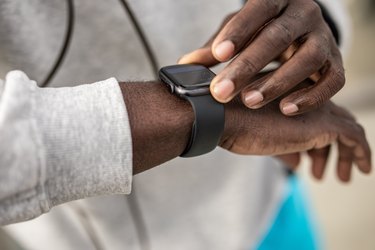
During clinical trials, Polar heart rate monitors are often used as the gold standard for "worn-on-the-body" heart rate monitoring. But does that translate to equal accuracy when you turn your Polar heart rate monitor into a calorie counter? Not always.
Polar Heart Rate Monitors: Chest Straps vs. Wrist-Worn Watches
Video of the Day
If you're looking for a wearable heart rate tracker that's readily available to consumers, you can hardly do better than a chest-strap heart rate monitor from Polar. Many of these models have been clinically validated for their accuracy, to the point that they're often used as the baseline for monitoring heart rate activity in clinical studies.
Video of the Day
Looking at a few examples of using Polar heart rate monitors as the gold standard also gives you some idea of what to look out for when it comes to choosing among other heart rate monitors.
For example, as noted in a research letter published in the January 2017 issue of JAMA Cardiology, researchers from the Cleveland Clinic recruited a small pool of 50 participants to test the accuracy of wrist-worn heart rate monitors. They randomly assigned each participant two different wrist-worn heart rate monitors to wear during exercise, and compared the wrist-worn readings against those from a Polar H7 chest-strap monitor that was worn at the same time.
Ultimately, they found that the chest-strap monitor was significantly more accurate than Polar's wrist-worn watch models; accuracy for the latter varied quite a bit depending on the monitor brand, exercise intensity and the type of activity being done.
Although wrist-worn heart rate monitors are convenient, their relative lack of accuracy when compared to chest-strap monitors cropped up again in a June 2019 issue of Cardiovascular Diagnosis and Therapy, conducted at the Cleveland Clinic.
In this study, 80 adult patients enrolled in cardiac rehabilitation were monitored during a rehab session that involved exercise on a treadmill or stationary cycle. They underwent monitoring with standard ECG limb leads, plus a Polar H7 chest-strap monitor, and two randomly assigned wrist-worn heart rate monitors.
Again, the accuracy of wrist-worn monitors, like Polar heart rate watches, varied according to the activity being done; all but one of them returned "acceptable" (greater than 80 percent) levels of correlation with the ECG while on a treadmill, but all of the wrist-worn models returned unacceptable results with some activity. The Polar heart rate monitor, by comparison, returned 99 percent accurate correlation across all of the activities tested.
Accuracy while measuring heart rate isn't the same as measuring the amount of calories burned. But because those heart rate readings are used to calculate energy expenditure (which is what your "calories burned" really measures), every little bit of accuracy helps.
Tip
Two of the best ways to be sure you're getting a clinically validated Polar heart rate monitor — which is especially important if you're wearing a heart rate monitor for medical reasons, but also guarantees better accuracy if you're tracking your heart rate to measure exercise intensity — are to talk to your doctor or to search the PubMed database for clinical trials validating your particular model of Polar heart rate monitor.
What About the Accuracy of Calories Burned?
There's always a catch. Here, it's that measuring your exercise intensity (in this case, according to heart rate) is just one of many factors that goes into estimating how many calories you've burned. And as Stanford researchers reported in a May 2017 issue of the Journal of Personalized Medicine, even good accuracy from a heart rate monitor doesn't always correlate to accurate calorie-burn estimates.
The researchers evaluated seven fitness-tracking devices with the help of a small group of 60 volunteers and found that six of the devices were accurate for heart rate to within 5 percent.
None of the devices were from the Polar brand, but the findings are still helpful for understanding that even when heart rate accuracy was good, the accuracy of measuring energy expenditure, or calories burned, was not: The most accurate device was off by 27 percent, and the least accurate was off by a staggering 93 percent.
Tip
Researchers explained that for the lay user in a nonmedical setting, the ideal error rate for gauging energy expenditure is less than 10 percent.
How Do Polar Watches Fare at Tracking Calories Burned?
As the Journal of Personalized Medicine study demonstrated, accuracy of heart rate monitoring doesn't necessarily correlate with accuracy of measuring energy expenditure, which is really what "calories burned" represents. But with Polar heart rate monitors so often functioning as the gold standard for measuring heart rate, is it possible that Polar fares better at being a calorie-counter watch?
The answer is a mixed bag, depending on which model is evaluated and the activity that they were used to gauge. For example, in a study published in a March 2010 issue of the British Journal of Sports Medicine, researchers found that the Polar Activity Watch 200 fell within the accepted 10 percent error threshold of calorie estimates — when used while hiking. They didn't evaluate the AW200 during other activities.
However, a March 2018 study published in Medicine and Science in Sports and Exercise found that despite being the gold standard for wearable heart rate monitors, the Polar H7 calorie accuracy didn't fall within the acceptable range. (Nor did any of the other devices tested.)
What the Research Says About Polar Heart Rate Monitors and Calories Burned
The last example is more promising: In a study published in the September 2010 issue of the Journal of Sports Science and Medicine, scientists evaluated the validity of the Polar S810i heart rate monitor against an armband monitor for estimating calories burned during indoor rowing. The small pool of 43 participants were monitored via indirect calorimetry to provide a baseline for accuracy of the devices under trial.
Like the other fitness tracking device used in the test, the Polar S810i heart rate monitor was shown to significantly overestimate energy expenditure during low-intensity exercise. However, there was no significant difference between the Polar results and the indirect calorimetry results at moderate exertion levels, and the overall results still correlated well at low intensities.
Overall, the researchers decided that despite the variability at low intensities, results correlated well enough for the Polar heart rate monitor to provide accurate calories burned estimates. But they went on to note that for that to be true, the heart rate monitor had to be programmed with the exerciser's measured VO2max (a measurement of your body's ability to uptake oxygen) and maximum heart rate, as opposed to the estimated values you typically have access to outside a clinical setting.
An older study, published in an August 2004 issue of the journal Medicine and Science in Sports and Exercise, evaluated a small group of 20 participants and found that when programmed with estimates for those numbers instead of actual readings, another Polar heart rate monitor, the S410, provided only rough estimates of calories burned. Using actual values of VO2max and maximum heart rate greatly improved the accuracy, although on that device mean energy expenditure for women was still overestimated by 12 percent.
Ultimately, Polar heart monitors aren't as accurate for measuring calorie expenditure as they are at tracking your heart rate. However, even if the numbers you get aren't 100 percent accurate, they might still be useful for goal-setting purposes and tracking your relative progress and workout intensity — i.e., whether the overall amount of energy you expend is trending up or down.
Related Reading
- Harvard Health Publishing: "Feel the Beat of Heart Rate Training"
- JAMA Cardiology: "Accuracy of Wrist-Worn Heart Rate Monitors"
- Cardiovascular Diagnosis and Therapy: "Accuracy of Wearable Heart Rate Monitors in Cardiac Rehabilitation"
- Journal of Personalized Medicine: "Accuracy in Wrist-Worn, Sensor-Based Measurements of Heart Rate and Energy Expenditure in a Diverse Cohort"
- Stanford Medicine News Center: "Fitness Trackers Accurately Measure Heart Rate But Not Calories Burned"
- Medicine and Science in Sports and Exercise: "Accuracy of Polar S410 Heart Rate Monitor to Estimate Energy Cost of Exercise"
- Journal of Sports Science and Medicine: "Accuracy of the Polar S810i Heart Rate Monitor and the Sensewear Pro Armband to Estimate Energy Expenditure of Indoor Rowing Exercise in Overweight and Obese Individuals"
- PubMed.gov: "PubMed"
- British Journal of Sports Medicine: "Polar Activity Watch 200: A New Device to Accurately Assess Energy Expenditure"
- Medicine and Science in Sports and Exercise: "Validity of Wearable Activity Monitors during Cycling and Resistance Exercise"