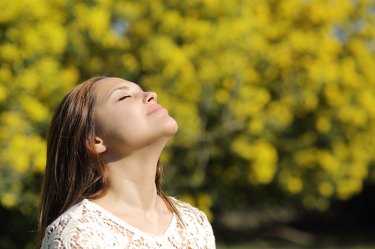
Deep breathing and coughing exercises can decrease the risk of lung complications following surgery. Not only can they prevent pneumonia, deep breathing helps to get more oxygen to the body's cells. These exercises can also be beneficial to individuals who are susceptible to pulmonary or respiratory problems. Coughing and deep breathing work to clear mucus and allow moist air to enter the airways.
Post-Operative Exercises
Video of the Day
Individuals are encouraged to perform coughing and deep breathing exercises after having surgery in order to help prevent pneumonia and other post-operative complications. Coughing brings up phlegm, which can help you breathe easier. The results of a study reported in the November 2005 issue of "Chest" found that performing deep breathing exercises following coronary artery bypass surgery improves pulmonary function.
Video of the Day
Coughing Exercise
If you are lying in bed and need to cough, it may be more comfortable to bend your knees up. Lean forward when you cough, if you are sitting in a chair. Place a pillow over your surgical incision and apply pressure to the area while coughing. This can help to alleviate any discomfort you feel. It's more comfortable to sit upright if you can when doing coughing exercises.
Breathing Exercises
You can perform breathing exercises by relaxing your shoulders and upper chest. Take a deep breath in through your nose. Hold the breath for three seconds. Breathe out slowly through your mouth. Repeat three times. Taking too many breaths can make you dizzy or light-headed. Perform breathing exercises every hour. Another deep breathing exercise is to sit or stand with your arms at your side. Take in a slow and deep breath through your nose. Raise your arms over your head at the same time. Breathe out through your mouth as you lower your arms back down to your sides.
Spirometer
Sometimes, it's necessary to use a spirometer after surgery to help keep your lungs clear. Sit up and hold the spirometer upright. Place the mouthpiece in your mouth, sealing your lips around it. Breathe in as slowly and deeply as you can. Try to raise the piston toward the top of the column. Hold your breath as long as possible before exhaling. The doctor or nurse will instruct you on how many repetitions and sets you should do. Cough between breaths to keep your lungs clear.
COPD
Coughing helps to remove mucus. Take in a deep breath and hold it two or three seconds before pushing out the air with your stomach muscles. A deep rather than a hacking cough works better at clearing mucus out of the lungs. Huff coughing requires that you take a breath a little deeper than normal. Use your stomach muscles to make a ha, ha, ha sound as you exhale rapidly three times. Cough deeply as you breathe through your diaphragm.
Relaxation Breathing
Deep breathing and coughing exercises are often recommended for people who suffer chronic health conditions, respiratory problems or chronic pain. You should not use breathing and coughing exercises without talking to your doctor first. If he approves, there are some easy breathing techniques that can help you to relax. Breathe in for a count of four seconds and then breathe out for a count of eight seconds. Gradually work yourself up to breathing in for a count of 10 seconds and out for a count of 20 seconds. Another breathing technique for relaxation requires taking short, deep and fast breaths. Push air out through your nose from your diaphragm. Relax and let your lungs fill back up with air.