Thinking about trying a new Pilates class at your gym? Like yoga, Pilates is almost as much about the breathing as it is about controlling the body's movements through the abdominal muscles (called the "powerhouse" in Pilates).
Before you attend a class, try some of these best Pilates ab moves at home. Do them in order for the biggest benefits, but modify where you need to.
Video of the Day
These moves (and their order) are considered classical Pilates, which follows the original system Joseph Pilates created in the 1920s.
"Classical varies from other forms of Pilates, because it means that I teach in a traditional order, which includes transitions between exercises," Christina Pabon, Pilates instructor at Life Time, says.
1. Hundred
The Pilates hundred move builds core strength while warming up the lungs and the rest of the body. It's named for the 100 beats and breaths that are counted during the exercise.
- Lie on your back with your legs in a tabletop position (as if your heels are resting on a bench, knees directly over the hips), arms activated and lengthened along your sides.
- Inhale and lift the chin up to the chest and lift your arms a few inches off the ground.
- On an exhale, extend your legs all the way forward and a few inches from the ground, keeping your lower back planted on the mat.
- Move the arms up and down five times (somewhat rapidly) on your inhale and five times on your exhale.
- Repeat 10 times, remembering to keep your neck long and shoulders down.
Tip
To modify, start with only five counts of 10 breaths. Or, adjust the position of your lower body: Plant your feet flat on the floor, leave your legs in tabletop or only extend your legs at a 45-degree angle. If you have neck issues, use a rolled towel or another prop to support your neck or keep your head down.
2. Roll-Up
The roll-up strengthens the abs and restores the spine to neutral alignment. It is uniquely effective in stretching and lengthening the lower back as well as stretching the hamstrings.
- Lie on your back with your entire body resting on the mat. With your shoulders wide and palms facing the floor, stretch your arms up overhead, reaching your legs forward with knees locked, lengthening through pointed toes.
- With a slow inhale, flex your feet and bring your arms up to the ceiling and roll your head up to bring your chin to your chest.
- As you exhale, slowly roll up and forward, adjusting your arm position so the arms stay extended out in front of the shoulders.
- Continue to roll forward, bending all the way over, and try to reach your forehead to your knees while still keeping the chin on the chest.
- On the return, inhale as you keep the abdominals contracted and the chin to the chest and slowly reverse the movement, articulating the spine back down to the floor vertebrae by vertebrae.
- Do 3 repetitions.
Tip
Use a bolster under your feet if you can’t complete the roll-up from supine position. If necessary, bend the knees and plant the feet flat on the floor until you can complete a full roll-up. Only roll as far as you can without lifting the lower body off the mat until you have strengthened the necessary muscles to complete this exercise correctly.
3. Rollover
The rollover is an advanced exercise that requires a strong core and should not be performed if you have any kind of neck or back problems. When done properly, the rollover strengthens your abdominal muscles, stabilizes the pelvis and improves posture while targeting the butt and lower back muscles.
- Lie on the mat with legs extended and arms at your sides, palms down.
- Contract your core muscles, press your palms into the floor, point the toes and raise both legs to the ceiling, squeezing them together and keeping the shoulders down on the floor.
- Using your abdominals to initiate movement, squeeze the glutes and slowly lift from the hips to bring your lower back off the floor as you roll the legs back until they are parallel to the ceiling.
- Open the legs slightly, flex the feet and hover the toes just off the floor.
- Next, roll your spine back down to the mat vertebrae by vertebrae, maintaining control with the abdominals.
- When your feet get a foot from the floor, squeeze the legs back together, point the toes and repeat a total of 3 rollovers.
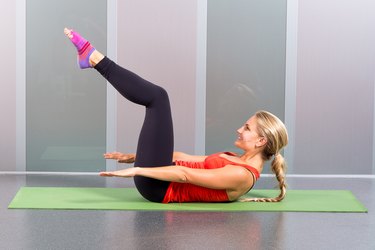
4. Single-Leg Stretch
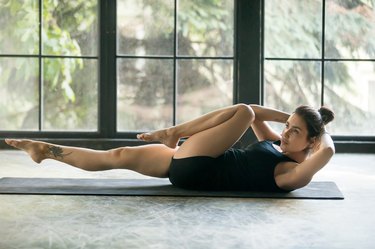
The single-leg stretch stabilizes the trunk and pelvis as well as increases upper-back and hamstring flexibility. It teaches the abs to initiate movement and maintain form and control throughout the exercise.
- Lie flat on the mat with the palms on the floor.
- Roll the chin to the chest and lift the left leg a few inches from the floor.
- Bend your right knee into your chest, forehead to the knee and shoulders rolled slightly off the ground.
- Take the hands to the right shin (elbows wide, left hand on top, right hand below it).
- Exhale percussively as you gently tug the knee slightly closer to the chest with each little exhale.
- Inhale as you switch legs and arms to the other side and repeat.
- Point the toes and use your abdominals to keep your lower trunk stable and glued to the mat.
- Do 6 repetitions on each leg, working up to 12 on each side as you get stronger.
5. Double-Leg Stretch
The double-leg stretch lengthens and strengthens the trunk, legs and arms. This exercise takes the body from one extreme to the other: full contraction "crunch" to a lengthened stretch, which intensifies abdominal engagement. If you feel pain in the lower back, raise the legs higher or keep them in tabletop until you're stronger. You can also leave the head down or set it down as arms come overhead.
- Lie flat with the spine imprinted to the mat. Lengthen through your pointed toes and widen your shoulders down to the floor.
- On an inhale, slowly lift the head up and bring the chin to the chest. Bring the shoulders up, stretch the arms forward, palms pressing into the outer thighs, and lift the legs so the heels are two inches off the ground.
- Exhale slowly as you draw both knees into the chest, forehead to the knees, with elbows wide and fingers lightly pressing onto the shins.
- As you extend the legs, the arms reach up and out overhead into a lengthening stretch.
- Only bring the legs as low as they can go without any part of your spine bowing up off the mat. The arms should extend back so they are touching the ears.
- Repeat this move 6 times, working up to 12 as you get stronger.
6. Spine Stretch
The spine stretch does exactly what it is named for: stretches the back (especially the neck and upper back) and the hamstrings and helps the brain to connect to the spine as it articulates and flexes forward.
- On an inhale, sit up tall with your legs straight and spread a little wider than the hips.
- Stack your spine vertically as if you were against a wall with the shoulders rolled back.
- Flex your feet and lengthen through your heels to engage your leg muscles.
- Bring your arms out straight from the shoulders, fingertips lengthening forward.
- On an exhale, start from the head and roll the chin down to the chest.
- Peel the spine off the "wall" behind you and round your spine into a C-curve forward, scooping your lower belly and pulling the ribs in.
- Pulse forward three times as you exhale. Inhale to return, stacking the spine back up. Repeat this move 3 times.
7. Open-Leg Rocker
The open-leg rocker engages the core and lats while training the body for proper spine articulation and stretching the hamstrings and spine. To modify, keep the legs bent as you roll forward and back. If you have shoulder, neck or back issues, proceed with caution or do it under the supervision of a certified Pilates instructor.
- Sitting up tall on your sit bones, bend the knees and grasp one ankle in each hand, toes pointed.
- Slowly extend the legs out straight and shoulder-distance apart and contract the abs.
- Inhale as you use your abs to roll back slowly onto your shoulder blades.
- Roll down the center of the spine, as opposed to one side or the other, and likewise on the way back. Steer clear of the neck when you roll back and prevent your legs from dropping too far back when rolling back.
- Exhale and roll up to the starting position, balancing on your sit bones. The key is to maintain balance, control and precision by initiating and maintaining the movement from your powerhouse.
8. Corkscrew
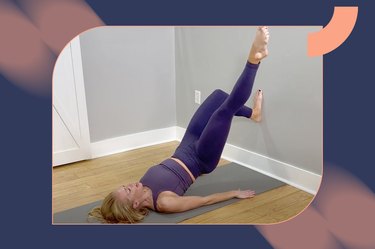
The corkscrew works the obliques, shoulders, neck and back muscles while massaging the spine and internal organs. With proper execution, the inner thighs and quads are also activated. For an easier version, don't take the legs into a full rollover. Bring the legs straight up to the ceiling and rotate both legs into a wide circle clockwise and then counterclockwise.
- Lie on your back, arms lengthened along the body, palms pressed into the mat, legs together and extended out straight.
- Lift the legs to the ceiling and roll over, bringing the legs parallel to the floor behind you, toes pointed.
- From here, keep the legs together and shift both legs to the right to roll back on the right side of the spine.
- As the legs approach the right side of the mat, keeping the knees locked, legs straight and inner thighs together, continue around with the legs to the left side.
- End the full rotation by returning the legs into the centered rollover position: legs overhead and parallel to floor with toes pointed.
- Reverse the entire movement, starting the roll down the left side and around the tailbone, then up the right side.
- Make 3 complete corkscrews on each side.
9. Saw
Stretch your side body with the saw exercise, which works all of the postural muscles, the abs (particularly the obliques) and back extensors. It also helps stretch the back of the hips and glutes as well as the hamstrings and back. As Kristi Cooper of Basi Pilates says, "This is a great exercise for 'wringing out the lungs,' or to create a shape within the body that allows you to fully exhale."
- Sit up tall, lengthening through the crown of the head with both legs extended straight out about shoulder-distance apart and feet flexed.
- Take your arms out to the sides at shoulder height, lengthening through the fingertips, keeping the shoulders rolled back and down.
- Inhale and rotate your torso toward the left leg, exhale and bend forward toward the left foot, reaching the right palm (facing down) toward the outside of the left pinky toe. Keep the back arm in a diagonal line with the front arm, palm turned up toward the ceiling.
- As you reach forward, add a stretching pulse for three saw-like motions, reaching forward, using your core muscles to keep both of your hips solid and glued down to the mat.
- Inhale to come up and return to starting position, then move to the other side.
- Do 3 full repetitions.
10. One-Leg Kick
The one-leg kick works the hamstrings and glutes and strengthens the back extensors. If you feel pressure in your lower back, separate your legs slightly or move the elbows forward a few inches (or both). If you have back issues that make back extension painful or uncomfortable, do not do this exercise.
- Lying on your belly with legs together and toes pointed, come up into a sphinx-like position onto your forearms with elbows underneath the shoulders.
- Line up the shoulders, elbows, wrists and hands and avoid hunching the shoulders into the neck.
- Keep your gaze about two to three feet in front of you on the floor.
- Anchor your pelvic bones to the mat and kick one heel into your glute for two pulse kicks.
- Straighten the leg back out onto the mat.
- Switch legs and do 6 reps on both sides.
11. Double-Leg Kick
The double-leg kick opens up the chest and the front of the shoulders as well as works the entire back side of the body. To simplify this move, shorten the range of motion on the kick. If you have back issues that make back extension painful or uncomfortable, do not do this exercise.
- Lying on your stomach with legs lengthening out and toes pointed, turn your head and place one cheek on the mat.
- Clasp your hands behind your back, placing them high on the back with elbows down toward the floor.
- Keep your spine long and lengthen through the toes and crown of the head throughout the entire exercise.
- With inner thighs and knees together, bend the knees and kick both heels to your glutes for 3 small pulses.
- As you lower the legs back down, keep the neck and head in line with the spine, lift the chest up, bring the shoulder blades together and lengthen the arms back (hands still clasped).
- Hold for a few seconds.
- As you slowly lower down, turn the head to the other side.
- Repeat on the other side, doing 5 reps for both sides.
12. Scissor
Scissors strengthen the abs, back and shoulders while increasing spinal flexibility and stretching the hamstrings and hip flexors. Scissors are a challenge and require focus to connect your breath with the movement correctly.
- Lie on the mat with arms along your sides, palms facing down. Take the legs back over your head, toes pointed as in a rollover.
- Bend the knees so the shins come to vertical and bring the hands in to prop the lower back up under the hips. Allow the majority of your weight to be supported by the abdominals, shoulders, triceps and elbows and avoid putting pressure on the neck.
- On an exhale, extend the legs up straight to the ceiling, keeping the inner thighs glued together.
- Slowly begin to scissor the legs, taking one leg toward the face and one leg toward the mat.
- Do a double pulse with an exhale on each scissor and inhale as the legs come back to center.
- Bend the knees back into the starting position and use your ab muscles to roll the spine down one vertebrae at a time.
- Once the tailbone is down on the floor, bend the knees and place your feet flat on the floor.
- Repeat each side 6 times.
Tip
To modify, keep your back flat on the floor and scissor the legs from straight up to just a few inches above the floor without allowing the spine to bow up or lift off the floor at any point.
13. Bicycle
The bicycle develops abdominal, hip and shoulder strength and increases the flexibility and strength of the hips. It's also great to do immediately following the scissor. To adjust, lie flat on your back and keep your spine melded to the mat.
- Lie down on the floor, arms lengthened out along your sides and palms down. Keep your legs together and toes pointed.
- Contract the abs, keep the shoulders down and roll the legs overhead into a rollover.
- While there, bring your hands toward the tailbone, keeping your elbows on the mat to prop yourself up.
- Bend your knees so the shins are vertical and put the weight of your pelvis into your hands. Take your legs straight up toward the ceiling, and then open them into a full scissor.
- Begin to bicycle the legs and bend the forward leg down, dropping the toe so it reaches for the mat. As that leg comes back up and unfolds to extend overhead, the opposite leg will come forward, bend and reach down into the same motion.
- After 5 reps, reverse your cycling motion.
14. Shoulder Bridge
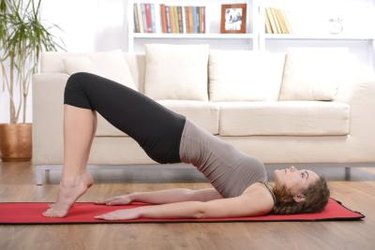
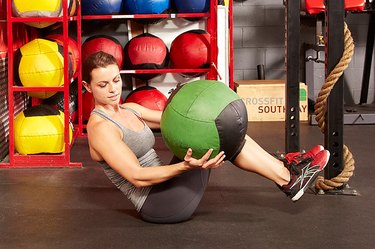
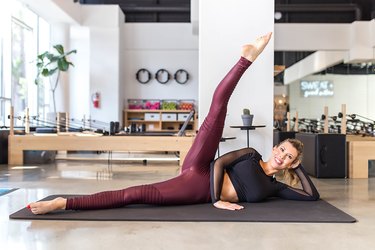
The shoulder bridge develops strength in the back and front of the legs and requires solid abdominal and hamstring strength. These muscles stabilize the pelvis as it stays lifted against the movement of the legs.
- Lie on your back with knees bent and feet on the mat, hip-distance apart, and arms down along your sides with palms pressing into the mat.
- Slowly tilt the tailbone off the floor and peel the spine one vertebra at a time up into a bridge.
- Bend the right knee into the chest and extend it toward the ceiling. Keep the toe pointed as you take the leg down toward the floor.
- Once the leg nears mid-calf of the other leg, flex the foot and return the leg back up to the ceiling, keeping the pelvis stable throughout the movement.
- Repeat for 3 repetitions before taking the leg forward, bending the knee toward the chest and placing the foot flat on the floor.
- Switch sides and do 3 more reps on the other side.
Tip
If you have shoulder, neck or knee problems, move very slowly when doing this exercise. If necessary, forgo the leg lifts and simply peel the spine off the floor, driving through the heels, and lowering the back down vertebra by vertebra for 6 repetitions.
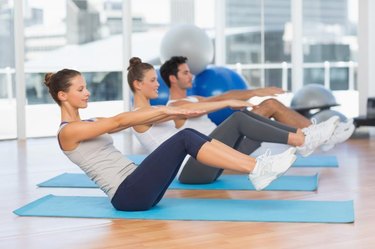
The Pilates teaser is known for its ability to challenge, strengthen and tone the core and improve balance.
- Start with your sit bones on the mat, legs extended out on the floor and toes pointed.
- Slowly tuck the chin to the chest, scoop the abdominals in and press the abdomen in as you roll backward onto your spine.
- Lie down on the floor as you lift your legs to a 45-degree angle and float your arms up until they are parallel with the legs.
- Next, take the chin to the chest and roll the torso up vertebrae by vertebrae while lifting your straight legs up to a 45-degree angle.
- Inhale at the top, then on exhale, contract the abdominals and slowly roll the spine back down, returning the arms to parallel with the legs.
- Repeat 3 times. At the end, bend the knees into the chest and roll up to sitting.
Tip
For a modification, start lying down with your knees bent and your feet flat on the floor. Grasp the back of the thighs and roll up and back down from there.
16. Swimming
Pilates swimming strengthens the back of the body — the glutes, thighs and back. When done properly, it lengthens the arms and legs, improves hip and back extension and is essential in working the hard-to-reach muscles along the spinal column. If you have back or neck pain while extending backward, do not perform this exercise.
- Lie flat on the mat on your stomach with your arms extended out in front of you and the legs outstretched behind you.
- Inhale and exhale normally as you pull the belly button to the spine and slowly lift the arms, chest, neck and legs off the floor. Point the toes and extend through the legs.
- As you breathe, alternate arm and leg movements up and down.
- Count from 1 to 10, starting with the right arm movement.
- In the movement, the alternate arm and leg should lift as far upward as possible before switching to the other side. Keep your entire body rigid, moving only the arms and legs.
Tip
To adjust, move slowly and do one arm and leg at a time without lifting the chest off the floor or lifting the head.
17. Side Kick Kneeling
Side kick kneeling stabilizes and strengthens the torso and glutes and improves balance and coordination. But if your knees do not handle pressure well, this is probably not the exercise for you. If you need to modify, decrease the range of motion of your leg or skim the free leg along the floor until you can lift off with control and precision.
- Kneel on your left knee and place the left hand on the mat directly under the left shoulder.
- Lift the right leg up so it is straight and parallel to the floor and the right knee and foot are aligned. Make sure that your left thigh stays in line with your left hip.
- Bring the right hand up, adding extra length into that side of the body. Lengthen through the crown of the head.
- Inhale quickly as you swing the free leg as far forward as possible without swiveling the pelvis forward or back.
- Exhale as you swing the leg as far behind the body as possible without losing balance or stability.
- Do 5 repetitions, and then switch sides and repeat.
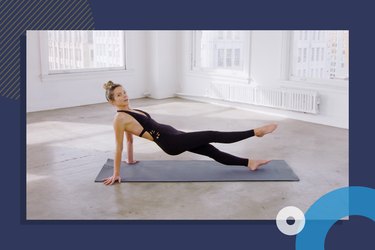
18. Side Bend
The side bend builds strength in the inner thighs, shoulder, lats and arms and increases flexibility. Because this exercise challenges your balance, it requires constant vigilance over your alignment and lengthens through your side.
- Sit on your mat with both knees bent and off to the left side, feet staggered (top foot forward).
- Lean onto your right hip and prop your torso up with your right arm.
- Place your buttocks, trunk and hand on the floor in a line toward the back edge of the mat.
- Using both your core and hips to remain stable, press up into a rainbow-shaped side plank, keeping the top arm alongside your body.
- On a slow inhale, turn the head left and try to rest the chin on left shoulder, lowering the body until the right calf touches the floor.
- Exhale slowly and return to side plank, bringing the left arm slowly overhead and alongside the left ear, lengthening through the fingertips.
- Come back to starting position, knees stacked and bent.
- Repeat 3 times before switching sides.
Tip
To make it easier, keep the lower leg bent with the knee on the floor, or you may come all the way down between side planks, leaving out the set with the calf touch.
19. Pilates Push-Up
The Pilates push-up is a terrific upper-body and abdominal exercise. It also works your triceps, shoulders, chest, abs, inner thighs and glutes. For a modification, "walk" forward on the hands as you roll down, bringing the knees to the floor and do your push-ups from the knees. If you cannot walk on the hands, regular kneeling push-ups will work.
- Standing at the foot of the mat with feet hip-distance apart, roll the chin down to the chest and roll down an imaginary wall, peeling the spine off that “wall” one vertebrae at a time.
- Once your hands reach the floor, walk out the hands in four “steps” into a plank position.
- Use your abdominals to support the spine as you hold your plank, squeezing the glutes and inner thighs and keeping the head and neck in line with the spine.
- Slowly lower down, taking your chest toward the floor until the chin touches the floor for three push-ups.
- Keep the hips locked, the head in line with the rest of the body and the trunk and legs rigid.
- After your third push-up, lift the waist up toward the ceiling into a pike and reverse the motion back to standing.
- Repeat the entire exercise 3 times, working up to more push-ups.