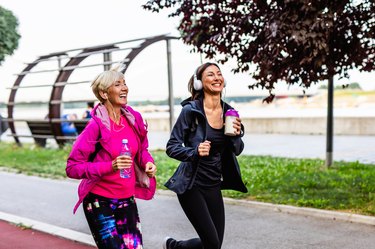
Ever wonder how exercise turns on so many of your body's key systems? Sweating and breathing hard are parts of a chain reaction initiated by your brain as you start to move. Here's a look at what happens in your respiratory system — lungs, airways and muscles that work together to enable breathing.
Effects of Exercise on Respiration
Video of the Day
Your lungs. The lungs are spongy organs situated on either side of the breastbone in the chest. The left lung, with two lobes, is slightly smaller than the right lung which is divided into three lobes, says the National Heart, Lung, and Blood Institute (NHLBI).
Video of the Day
The lungs cannot move on their own. Rather, they rely on contractions of muscles in the chest and abdomen in order to function properly, the institute explains. The lungs are surrounded by a thin double-layered membrane, called the pleura. This membrane protects the lungs and helps them move back and forth as air is inhaled and exhaled, says the National Center for Biotechnology Information (NCBI). The fluid between the layers of the membrane reduces friction during the breathing process.
Your muscles. The parasympathetic nervous system communicates to the diaphragm muscle and intercostal muscles, letting them know how quickly or how slowly to contract in order to adjust the rate of breathing to meet the body's needs, explains NCBI. During exercise, when the pace of breathing becomes more rapid, the abdominal muscles get involved to help with exhalation.
Your airways. Airways are the pipes that carry air into the lungs, explains NHLBI. They also carry waste (carbon dioxide) out of the lungs. Airways include the mouth, nose (the nasal cavity and sinuses), voice box, windpipe, bronchial tubes and smaller tubes called bronchioles that branch off the bronchial tubes.
Air enters through the nose or mouth and travels beyond the voice box, down the windpipe, into the bronchial tubes that feed the oxygen to each lung. From there, the bronchial tubes and bronchioles take over and carry the oxygen and carbon dioxide to where it needs to go.
Read more: Positive and Negative Effects of Exercise
Why Am I Breathing So Heavy?
When beginning a new exercise routine, the reality of your physical limitations may become quickly apparent. Plans to run a 5k may seem impossible if you can't catch your breath after running to the end of the block. But don't give up: Keep your goal of finishing a 5K but know you may need to give yourself a planned timetable to gradually build up your stamina.
Just like you have to train to build strength in the muscles of your arms and legs to lift heavier weights, you must train the muscles in your respiratory system to build stamina, says the American Lung Association. As your fitness improves, you'll be able to breathe more easily with vigorous physical activity.
Of course, you do want to make sure that the problem is nothing more than being new to exercise or to a greater demand that you're putting on yourself. "Difficulty in breathing after vigorous exercise may be related to your fitness level, asthma, overexertion or any number of other causes," explains Farhan Khabaz, MD, a pulmonologist and intensivist at St. Jude Medical Center in Fullerton, California.
Read more: Benefits of Deep Breathing
Before you make the assumption that you're out of shape and are experiencing a complete normal reaction, Dr. Khabaz suggests paying attention to your breathing and heart rate during and after exercise to help you be sure. "The key is how quickly does your breathing return to normal," he points out. "Breathing and heart rate should steadily slow after you stop, returning to normal within several minutes."
If you haven't been physically active in a long time or you experience shortness of breath after trying to run a 5K for the first time ever, then the obvious reason is your body struggling to meet the new demand. How can you tell if it's something else? "Watch for symptoms that aren't normally associated with exercise, even vigorous exercise, such as chest pain, heaviness or pressure, paleness, heart palpitations or dizziness," Dr. Khabaz says. "Those should not be ignored and should prompt a conversation with your doctor."
- Farhan Khabaz, MD, pulmonologist, intensivist, St. Jude Medical Center, Fullerton, California
- National Heart, Lung, and Blood Institute: “How the Lungs Work”
- National Center for Biotechnology Information: “Physiology, Exercise”
- National Center for Biotechnology Information: "Anatomy, Thorax, Lung Pleura and Mediastinum"
- American Lung Association: "Exercise and Lung Health"
Is this an emergency? If you are experiencing serious medical symptoms, please see the National Library of Medicine’s list of signs you need emergency medical attention or call 911.