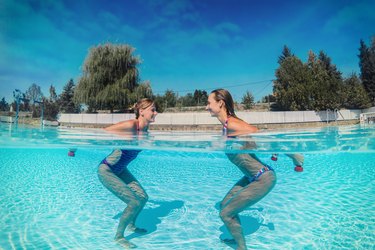
Though they may look easygoing on the outside, water aerobics offer a variety of health benefits, from stronger bones to better blood pressure.
Learn all about the benefits pool exercise — and the best workouts you can do in the pool.
Video of the Day
Video of the Day
Tip
If you're not a strong swimmer, it's best to perform all of these exercises in shallow water. You can also stand near the edge of the pool for extra balance and assistance as you try different moves.
3 Water Aerobics Workouts
1. Pool Walking
Walking comes with a host of benefits, including stronger knees and better sleep. And when you do it in water, you also reduce any excessive impact on your joints (more on that below).
- Stand in the water at chest level, facing the opposite end of the pool.
- Place one foot in front of the other and walk at a brisk speed back and forth across the length of the pool.
- As you walk, pump your arms at your sides like you're power walking.
Tip
You can make this beginner-friendly water exercise less intense by walking in more shallow water. Or, make this move a greater challenge by carrying a pair of pool hand weights, according to the Mayo Clinic. Try the Sunlite Sports High-Density EVA-Foam Dumbbell Set (Amazon.com, $19.97).
2. Skipping Rope
In the pool, you can get all the cardio benefits of jumping rope without any of the stress on your knees and hip joints. All you need is a hollow pool noodle. Try a five-pack of the Fix Find Pool Noodles (Amazon.com, $17.99).
- Stand in the water at shoulder level.
- Hold one end of a hollow noodle in each hand.
- Bring the noodle in front of your body with arms relaxed.
- Sweep the noodle under your body, while simultaneously jumping up and tucking your knees into your chest.
- Sweep the noodle overhead until it's back at the starting position and repeat.
To modify this exercise, you can do the same motion with no noodle at all, according to Swim England. That minimizes some of the resistance, making the motion easier for your upper body.
3. Treading Water
Treading water is no easy feat, and it works your entire body. If you're really up for a cardio- and upper-body challenge, wear a pair of webbed gloves to add even more resistance. Try TAGVO Aquatic Gloves (Amazon.com, $9.99).
- Stand in the water at chin level with your arms at your sides.
- Paddle your arms in front of your body and kick your legs until your body rises off the bottom of the pool.
- Continue to paddle your arms and legs as though you were swimming in place without letting your feet touch the bottom.
This is an intense aerobic exercise and can burn 450 calories or more in just half an hour, according to Harvard Health Publishing. Be sure to take breaks as needed, either placing your feet on the bottom or floating on your back.
Note: Treading water in shallower water is more challenging. So, if you want to modify this move, swim to deeper water. However, stay by the edge of the pool for extra assistance if needed.
4 Exercise Moves to Try in the Pool
Move 1: Jumping Jacks
- To target your lower body, you don't need to devote your entire aqua aerobics routine to thigh exercises in the pool. Instead, give jumping jacks a try to build total- (and lower-) body strength.
- Stand in the water at chest level with your feet together and arms at your sides.
- In an arc motion, bring your arms overhead as you jump your legs apart.
- With a quick rebound, reverse the motion and return to the starting position.
Tip
Thanks to the resistance of the water, this move definitely feels harder in the pool than it does on land. Take your jumping jacks a little slower in the pool than you might in the gym.
Move 2: Side Shuffle
Keeping you in a low squat, this exercise focuses on your thigh and butt muscles, including your quads, hamstrings and glutes.
- Stand in the water at thigh level.
- Bend your knees slightly and push your hips back into a half-squat position.
- Holding your upper body steady, quickly step sideways across the width of the pool.
- Reverse directions once you reach the other side and repeat.
Move 3: Alternating Scissor Jump
When you do it with good form, this lower-body pool thigh exercise should look a little like exaggerated jogging.
- Stand in the water at chest level with your feet shoulder-width apart and arms at your sides.
- Jump up and kick your left leg forward, driving your right arm forward with a bend in your elbow.
- At the same time, kick your right leg and left arm behind you.
- Land back in the starting position.
- Repeat on the opposite side, alternating between the two positions as quickly as possible.
Move 4: Butt Kicker
A hamstring-focused move, you might do butt kickers in your dynamic warm-up routine at the gym. In the pool, the water's resistance makes them even more challenging.
- Stand in the water at waist level, facing the side of the pool.
- Keeping your body upright, bend your right knee and kick your right heel up to your glutes.
- With control, lower your right foot back to the bottom of the pool and repeat on the opposite side.
- Quickly alternate your legs back and forth.
Tip
For this water aerobics exercise, you can hold the edge of the pool for extra balance.
4 Benefits of Water Aerobics Exercises
1. They Torch Calories
One big advantage of exercising in the pool? The water adds extra resistance, making all of your aerobic exercises a little more challenging.
The amount of calories you can expect to burn will vary, depending on factors like your weight, gender and exercise intensity, according to Harvard Health Publishing. You can use the chart below to get an idea of how many calories you can expect to burn after half an hour of aqua aerobics exercises.
Calories Burned
Weight | Calories Burned |
|---|---|
125 pounds | 120 |
155 pounds | 144 |
185 pounds | 168 |
215 pounds | 195 |
245 pounds | 222 |
2. They're Easy on the Joints
Swimming is a low-impact exercise that's easy on the joints, according to Harvard Health Publishing. When you jump or run, your joints absorb some of the ground's impact.
Thanks to the buoyancy of water, water aerobic exercises put less stress on your joints, like sensitive knees or hips. Pool workouts are ideal for older adults or anyone who experiences joint pain with higher-impact activities.
How Many Days a Week Should You Do Water Aerobics?
Considering water aerobics are easier on sensitive joints, you can do this form of exercise pretty often. As much as 3 to 4 sessions per week is generally safe for most people. However, if you have pre-existing medical conditions, it's best to confirm with a medical professional.
3. They Build Strength
When you think of strength training, you probably imagine dumbbells, barbells or kettlebells. But you don't need to spend hours in the gym to get stronger — water exercises do the trick, too.
Just like weights, water provides extra resistance, helping you build stronger muscles and bones, per Harvard Health Publishing. While you don't want to cut out other forms of exercise (like walking), aqua aerobics can be a little more advantageous, thanks to the built-in resistance factor.
4. They Can Reduce Blood Pressure
Doing water workouts a few times per week can have a positive affect on your blood pressure levels, according to a small May 2018 study in PLOS One. After a 12-week water aerobics program, participants significantly improved their blood pressure.
- Harvard Health Publishing: "Great Exercise That's Easier on the Joints"
- Harvard Health Publishing: "Calories burned in 30 Minutes for People of Three Different Weights"
- Swimming.org: "Tone Your Body With the Skipping Rope Exercise in Water"
- Mayo Clinic: "Aquatic Exercises"
- PLOS One: "The Effect of 12 weeks of Water-Aerobics on Health Status and Physical Fitness: An Ecological Approach"