Good posture can radically improve your overall physique. It's not just about appearance, either. Bad posture is the result of some muscles being too tight and others being too weak. This can set off a chain reaction in your entire musculoskeletal system, resulting in pain, nerve damage and loss of functionality.
While people tend to think of postural problems as an upper body issue, they can be equally attributed to imbalances from head to toes. But the shoulders and upper back are a great place to start on the road to good posture. Posture is best restored gently and gradually, beginning with isometric exercises before progressing to more challenging exercises that involve weights.
Video of the Day
Video of the Day
Read more: How to Fix the Worst Posture Mistakes
Shoulder Squeeze
Shoulder squeezes work the rhomboids (near your shoulder blades) and the middle trapezius muscles, which extend downward several inches from the below the neck and across to the shoulder tips.
- Stand with your feet hip-width apart (or sit) and raise your arms to your sides so they're at shoulder height.
- Bend your elbows so that your forearms are at a 90-degree angle and parallel to the floor.
- Slowly move your elbows back while squeezing your shoulder blades, making sure you feel the muscle contraction in your back.
- Hold for 3 seconds, then release and repeat.
Swiss Ball Robbery Pinch
The robbery pinch targets the lower trapezius, which pulls the shoulder down, keeping them from shrugging upward. For an advanced version, hold light dumbbells.
- Rest your lower abdomen on a Swiss ball with your chest protruding over the top.
- Point your elbows toward your back pockets and squeeze your shoulder blades together.
- Hold for 3 seconds, then release and repeat.
Reverse Wall Press
When combined with contraction of the abdominal muscles, this reverse wall press activates the serratus anterior and the upper trapezius muscles, both important for posture.
- Standing with your back against a wall, hold your arms out to the side at shoulder height.
- Contract your abdominal muscles and press your fingertips into the wall.
- Hold for 3 seconds.
Airplane
Airplanes strengthen the muscles surrounding the shoulders — between the shoulder blades and in the upper back.
- Lie on your stomach with your toes pointed inward toward each other.
- Stretch your arms out perpendicular to your torso with your palms down.
- Lift your head, arms, shoulders and upper back off the floor.
- Once elevated, reach your arms back behind you until you feel the flexion.
Seated Row
Seated row is a great all-around back exercise that works most of the stabilizing muscles up and down the spine.
- Sit on the bench of a row machine.
- Squeezing your shoulder blades together, pull the handles toward your chest, elbows tucked in toward your sides.
- Extend your arms, allowing your shoulder blades to relax fully.
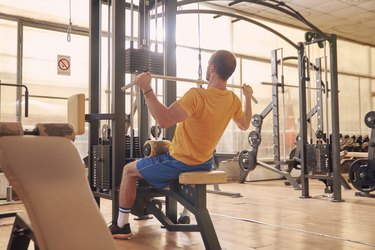
Lat Pulldown
As the name suggests, the lat pulldown works the latissimus dorsi. (muscles in your upper back, often called "lats"). Because they connect the spine to the humerus (upper arm bone), the lats can cause shoulder problems. Fully extending your arms at the peak of this exercise is important for keeping them stretched out.
- Hold the bar of a lat pulldown machine with both hands using a wide grip. Sit with your thighs under the supports.
- Pull the bar down toward your upper chest.
- Slowly release your arms upward until they're fully extended, but don't shrug your shoulders up.
Push-Up
Push-ups help strengthen your back and improve your posture in many ways. In addition to targeting the shoulders, they improve your core stability and stabilize your lower back (when done with proper form, of course).
- Lie face-down on the floor with your hands under your shoulders.
- Pushing straight up, use your arms to lift your body off your floor.
- Maintaining a straight back, bend your arms and slowly lower your chest to the floor.
Don't Forget Core Exercises
As anyone who embarks on a fitness regimen quickly discovers, everything is connected. While your postural problems may be most visible in your upper body, your core muscles such as the abdominals and glutes also play a role in supporting good posture and a well-balanced gait.
In addition to upper body exercises such as those mentioned above, be sure to round out your workout with crunches, leg lifts and planks that will provide a strong core.