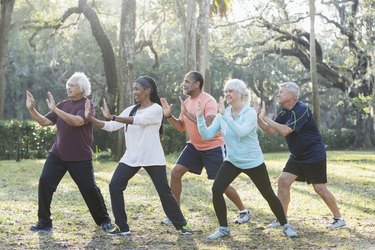
Tai chi, qigong and yoga are all ancient meditative practices that involve doing low-impact exercises that help strengthen your mind-body connection. Although they share similarities, they are different forms of mindful movement.
For example, yoga combines breathing techniques and poses (asanas) that not only help you de-stress but also improve your mobility, strength and balance, according to the National Center for Complementary and Integrative Health (NCCIH).
Video of the Day
Video of the Day
On the other hand, qigong consists of dynamic (active) and meditative (passive) movements that promote relaxation and focus, per the NCCIH. Considered an active form of qigong, tai chi is a series of standing exercises that flow from one move to the next and is paired with deep breathing, according to the Mayo Clinic.
Want to learn more about the differences between yoga and qigong, and qigong versus tai chi? Get the scoop on these meditative movements and their benefits.
Related Reading
The Origins of Yoga, Qigong and Tai Chi
Yoga
As a practice, yoga is rooted in Indian philosophy and has been around for thousands of years. There are many different types of yoga, including Vinyasa and Ashtanga, but all types are based on the Yoga Sutras of Patanjalix, written by sage Sri Swami Satchidananda.
According to this text, yoga is comprised of eight different limbs, which help you learn how to overcome stressful situations and live a life of purpose.
Yoga was created with the intention of joining your individual self (aka jiva) with pure consciousness (aka Brahman), according to the Sivananda Ashram, a part of the International Sivananda Yoga Vedanta Centres. So in essence, yoga connects your body, mind and spirit.
Qigong
Developed thousands of years ago, qigong was originally created as a part of traditional Chinese medicine, per the NCCIH. This meditative practice involves using exercise to enhance energy throughout your body and sharpen your focus.
Qigong can be both active and passive, depending on your personal preference. Tai chi (more on that below) falls within the active, movement-based side of the practice, while the passive aspect of the practice includes deep breathing and meditation. You can practice both active and passive qigong techniques together.
Tai Chi
Tai chi is actually a form of ancient Chinese martial arts and dates back more than 3,000 years to the Zhou Dynasty around 1100 to 1221 B.C., according to the Tai Chi for Health Institute.
Its principles are rooted in the Chinese philosophy of Taoism, which emphasizes the importance of maintaining a balance of the opposites yin and yang. The exercises harmonize the yin and yang by combining softer, fluid motions with more intense, challenging movements.
There are several styles of tai chi, but they all emphasize balance, whether that's literally finding balance with your body or in different parts of your life.
Tai Chi vs. Yoga: What Each Practice Looks Like
Yoga workouts are structured with a breath-focused, meditative portion at the beginning and end. In between breath work, you do a yoga flow, moving from one pose to another. There are hundreds of different yoga poses, like downward dog and cat-cow.
The poses in your flow and the amount of time you hold each pose depend on the type of yoga you're doing. For the most part, though, yoga blends seated and standing poses and inversions all in one practice. Yoga also requires very little equipment (all you need is a mat and a few props), so you can do this practice anywhere.
On the other hand, tai chi is generally practiced from a standing position. And while yoga involves holding static poses, tai chi has consistent movement throughout the practice, kind of like a slow-paced dance.
The main difference between the benefits of tai chi versus yoga is that tai chi might be a little easier on the body, depending on what style of yoga you're doing.
Qigong vs. Yoga: What Each Practice Looks Like
Yoga is a workout where you flow through a series of poses. This established structure is the main difference between yoga and qigong.
Qigong has both active and passive sides, and the nature of each session depends on what your body needs that day, per the NCCIH. Similar to tai chi, qigong is generally done standing, but the postures are more gentle and are mixed with deep breathing.
If you're debating between a qigong or yoga session, think about what your body needs. For example, if you're feeling particularly sore the day after a tough workout, qigong may be preferable. But if you want more intensity, choosing a faster-paced style of yoga, like Vinyasa, is the way to go.
Qigong vs. Tai Chi: What Each Practice Looks Like
As mentioned, tai chi is a more active form of qigong. Tai chi usually has some sort of warm-up, followed by a flowing series of standing exercises.
So, what's the difference between tai chi and qigong? Qigong is a little more customizable, depending on what you want to do that day. An entire qigong session can be completely passive, involving only breathing and meditation and no movement. Or, you can start with a passive practice and move through different choreographed postures. In other words, there are no hard-and-fast rules.
Related Reading
The Benefits of Yoga, Qigong and Tai Chi
1. Enhances Balance
All three of these mind-body practices are an excellent way to build balance, which is especially helpful for older adults, who are at higher risk of falls and fall-related injury.
As you age, being steady on your feet is crucial. According to a January 2016 systemic review and meta-analysis in Age and Aging, older adults who did yoga saw small improvements in their balance and mobility..
But for those who may not be able to comfortably get down to the ground, tai chi and qigong (which mainly involve standing movements) are good balance-building alternatives that move your entire body. Regular qigong practice can improve your overall balance and help prevent fall-related injury, per the NCCIH.
2. Decreases Stress and Anxiety
The calming and restorative movements of yoga can also help decrease stress and promote relaxation.
According to a small February 2018 study in the International Journal of Preventative Medicine, women who did just three sessions of Hatha yoga a week for four weeks significantly decreased their depression, stress and anxiety symptoms.
The breathing exercises and meditative flows in qigong and tai chi have similar effects. Researchers of a March 2014 study in Psychiatric Clinics of North America found that both practices can help promote relaxation and may benefit symptoms of anxiety and depression.
3. Builds Muscle Strength
Tai chi, yoga and qigong can help build total-body strength. After 12 weeks of yoga practice, participants improved their cardiovascular endurance and muscular strength and endurance, according to a June 2015 study in Evidence-Based Complementary Alternative Medicine.
Similarly, qigong can help improve both upper- and lower-body strength, much like resistance training, according to Harvard Health Publishing. Considering most qigong and tai chi exercises are done standing, they can be especially helpful in improving your core strength.
4. Improves Mobility and Flexibility
Alongside increased strength, yoga is a great way to improve your flexibility, according to the Mayo Clinic. Many yoga poses focus on gradually and gently building your body's range of motion.
Thanks to various overhead reaching movements, a regular tai chi practice can also help improve your overall flexibility, especially in your spine, according to a February 2021 review in BMJ Open Sport & Exercise Medicine. The slow and steady standing postures in tai chi can also help open up different areas of your body, improving your overall mobility.
5. Promotes Good Posture
Because of the way many yoga poses are performed, they encourage better posture, according to Carolina Araujo, CPT, a California-based personal trainer and yoga practitioner.
"Many yoga poses involve pulling your shoulders down and back away from your ears while keeping your back flat," she says. "That's exactly what I tell my training clients when they need help sitting and standing with better posture."
Similarly, many tai chi motions also encourage better posture, according to Harvard Health Publishing. Tai chi encourages holding your head over your torso, undoing a lot of the forward-leaning tendencies we may develop sitting at a computer all day.
Incorporating Mindful Movement
Although tai chi, qigong and yoga share many similar benefits, they have different origins and movements that may help you pick which practice is best for you.
Tai chi is a form of qigong and involves flowing through a series of movements, according to Piedmont. Qigong, however, is a somewhat broader practice that includes deep breathing and can be used toward a specific health goal (like increasing your lung capacity).
So, if you have a specific health issue you want to focus on, qigong is probably the best form of movement for you. But if you want to improve your overall balance and strength, tai chi and yoga are better choices.
Yoga and tai chi are a little more fitness-focused than qigong, according to Araujo. Yoga is a more holistic form of movement that combines strength, balance and breath work. There are also plenty of different yoga types — some are strength-based, while others are more restorative, so you can choose whichever practice suits your goals.
"For the most part, mindful exercise is low-impact and friendly for all ages and fitness levels," Araujo says. "Although some yoga poses can be a little more challenging and strenuous, you can choose flows or classes that feel comfortable for your level."
Try a mix of all three mindful movements throughout your week, Araujo recommends. If you don't want to settle on one exercise alone, there's no rule that says you can't mix elements you like from each practice.
- NCCIH: "Yoga: What You Need To Know"
- NCCIH: "Qigong: What You Need To Know"
- Mayo Clinic: "Tai Chi: A Gentle Way to Fight Stress"
- Sivananda Ashram: "YOGA"
- Tai Chi for Health Institute: "History of Tai Chi"
- Age and Aging: "Yoga-Based Exercise Improves Balance and Mobility in People Aged 60 and Over: A Systematic Review and Meta-Analysis"
- Harvard Health Publishing: "The Health Benefits of Tai Chi"
- Piedmont: "The Difference Between Tai Chi and Qi gong"
- Psychiatric Clinics of North America: "Tai Chi and Qigong for the Treatment and Prevention of Mental Disorders"
- BMJ Open Sport and Exercise Medicine: "Effect of Tai Chi on Muscle Strength, Physical Endurance, Postural Balance and Flexibility: a Systematic Review and Meta-Analysis"
- Harvard Health Publishing: "Proper Posture the Tai Chi Way"
- Evidence-Based Complementary Alternative Medicine: "Effects of a 12-Week Hatha Yoga Intervention on Cardiorespiratory Endurance, Muscular Strength and Endurance, and Flexibility in Hong Kong Chinese Adults: A Controlled Clinical Trial"
- International Journal of Preventative Medicine: "The Effect of Yoga on Stress, Anxiety, and Depression in Women"