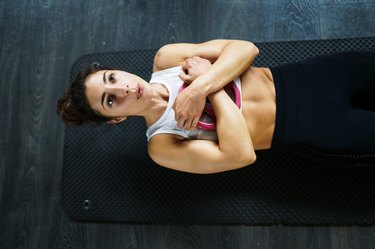
Don't be surprised when you have abdominal pain after an ab workout — your muscles are adjusting to the stress that you just put on them. You might have pain as you tax your muscles during the workout and for a few days after, a phenomenon known as delayed-onset muscle soreness.
Read more: The 41 Hardest Ab Exercises
Video of the Day
Video of the Day
Abdominal Pain After Core Workout
That burning and stomach pain after an ab workout is known as acute soreness, according to the American College of Sports Medicine. The pain that you feel starting to develop between 12 and 24 hours after the workout, however, is delayed-onset muscle soreness, or DOMS. It often peaks between 24 to 72 hours after the ab workout. Not only can it appear after doing an ab workout for the first time, but also if you increase resistance — such as using a weight during crunches — or the number of repetitions.
DOMS likely occurs because of microscopic damage to your abdominal muscle fibers from the stress of the exercise, whether it was crunches, planks or another exercise. As your muscles repair themselves, you feel the ache of soreness. In addition to the pain, you might experience swelling, stiffness, tenderness to the touch and temporary reduction of strength in your ab muscles, according to ACSM.
Read more: Is it Bad to Work Out with Sore Muscles?
DOMS vs. Injury
Don't mistake an injury for DOMS — if you have serious abdominal pain after a core workout, you might need to see a doctor. Johns Hopkins Medicine says that if the pain is lasting a long time and affecting your performance, it might be an injury, such as a muscle tear.
Other signs to watch out for include pain that doesn't go away with rest, continues to get worse or requires an increasing amount pain medication, as well as developing tingling or numbness in the affected muscles. Cleveland Clinic also notes that reasons to be concerned include pain paired with pressure and bruising or pain that is so intense that it causes nausea or vomiting.
Treating Sore Muscles
You don't have to completely refrain from exercise while you have sore muscles, but if it's painful, take a few days off to let your muscles rest and recover. If you do choose to exercise, Johns Hopkins Medicine suggests making it a light workout rather than going hard on the same part of your body.
Read more: How to Ease Muscle Soreness After a Workout
Additionally, gentle stretches for your abdominal muscles might help the pain subside, suggests the Cleveland Clinic.Try the cobra stretch, which targets your ab muscles, according to the American Council on Exercise:
- Lay on your stomach on an exercise mat. Position your hands directly under your shoulders with your hands pointed forward.
- On the exhale, press your hips into the mat and use your hands to push your chest up and away from the ground.
- Hold the position, feeling the stretch in your abdominal muscles, for 15 to 30 seconds.
- Gently lower your upper back and return to the starting position.
Other strategies to help relieve pain caused by DOMS include applying ice to reduce inflammation, heat to increase blood flow to your muscles and the use of a non-steroidal anti-inflammatory drug, such as ibuprofen.
Was this article helpful?
150 Characters Max
0/150
Thank you for sharing!
Thank you for your feedback!