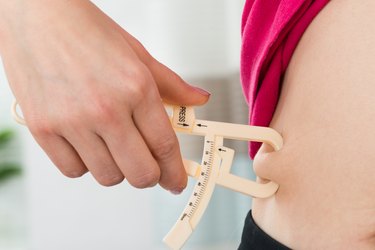
Skinfold measurement equations can help produce a relatively accurate estimate of body fat as long as the measurements are taken correctly. Two equations are required for this process -- one to estimate body density and one to estimate percent body fat from the body density. Professionals use a variety of different equations depending on how many skinfold sites are taken and the gender, age and ethnicity of the person being measured.
Skinfold Measurement Equations and Gender
Video of the Day
Women typically have more body fat than men and often carry it in different locations. Because of this, there are different skinfold sites for men and women along with different equations for each gender. For example, a three-site formula developed by Andrew Jackson and M. L. Pollock for women involves calculating body density using the sum of measurements taken at the triceps, thigh and suprailium, but the corresponding formula for men uses skinfold sites at the abdomen, chest and thigh. The suprailium site is located on the back above the hip bone.
Video of the Day
Number of Skinfold Measurements
The use of three skinfold sites is common in many of the skinfold measurement equations, including multiple equations using different combinations of three sites, but this isn't the only option. Some equations use just two sites, while others use four or even seven sites. The American Council on Exercise notes that the formulas developed by Jackson and Pollock using three sites tend to be the most accurate for the general population.
The Jackson and Pollock equation to calculate body density in women is: 1.0994921 - (0.0009929 x the sum of the skinfold sites in millimeters) + (0.0000023 x the sum squared) - (0.0001392 x age). For men, it's: 1.10938 - (0.0008267 x sum) + (0.0000016 x sum squared) - (0.0002574 x age). Once you've calculated body density, you calculate percent fat by using the equation [(495 / body density) - 450] x 100.
Online Tools for Calculating Body Fat Percentage
To make the process of determining body fat levels from skinfold measurements easier, you can use an online calculator. This simply involves plugging in the skinfold measurements along with the gender, age and weight of the person measured. These calculators provide percent body fat as well as estimated lean mass and fat mass.
Some websites also have tables you can use to simplify the process. For example, the American Kinesiology website has a table that can help determine the body fat percent of teenagers by using the sum of skinfold measurements taken at the triceps and calf.
Other Potential Considerations
The precision of the measurements determines how accurate the final result is, so it's best to have a highly trained professional take your measurements and to consult the same person each time you have your body fat tested. It's easy for inexperienced people to measure at the wrong place or to get a pinch that is larger than it should be.
The general equations used for predicting body fat with skinfold measurements aren't as accurate in younger people, older adults or people who have underweight or have obesity. In these groups, it's best to use specialized equations rather than the general ones. For even greater accuracy, you can use equations that take into account age, ethnicity and gender, rather than just age and gender.
- University of Michigan: Alternative Skinfold Measurement Formulas to Calculate Percent Body Fat
- South Dakota State University: Body Composition: Skin-Fold Measurements
- American Council on Exercise: Percent Body Fat Calculator: Skinfold Method
- American Kinesiology: Body Composition, Physical Activity, and Nutrition