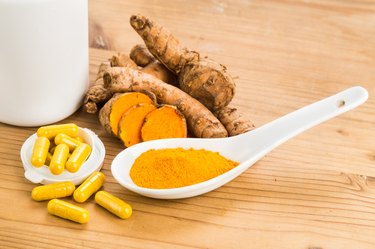
Spice lovers all over the world have long used powdered or grated turmeric to add color and a deep, earthy flavor to food. However, the spice's uses and benefits go well beyond the culinary: Turmeric and curcumin — its yellow pigment — are available as supplements, which people take to ease digestive problems, speed wound healing, soothe skin diseases, treat liver conditions, and more.
But are turmeric and curcumin's purported health benefits based on fact, or are they just folk medicine? Keep reading to learn more about the potential medicinal uses of turmeric and curcumin supplements.
Video of the Day
Video of the Day
Turmeric and Curcumin
As the National Center for Complementary and Integrative Health (NIH) explains, turmeric is native to Southeast Asia and grown mostly in India. A plant in the ginger family, its underground stem is used to make the common spice that's a major ingredient in curry powder.
The substance curcumin is a main component of turmeric; curcumin gives the popular spice its beautiful yellow-orange color. As a curcuminioid, it also contributes to the spice's uses and reputed health benefits. But as the NIH notes, "Much research has been done on substances from turmeric, but their health effects remain uncertain... Because the actions of turmeric and its components in people are complex and not well understood, no clear conclusions have been reached about whether these substances have benefits for health conditions."
Turmeric Uses and Benefits
Scientific proof aside, turmeric and curcumin have long been viewed to improve health in naturopathic practices such as Ayurveda and traditional Chinese medicine.
Limited research does seem to back up some of the claims about the spice's benefits on human health. For example, a small study of men, published in the November 2020 issue of the journal Antioxidants, concluded that, as a proven antioxidant, curcumin may indeed have a positive impact on oxidative stress, which can damage cellular structures. "Pure curcumin has the potential to ... increase total antioxidant capacity," researchers wrote. "Further research, however, is necessary."
Often used to soothe dyspepsia, turmeric also shows promise in helping relieve the symptoms of indigestion, gas and bloating. "Current evidence suggests that curcumin has a positive albeit not statistically significant effect (compared to placebo) on IBS [irritable bowel syndrome] symptoms, alleviating pain and improving quality-of-life scores in patients with at least moderate symptom severity," notes a meta-analysis published in the October 2018 issue of the Journal of Clinical Medicine. "With its unique antioxidant and anti-inflammatory activities and ability to modulate gut microbiota, it is a potentially useful addition to our [tools] for managing IBS." These researchers, too, admitted that their findings were based on limited evidence, and agreed that more robust research is needed.
Turmeric's anti-inflammatory properties make it a promising potential treatment for osteoarthritis (OA). In January 2021, a panel of reviewers published in BMJ Open Sport & Exercise Medicine concluded, "Compared with placebo, there appears to be a benefit of turmeric on knee OA pain and function. Based on a small number of studies the effects are similar to that of NSAIDs."
Turmeric is also being studied as a preventative and treatment for cancer. "Extensive research over the past two decades suggests that curcuminoids, the active ingredient in turmeric ... interfere with multiple cell signaling pathways, providing support for the potential role of curcumin in modulating cancer development and progression," writes the National Cancer Institute.
Turmeric Spice and Supplements
The recommended turmeric or curcumin dose depends on the form of the supplement you are using. "While doctors commonly recommend taking 500 milligrams twice daily with food, the dose that's right for you depends on your overall health," writes the Cleveland Clinic. "More isn't always better, so talk to your doctor... It's safe to take up to 8 grams per day, but [our] recommendation would be somewhere on the lighter side: 500 to 1,000 milligrams a day for the general population."
Johns Hopkins Medicine, meanwhile, recommends consuming turmeric and curcumin in food form. "Incorporating the spice regularly into your meals can safely boost your intake," they observe. "It's better to get curcumin and most other nutrients in whole food form rather than to take turmeric pills, tinctures, capsules or gummies."
The amount of curcumin in turmeric is variable. Your doctor can recommend a turmeric form, and an appropriate dosage, to address your health concerns. Research capsules and supplements before purchase to ensure that you are getting the most bioavailable supplement possible, but keep in mind that claims like these are not approved by the FDA.
Whichever form of turmeric or turmeric supplement you choose to consume — fresh root, spice powder, tea or pills — take it as directed by your health practitioner and in accordance with the label directions, and monitor yourself for side effects.
Turmeric and Curcumin Supplement Side Effects
Per the National Library of Medicine, turmeric is "generally recognized as safe" by the U. S. Food and Drug Administration. However, turmeric and curcumin supplements should not be taken by certain individuals. For example, do not take a turmeric or curcumin supplement if you are pregnant, breastfeeding or have gallstones or blocked bile ducts, warns Mount Sinai.
There's more. "Taking large amounts of turmeric and curcumin in supplement form for long periods of time may cause stomach upset and, in extreme cases, ulcers," they warn. "When combined with medications for diabetes, turmeric could cause hypoglycemia (low blood sugar). Because turmeric may act like a blood thinner, you should stop taking it at least two weeks before surgery."
Turmeric and curcumin can also strengthen the effects of blood-thinning drugs, increasing your bleeding risk, they warn. And it can increase your levels of stomach acid and interfere with the action of acid-reducing drugs.
Always consult your primary care physician before starting any dietary supplement, to ensure that it is safe for you.
Related Reading
- National Center for Complementary and Integrative Health: "Turmeric"
- Antioxidants: "Antioxidant Potential of Curcumin—A Meta-Analysis of Randomized Clinical Trials"
- Journal of Clinical Medicine: "A Meta-Analysis of the Clinical Use of Curcumin for Irritable Bowel Syndrome (IBS)"
- BMJ Open Sport & Exercise Medicine: "Therapeutic Effects of Turmeric or Curcumin Extract on Pain and Function for Individuals with Knee Osteoarthritis - a Systematic Review"
- National Cancer Institute: "Curcumin (Curcuma, Turmeric) and Cancer (PDQ®)–Health Professional Version"
- National Library of Medicine: "Turmeric"
- Mount Sinai: "Health Library - Turmeric"
- Cleveland Clinic: "7 Health Benefits of Turmeric"
- Johns Hopkins Medicine: "Turmeric Benefits"