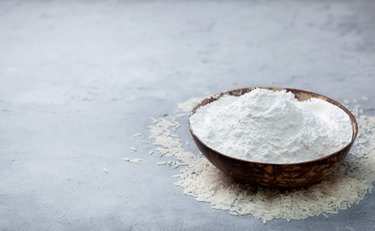
Bakers on a gluten-free diet have a lot of choices, including coconut, almond, buckwheat, chickpea, quinoa and oat flours — and many more. Rice flour is a go-to gluten-free flour for many bakers, but it has its pluses and minuses, nutritionally. There is also a limit to what you can bake with it.
Tip
Rice flour is gluten free.
Video of the Day
Rice on a Gluten-Free Diet
Rice is a popular grain for people on a gluten-free diet. All types of rice in their natural state are gluten-free. Therefore, you can confidently add rice flour to your gluten-free foods list.
Video of the Day
Although all types of rice can be made into flour, you will only typically find white rice flour and brown rice flour on grocery store shelves. These are the most common types used in baking.
White rice and brown rice flours differ both nutritionally and in how they perform in baked goods. This has to do with how they are processed — or not processed.
Brown rice is a whole grain that undergoes very little change from its natural state during processing. It retains all three parts of the grain — the bran, germ and endosperm. The bran is the outer covering that is rich in fiber.
The germ is the core of the grain that contains most of the nutrients, including B vitamins, vitamin E, healthy fats and antioxidants, according to the Harvard T.H. Chan School of Public Health. Finally, the endosperm provides primarily starch with a little protein and vitamins.
Read more: 10 Best New Gluten-Free Foods
White rice begins as a whole grain, but it is then milled to remove the bran and germ. This gives it its white, polished appearance and a finer texture. However, with the bran and germ removed, white rice has significantly less nutritional value than brown rice.
For example, according to the USDA, one cup of brown rice flour has 11.4 grams of protein and 7.3 grams of fiber compared to one cup of white rice flour which has 5.9 grams of protein and 2.4 grams of fiber. Brown rice also has more than three times the amount of iron and four to five times as much magnesium, phosphorus, zinc and most of the B vitamins.
Tip
Always check the labels of the rice products you choose. Occasionally you will come across naturally gluten-free foods that are processed in a plant that also processes wheat. In this case, you cannot be 100 percent sure that it is free from gluten. The Celiac Disease Foundation recommends looking for a gluten-free label and reading the ingredients list to make sure there are no gluten-containing ingredients.
Baking With Rice Flour
Brown rice flour is definitely the healthier gluten-free diet choice, but it does have some drawbacks for baking and it won't work in all recipes in which white rice will work. Here are a few of the main differences:
- White rice has a more mild, neutral flavor than brown rice, which has a slightly nutty flavor. This flavor may come out in some recipes with other mild tasting ingredients but not in others with stronger flavors.
- Brown rice flour is somewhat heavier than white rice flour because it contains all three parts of the grain. This means it's not the best flour for making light, airy cakes. But it's one of the best gluten-free flours for bread, brownies and cookies.
- Both brown and white rice flours tend to have a slightly grainy texture compared to wheat flour. Because brown rice is more fibrous, it can be slightly more grainy. It's not the best choice for more delicate, light baked goods.
In most recipes, brown and white rice flours have to be combined with other gluten-free flours in order to get the right rise and texture. A flour blend suitable for a gluten-free diet might contain both white and rice flour, in addition to potato starch and tapioca flour. Xanthan gum is often added to replicate the elasticity gluten gives to baked goods and to bind the flour, hold moisture and provide structure.