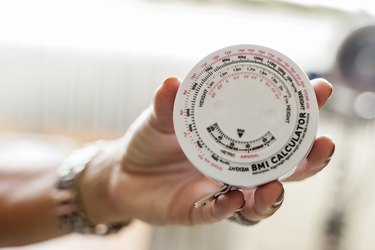
Body mass index -- BMI -- is a measurement used by doctors to classify a patient as underweight, overweight or right on target. Body frame size is not used when calculating BMI; instead, you can figure out your BMI using your height and weight. The BMI measurement does not take into account body composition or sex differences, so its accuracy is debatable.
BMI Breakdown
Video of the Day
BMI is based on the concept that your body weight should be proportional to your height. Using the metric system to calculate BMI, you would use your weight in kilograms divided by your height in meters, squared, using this equation: BMI = [weight in kilograms / (height in meters)2].
Video of the Day
To use pounds and inches, multiply 703 times your weight in pounds divided by your height in inches, squared. The equation is: BMI = weight in pounds / (height in inches X height in inches) X 703.
For men and women 20 years and older, BMI is interpreted using these categories:
- Below 18.5 = Underweight
- 18.5 to 24.9 = Healthy Weight
- 25.0 to 29.9 = Overweight
- 30.0 and Above = Obesity
For example, the equation for a 5-foot 10-inch man at 185 pounds would be: BMI = 185 / (70 X 70) X 703 = 26.5.
With a BMI of 26.5, this man is considered overweight. However, the BMI measurement does not account for the weight of water, bone or muscle. Keep in mind that muscle is denser and thus weighs more than fat, so a person who strength trains frequently may be classified as overweight according to BMI, yet actually have a healthy body weight.
Calculate Ideal Body Weight Range Using Frame Size
Factors that influence a person's ideal body weight -- IBW -- include height, sex, age, body frame, body type and activity level. Since body weight fluctuates depending on these variables, your IBW actually lies within a range. You can figure out your IBW range using your height and a sex-specific equation. Men use 106 pounds as a baseline for the first 60 inches -- 5 feet -- of height, and then add 6 pounds for every inch over 5 feet. Likewise, women use 100 pounds as a baseline, and then add 5 pounds for every inch over 5 feet. A person under 5 feet tall would use 100 pounds as a baseline, and then subtract 2 pounds for each inch under 5 feet.
As an example, for a man who stands 5 feet 10 inches: IBW = 106 + (10 X 6) = 166 pounds
And for a woman who stands 5 feet 8 inches: IBW = 100 + (8 X 5) = 140 pounds
Body frame size influences your ideal weight range. A simple and straightforward method to determine your frame size is wrist measurement. Wrap your thumb and middle finger around your wrist, just above the wrist joint. If the fingers overlap, then you have a small frame. If they just meet, then you have a medium frame. If your thumb and finger don't meet, then you have a large body frame.
The equation gives the IBW for a medium-framed adult. A large-framed adult will add 10 percent to the IBW for a target weight range; in contrast, a small-framed adult will subtract 10 percent.
As an example, for a large-framed woman standing 6 feet tall: IBW = 100 + (12 X 5) = 160 pounds. Her IBW range is 160 to176 pounds.
BMI for Men vs. Women
BMI measurements aren't perfect. For both men and women, research has demonstrated errors when BMI is used to classify body weight. According to a 2012 publication in PLOS One, BMI generally underestimates obesity in women. In the study, BMI measurements were compared to dual energy X-ray absorptiometry scan results. DEXA scans distinguish between bone and muscle mass, and give a precise measure of percent body fat. Nearly half of the women included in the study were actually overweight according to their body fat percentage, yet classified as normal weight by BMI. For different groups of men in the study, BMI measurements over- and underestimated obesity compared to actual percent body fat measures by DEXA.
A healthy body fat percentage is different for men and women. Women's bodies actually require more body fat to maintain menstruation and the ability to have children. Considering this physiological difference, using the same equation and BMI ranges for both sexes may not be appropriate.
Alternatives to Using BMI
To determine weight-related health risks, you can use waist circumference as an alternative to BMI. According to "Medical News Today," waist size and waist-to-height ratio are better indicators for health risks related to your weight than BMI. Men with waists larger than 40 inches and women whose waists are larger than 35 inches are at increased health risk, according to the National Heart, Lung and Blood Institute.
Other options for measuring percent of body fat include using calipers, or the skin-fold method. This typically involves measuring the thickness of skin folds at different places on the body. More expensive, yet precise, options include DEXA and underwater weighing, but these aren't practical for most people.
- Medical News Today: Why BMI is Inaccurate and Misleading
- CDC: About Adult BMI
- Nutrition411: Ideal Body Weight (IBW) and Adjustments for Adults
- PLOS: Measuring Adiposity in Patients: The Utility of Body Mass Index (BMI), Percent Body Fat, and Leptin
- TIME: Americans May Be Fatter Than We Think, Study Says
- ACE: What are the Guidelines for Percentage of Body Fat Loss?
- NIH: Classification of Overweight and Obesity by BMI, Waist Circumference, and Associated Disease Risks