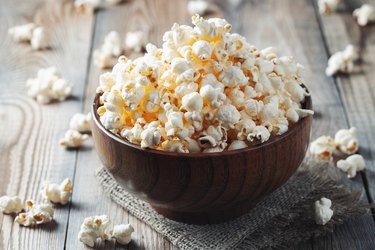
Whether you're in need of a movie night snack or are feeling peckish after lunch, air-popped popcorn is perfect for munching on. Low in calories and high in fiber, popcorn can be perfectly healthy if you prep it without too much butter or salt and eat it in moderation.
While movie theater butter may be tempting, stay away from too many toppings to keep your popcorn healthy. But if you're looking to add some flavorful seasoning to your snack, make it yourself and enjoy it right off the stove.
Video of the Day
Video of the Day
The Fiber in Popcorn
Women need 25 grams of fiber per day while men need 38, per Harvard Health Publishing. And a cup of air-popped popcorn totals only 31 calories with 1.2 grams of fiber, which is about 3 to 5 percent of the daily recommended value, according to the USDA.
Popcorn can be a good source of fiber, depending on how much you eat. Currently, a food that provides 10 to 19 percent of the daily recommended value is considered a "good source," according to the FDA, so you'll need about so you'll need to eat about four cups of air-popped popcorn (which is only 124 calories) for your snack to be considered a good source of the nutrient.
Read more: 19 High Fiber Foods — Some May Surprise You!
You're probably aware that fiber is a healthy nutrient, but what does it actually do for your body? Fiber is a type of carbohydrate that's naturally found in many plant food. But while other carbs are quickly digested by the body, fiber is slowly processed in your intestines, which is why it keeps you feeling satiated.
Fiber is classified as either soluble or insoluble in form, according to the Mayo Clinic. Soluble fiber — found in oats, peas and beans — dissolves in water, forming a gel-like material that can help lower cholesterol levels. On the other hand, insoluble fiber — found in popcorn, cauliflower, green beans and potatoes — doesn't dissolve in water but helps keep the digestive system regular.
How to Make Popcorn at Home

While there seems to be plenty of healthy popcorn options on the market these days, nothing beats making your own at home right on the stove. This Grecian popcorn recipe takes 11 minutes to make and requires only a handful of ingredients.
This recipe is not only high in fiber but healthy, unsaturated fat, too. Unsaturated fats can benefit your cholesterol levels, inflammation levels and overall heart health but can also help keep you satiated, according to Harvard Health Publishing. This is the perfect movie night snack, in our book.
Get the Grecian Popcorn recipe and nutrition info here.
Read more: List of Foods High in Soluble Fiber
- Harvard Health Publishing: "The Truth About Fats: the Good, the Bad, and the In-Between"
- Mayo Clinic: "Dietary Fiber: Essential for a Healthy Diet"
- USDA MyFoodData: "Snacks, Popcorn, Air-Popped"
- FDA: "CFR - Code of Federal Regulations Title 21"
- Harvard Health Publishing: "Should I Be Eating More Fiber?"