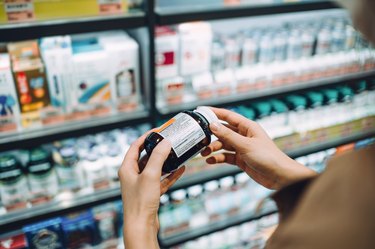
Many people take vitamins and supplements, be it a multivitamin or a specific pill to help with nutrient deficiencies or certain health conditions. But are supplements safe? The short answer is not always, which is why it can be tricky to find a vitamin brand you can trust.
Dietary supplements include vitamins, minerals, herbs, amino acids and enzymes, per the U.S. Food and Drug Administration (FDA). And they're common — about half of U.S. adults take them, according to Harvard Health Publishing.
Video of the Day
Video of the Day
But it can be easy to make mistakes when taking supplements, like taking one that you don't actually need or that isn't effective. That's because most vitamins are not FDA-approved or regulated before they hit the market, meaning the administration doesn't have the authority to review supplements for safety and effectiveness before they're sold.
Why aren't vitamins FDA-approved? Well, it's up to supplement manufacturers to make sure their products are safe before they go to market, per the FDA.
If a supplement contains a new ingredient, though, the manufacturer must notify the FDA so they can review (but not approve) it for safety. And if the FDA finds that a supplement is unsafe, it can issue a warning or require that the product be taken off the market, per the National Center for Complementary and Integrative Health (NCCIH).
But none of these reviews check for effectiveness, which means you're often left to wade through scientific jargon and marketing lingo on your own to determine if a supplement is legit.
That's where we come in. Here, LIVESTRONG.com asked experts to break down the red flags that may tip you off that a supplement is unsafe or ineffective.
Should You Take Supplements?
It can feel like there's a new pill, powder or gummy popping up every day claiming to support your health. But should you even take supplements?
"There's no population group that specifically needs supplements other than those with a documented vitamin or mineral deficiency who are ordered by their doctor to take supplements," says Andrea Paul, MD, physician and medical advisor for Illuminate Labs.
"Certain supplements can be a good first-line solution to some health problems, as they tend to have fewer side effects than pharmaceutical drugs. But purity is much more of an issue with supplements than with prescribed drugs," she says.
In short: Talk to your doctor before taking a supplement, and make sure it's a good-quality product.
1. There's a Lack of Research to Back It Up
Reputable manufacturers should have published test results that prove their supplements are safe and effective.
"There's a significant amount of clinical research suggesting that many supplements are adulterated or high in contaminants," Dr. Paul says. "Without test results proving the label accuracy and purity of the products, consumers have no way to ascertain the safety of a supplement."
If you're wondering whether a supplement might do more harm than good, Dr. Paul recommends reaching out to the manufacturer directly and asking them to provide test results.
"If manufacturers send a Certificate of Analysis (CoA), that's another red flag, as this document is not the same as test results," she says. "It's a document provided by suppliers detailing what should be in the supplement, not proving what's actually in it."
When you do find research that appears to support the use of a particular supplement, there are still more red flags to look out for. For example, you should be skeptical if the research cites studies that aren't peer-reviewed, if it fails to consider different types of individuals or groups and if it draws conclusions based only on one study, per Tufts University's Gerald J. and Dorothy R. Friedman School of Nutrition Science and Policy.
2. The Supplement Hasn't Been Quality Tested
Although the FDA doesn't regulate supplements before they hit the market, it does set something called Current Good Manufacturing Practices (CGMPs). These guidelines include requirements for supplement preparation and storage.
A trustworthy supplement should be CGMP-compliant, meaning that it has been quality tested and verified by one or more of the following groups:
- National Science Foundation (NSF): Tests and reviews supplements for safety, effectiveness, quality and sustainability or performance.
- Consumer Lab: Checks for identity, strength, purity and if the supplement disintegrates appropriately in the body.
- United States Pharmacopeial Convention (USP): Verifies that supplements contain the ingredients listed on the label, are CGMP-compliant, are free of harmful levels of contaminants and will absorb into the body properly.
Tip
If a supplement complies with CGMPs and has been third-party tested, that information will appear on the label or the manufacturer's website.
3. The Label Makes Wild or Miraculous Claims
The labels on dietary supplements can't make claims about treating, curing or preventing any disease, according to the NCCIH. Only drugs are allowed to make those kinds of statements. As a result, it's best not to trust any supplement that makes promises that seem too good to be true.
"Most of these claims end up to be false unless there are verified studies that support those claims," says Reuben Chen, MD, a board-certified physician.
Supplement labels can only make statements that describe the relationship between a substance in the supplement and the reduced risk of a specific condition, per the NCCIH. And those claims have to be backed by scientific evidence. For example, a label can say that calcium may lower your risk for bone-related conditions.
How to Spot a False Promise
Per the NSF and Tufts University, here are some buzzwords to look out for that may indicate a supplement is making a far-fetched claim:
- "Pharmaceutical strength:" There is no such thing as pharmaceutical-strength over-the-counter supplements.
- "Promise" or "guarantee:" Many supplements swear they'll help you become thinner, stronger, smarter or otherwise "improved" in some way. These promises are typically false.
- "Quick fix:" This type of language takes advantage of wishful thinking by suggesting that a supplement is an easy cure for a problem.
4. The Label Says the Ingredients Are All-Natural
While there is a long and valuable history behind the use of plants as medicine, that doesn't always mean that plant-derived or "natural" ingredients are safe or beneficial for your health.
In fact, the term "all-natural" isn't regulated by the government, so the phrase by no means guarantees a supplement's safety (or that the product even contains natural ingredients to begin with), per the NSF.
What's more, some natural herbal supplements have failed to show any real benefits when scientists have studied them, per the NCCIH.
For example, many studies of the benefits of echinacea, an herb that is popularly used for the common cold, showed little evidence that it could help treat a cold, per the NCCIH. And kava, a plant native to the islands of the South Pacific that has been used for anxiety, may be linked to severe liver damage.
Tip
Curious what other herbal supplements may not live up to the marketing? Check out these NCCIH factsheets and talk to your doctor before trying any supplement to make sure it's safe for you.
5. It Contains Unregulated Ingredients
One risk of using supplements is that they may contain unregulated ingredients, which can be harmful to your health, per the Virginia Department of Health.
"Many companies use poor quality or even illegal ingredients, as much of this stuff is not regulated," says Kylene Bogden, RDN, cofounder of FWDfuel. "There is no way to know how this might affect you."
What's more, the product labels may be incorrect. For instance, an April 2019 study in Hepatology Communications found that appearance enhancement, weight loss and sexual performance supplements were the most commonly mislabeled.
The study's researchers tested 272 herbal and dietary supplements and found that 51 percent of them weren't correctly labeled. What's more, many of these supplements were linked to liver injury because they contained hepatotoxins (chemicals that are damaging to the liver).
There's therefore no guarantee that all supplements are safe, as products can include unregulated ingredients and/or be mislabeled.
The Takeaway
When choosing the best supplement for you, it's important to be an informed consumer and keep an eye out for these red flags that indicate a supplement is sketchy and potentially harmful to your health.
It's also best to make sure that you speak with your doctor to make sure you actually need to take a supplement in the first place. They can also help you determine which specific products are safe for you and help you avoid any potentially harmful interactions with medications you take.
- Harvard Health Publishing: "Supplements: A scorecard"
- FDA: "What You Need to Know about Dietary Supplements"
- NCCIH: "Using Dietary Supplements Wisely"
- NCCIH: "Natural Doesn't Necessarily Mean Safer, or Better"
- NCCIH: "Herbs at a Glance"
- Virginia Department of Health: "Use of Unregulated Supplements Can Cause Harm"
- Hepatology Communications: "The Contents of Herbal and Dietary Supplements Implicated in Liver Injury in the United States Are Frequently Mislabeled"
- FDA: "Current Good Manufacturing Practices (CGMPs) for Dietary Supplements"
- NSF: "Dietary Supplements Claims, Labels and Regulations"
- Consumer Lab: "Brands Tested"
- USP: "USP Verified Mark"
- NSF: "Testing, Inspection and Certification"
- Tufts University's Gerald J. and Dorothy R. Friedman School of Nutrition Science and Policy: "Special Supplement: 10 Red Flags of Misleading Nutrition Claims"