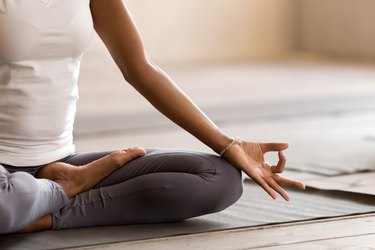
Unfortunately, there's no scientific evidence supporting the use of yoga for hemorrhoids. But yoga does count as exercise and a healthy lifestyle choice in general — both of which can help you maintain healthy bowel function to reduce or avoid hemorrhoids.
The Lowdown on Hemorrhoids
Video of the Day
Hemorrhoids may be the butt of many jokes — get it? — but if you're dealing with this painful swelling and inflammation in the veins around the anus and/or rectum, you're far from alone. As MedlinePlus points out, hemorrhoids are very common in both men and women, and by the time you hit age 50 you have a one in two chance of already having had them.
Video of the Day
Hemorrhoids — also known as piles — can be a little tricky because the most common symptom of them is bright red blood in your stool, on your toilet paper or in the toilet bowl. You might also feel pain or itching. But even though hemorrhoids are common (and even though there's a strong cultural aversion to discussing matters "down there"), any time you notice rectal bleeding you should talk to a doctor. That blood might be a telltale sign of a more serious condition that is best caught early.
Once you're certain the literal pain in your butt is from hemorrhoids, it's time to get down to business — sorry, that has to be said — and deal with proven treatments that can help you feel better. Because there's no scientific evidence that yoga helps treat hemorrhoids, yoga is not on the list.
But because regular exercise and healthy lifestyle choices in general are an important part of preventing and managing hemorrhoid flare-ups, doing yoga for external piles (another fun name for hemorrhoids) may still be beneficial.
Treating Your Hemorrhoids
So you've got hemorrhoids, and while yoga might help prevent future flare-ups, there's no guarantee it can help you now — and if you have external hemorrhoids, putting on body-hugging yoga gear might be the very last thing you want to do. What can you do to make the pain go away right now?
Start by going to the toilet. Seriously — despite the urge to put that suddenly painful function off, Harvard Health Publishing recommends getting it over with as soon as the urge strikes. That's because if you self-constipate, as it were, by holding your stool in, the result can be increased pressure and straining once things finally come to a head.
Harvard Health also recommends establishing regular bowel habits by scheduling a set time each day to sit on the toilet for a few minutes. Even if it doesn't soothe your "'roid" rage right now, this habit can help reduce their recurrence later on.
If you have active hemorrhoids, take a 20-minute "sitz bath" after each bowel movement and a few times a day in between. If you don't have a bathtub, ask a local pharmacy for a tub that's designed to fit over your toilet seat and accommodate your hips. Once you emerge, keep your anal area clean and dry — but don't rub it. Instead gently pat it dry; Harvard notes that you can even use a hair dryer.
Other things you can do to soothe active hemorrhoids include applying topical creams, some of which are available over the counter; using soothing witch hazel wipes; sitting on cushions instead of hard surfaces; even placing a small, cloth-wrapped ice pack against the affected area for a few minutes.
In occasional cases, serious hemorrhoids may require surgical treatment.
Read more: Foods That Help Heal Hemorrhoids
Preventing More Hemorrhoids
Hemorrhoids are caused by increased pressure in veins around (or inside) your anus or rectum and, although they're very common in the general population, there are a few risk factors that can leave you more likely to get piles. These include pregnancy, being very overweight, standing too much and lifting too much.
Harvard Health Publishing provides a list of practices that can help prevent hemorrhoids or at least reduce their recurrence — chief among them, healthy lifestyle choices such as eating plenty of fiber, staying hydrated and exercising regularly. And although there's no clinical proof that yoga is directly helpful for hemorrhoids, yoga can be very helpful for maintaining healthy lifestyle habits.
Consider a study published in a 2018 issue of the International Journal of Behavioral Nutrition and Physical Activity, in which researchers collected data from more than 1,800 young adults participating in a project on eating and healthy activities. The clinicians found that regular yoga practice was associated with healthy lifestyle choices like eating more servings of fruits and vegetables and fewer servings of sugary beverages, along with a more active lifestyle in general.
All of those benefits represent exactly the sort of healthy lifestyle practice that can help keep hemorrhoids at bay — although if you notice that exercise is exacerbating your hemorrhoid pain, it's time to talk to your doctor.
But Seriously: Yoga for Hemorrhoids?
Why does the topic of doing yoga for hemorrhoids even come up? It's because many practitioners claim that certain yoga poses or techniques are helpful in preventing or treating hemorrhoids.
For example, Asana International Yoga Journal claims that the yoga technique of "ashwini mudra" (a rhythmic and purposeful contraction of the anal sphincter) helps prevent the enlargement or swelling of hemorrhoidal tissue, and that inverted postures can offer relief from the pain of hemorrhoids. The journal also recommends certain enema-style yogic cleansing practices that aren't part of a typical Western practice.
While it's hard to argue with the wisdom of a millennia-old tradition, it can also be dangerous to take those practices out of context — which is, unfortunately, a very real hazard when you're considering yogic cleansing practices as a quick escape from a fiery backside. That's why it's so important to focus your attention on practices that have been clinically shown to help with this common ailment.
Can you try doing yoga inversions or other postures to see if they help your hemorrhoid symptoms? As long as your doctor hasn't forbidden the practice and you have the appropriate training and strength to perform those postures, you might as well give it a shot. However, yoga inversions come with their own set of potential risks, and it's hard to verify the true sourcing behind the more esoteric "yoga for hemorrhoids" techniques you may see advertised.
So, talk to your doctor before you attempt anything that is invasive or strenuous to your body, no matter how sincerely or convincingly it may be recommended to you. That might seem like overkill, but it's a lot better than presenting to the emergency room because an unconventional hemorrhoid treatment backfired on you.
- MedlinePlus: "Hemorrhoids"
- Harvard Health Publishing: "Hemorrhoid Help: Preventing and Treating Flare-Ups"
- International Journal of Behavioral Nutrition and Physical Activity: "Yoga's Potential for Promoting Healthy Eating and Physical Activity Behaviors Among Young Adults: A Mixed-Methods Study"
- Harvard Health Publishing: "Hemorrhoids and What to Do About Them"
- Asana International Yoga Journal: "Yoga Therapy for Hemorrhoids Yoga Therapy (Piles)"