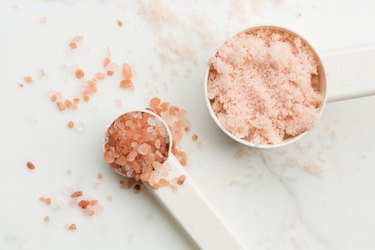
Table salt is probably the most important seasoning you can have in your kitchen, but not all salt is created equal. Himalayan rock salt is a trendy type of gourmet salt that's full of flavor and minerals. It's a natural product, like sea salt, but it comes from salt mines rather than the sea.
Tip
Himalayan rock salt can add flavor and a pop of pink color to your food. Because it has several essential minerals, it may have some health benefits as well, but it's important to know it's still a major source of sodium.
Video of the Day
Rock Salt Versus Sea Salt
There was a time when the only table salt option available to home cooks was iodized, fine-grain salt. If you've browsed the salt section at the grocery or cooking store lately, you know that salt has become a gourmet seasoning, with so many flavors, colors and textures. These salts are an easy way to kick up even the simplest of dishes.
Video of the Day
Read more: Healthy Cooking Tips for Beginners
All salt is made up primarily of the minerals sodium and chlorine to form sodium chloride. Specialty salts like sea salt or Himalayan rock salt also retain their natural minerals, in addition to sodium chloride.
Unlike sea salt, which is made by evaporating any type of seawater, Himalayan rock salt comes only from salt mines in an area of Pakistan located in the Himalayan mountains. Himalayan rock salt is also known as Himalayan pink salt because of the pink color imparted by the various minerals in the region where it's mined.
A chemical analysis of Himalayan pink salt published in the Romanian Journal of Chemistry in March 2016 found that the mineral content can vary, depending on the exact area from which it was mined. In addition to sodium chloride, Himalayan pink salt contains the following minerals: oxygen, potassium, sulfur, calcium, magnesium, aluminum, silicon, iron and fluoride. These minerals give the salt its taste and pink color.
Himalayan Salt Benefits
The minerals in Himalayan pink salt may have some health benefits. However, the minerals are available in only tiny trace amounts. It's unclear whether using Himalayan salt actually benefits your health.
Himalayan salt benefits might include improvements in your electrolyte balance, since it contains electrolytes like potassium, calcium and magnesium, as well as sodium and chloride. Electrolytes are essential for maintaining fluid levels, effective muscle contractions and nerve signals, among other functions. Some of the minerals in Himalayan rock salt, like calcium, magnesium and silicon, also play an important role in bone health.
A June 2017 article published by the Department of Food Science at the University of Guelph in Ontario, Canada, compared Himalayan pink salt to regular Morton's table salt, Celtic sea salt and Maldon salt (a typical sea salt).
The researchers found Himalayan salt benefits include having more potassium than the other salts. Because of its extra minerals, Himalayan rock salt also has slightly less sodium than both Maldon and Morton's table salt.
Salt, Sodium and Health
No matter which type of salt you use, it's best to use it in moderation. The 2015-2020 Dietary Guidelines from the Department of Health and Human Services advises Americans limit their sodium intake to no more than 2,300 milligrams per day, a figure called the recommended maximum limit (UL).
Excess dietary sodium is linked to increased risk of high blood pressure and cardiovascular disease. According to the USDA, Himalayan pink salt has 420 milligrams of sodium per gram, or one-quarter teaspoon.
Rock salt has a much larger grain than processed table salt, so the same quarter teaspoon of table salt has 590 milligrams of sodium. Some people find that they use less salt when using a rock salt versus a fine-grain salt, so using Himalayan rock salt can be helpful if you're trying to cut back on sodium.
Read more: 10 Myths About Salt Debunked
Using Himalayan Pink Salt
Because of its larger and irregular grain size, Himalayan pink salt is best used as a finishing salt on meats, fish or vegetables. A little sprinkle goes a long way in terms of flavor and a pop of pink color.
You can also use it to flavor liquids, like sauces or soup, since it will melt. However, it's probably not a good idea to bake with Himalayan pink salt because the large grains may not melt into the batter, and you'll risk biting into a piece of salt.
Another way to use Himalayan rock salt is to add it to your bath. Some people believe the minerals help to draw impurities out of your skin. A Himalayan pink salt bath can definitely be relaxing, whether from the minerals or just a few minutes of quiet time alone — and that's always a benefit for your health.
- Romanian Journal of Chemistry: “Morphological and Microchemical Characterization of Himalayan Salt Samples”
- Department of Food Science University of Guelph: “Salt as an Ingredient in Meat: Are All Salts Created Equal?”
- U.S. Department of Health and Human Services and U.S. Department of Agriculture: “2015 – 2020 Dietary Guidelines for Americans”
- USDA FoodData Central: “Pink Salt”
- USDA FoodData Central: “Table Salt”