



























Weight Loss Strategies and Portion Size

Weight Loss Strategies and Portion Size
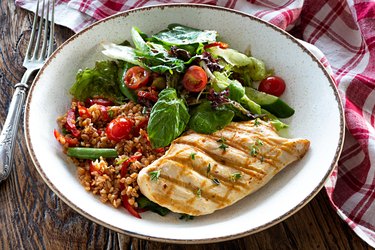
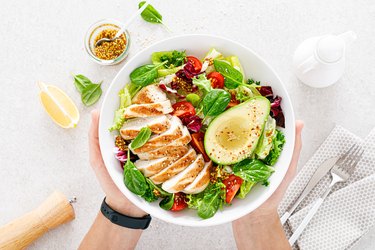
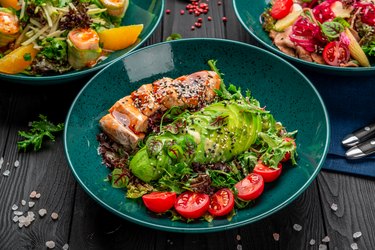
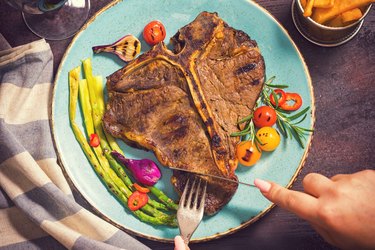
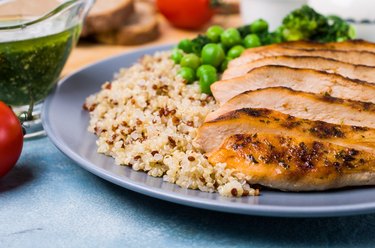
Photo Credit chicken meat and vegetables in plate image by dinostock from Fotolia.com

To lose weight, you need to use more calories than you consume. Because of this, understanding proper portion sizes is a key element to most healthy weight loss strategies. Many people think of serving size and portion size as the same thing, but this isn't the case. People often consume portions that consist of more than one serving.

Understanding Serving Sizes

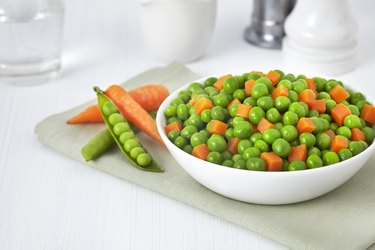
Using the nutrition facts information on food labels or following a diet that tells you how many servings from each food group you can eat both require you to understand what constitutes a serving. On food labels, the amount of food considered a serving is listed. However, there are also standard serving sizes used by the U.S. Department of Agriculture's Food Pyramid and the American Diabetes Association. A fruit or vegetable serving is usually 1/2 cup, except for dried fruit, which is 1/4 cup, and green leafy vegetables, which is 1 cup, or the size of your fist; a meat, fish or poultry serving is usually 3 oz., or about the size of your hand; and a serving of cheese is usually 1 oz., or the size of your thumb. (See References 1,2)

Controlling Your Portion Sizes

One way to cut calories is to control your portion sizes, or the amount of food you actually eat. Once you understand what a serving is, you can measure your food so you know how many servings you are eating. Eating smaller portions means eating fewer calories, which can lead to weight loss. Try putting only one serving of each food on your plate, eating that food slowly, then waiting a few minutes to see if you are really hungry before eating more.

Half-Plate Method

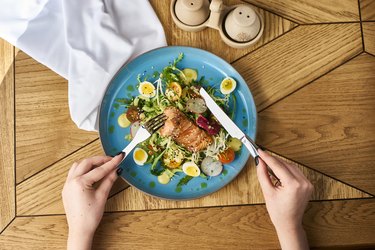
One simple way to use portion sizes for weight loss is the half-plate method. The American Diabetes Association recommends this method, which involves filling half of your plate with non-starchy vegetables, then half of the remaining space with protein and the rest of the plate with your starch. You add an 8-oz. glass of milk and a piece of fruit for a balanced meal with the proper portions. Using a portion control plate to follow these recommendations may be more effective than dietary education alone, according to a study published in 2007 in the "Archives of Internal Medicine."

Considerations

The size of your plate also makes a difference, whether you decide to follow the half-plate method or not. Using a smaller plate helps you to eat less, so try a 9-in. plate rather than a larger plate for dinner. Eat foods with less fat and sugar, and more fiber to help you feel full for longer, and don't add fatty sauces to your vegetables.

References

Article reviewed by JudithT Last updated on: Mar 1, 2011

Must see: Photo Galleries

Member Comments