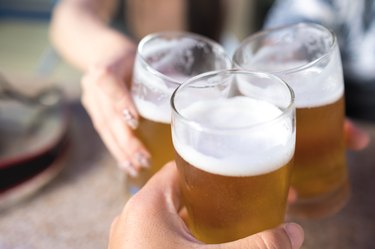
Beer is a curious substance. It's existed for thousands of years and has always been popular, yet it is made from a wide variety of ingredients. Despite the variations in its sources, beer is considered a fairly nutritious beverage. There are many nutrients, like protein, in beer that are considered healthy and beneficial. In fact, in the early days of continental exploration, it was thought that beer had all the nutrients you'd need to stay healthy — at least, that was the case if you were an explorer. But as it turns out, when it comes to vitamin content, you may be better off seeking out an alternative beverage to get your daily nutrient fix.
Video of the Day
Video of the Day
Looking at Beer's Vitamins
Despite the many variations in beer ingredients and its production process, the primary vitamins in beer are usually B-complex vitamins. You can obtain between 5 and 10 percent of your daily value for vitamins like folic acid, niacin, riboflavin and vitamin B-6 in each serving of regular beer. Consuming these vitamins is important; B-complex vitamins are essential water-soluble nutrients. This means that they need to be consumed and replaced each day in order for you to stay healthy.
B-complex vitamins like the ones found in beer help your body make energy when you consume food. They can also help prevent a variety of diseases. B-complex vitamins are particularly well known for their role in helping maintain red blood cells in your body and keeping your nervous system healthy. However, if you're looking for nutrients, B-complex vitamins can be found in higher amounts in other foods and beverages. Alternatively, you might want to seek out some non-alcoholic beer; otherwise, you may be consuming mostly empty calories.
Alcohol in Beer
The alcohol (or lack thereof) in beer helps determine its serving size. A regular beer typically has about 5 percent alcohol content, while light beers may have around 4 percent or less. The U.S. Dietary Guidelines for Americans state that women can consume one drink per day, while men can consume two drinks per day. The Centers for Disease Control states that those who are pregnant, who have certain medical conditions and who are underage should not drink at all. Moderate drinking can be a perfectly acceptable part of a healthy diet, but drinking more than the recommended amounts or drinking every day can increase the risk of health issues, like cancer, and injuries.
In contrast, nonalcoholic beer, made with similar ingredients but lacking alcohol content, can help boost health. Nonalcoholic beer can help maintain levels of electrolytes, especially in people who exercise. Alcohol-free beer can also reduce the likelihood of osteoporosis in women and increase the levels of antioxidants in their breast milk. Notably, the nutrient-rich beer that explorers and sailors once consumed had almost no alcohol compared to the beer that's consumed today.
Read more: 18 Healthy Beers
Beer Nutrition Facts
These days, talking about beer's nutrition facts can be a bit complicated. You might have a beer like Heineken or one like Guinness. The two are not comparable beverages — it would be the equivalent of comparing products like apple cider with freshly squeezed mango juice. Beyond the difference in ingredients, the alcohol in beer also varies between types. You can even buy products like gluten-free beers or non-alcoholic beers. In contrast, high-alcohol beers exist too. The beer with the highest alcohol content has more alcohol than most spirits, with 67.5 percent ABV.
Beer's nutrition varies depending on the way it is produced. A standard 12-ounce can of beer will be high in B-vitamins, magnesium and phosphorus. These values decline in light beers. However, they may change between anything from a sweet alcoholic ginger beer like Crabbie's to a dark stout, like Guinness. This also changes the caloric content – a Bud Light will have 110 calories per single bottle, while the same amount of Corona Extra will have 148 calories; 1556, a beer from the popular New Belgium Brewing Company, contains 205 calories.
- Daily Beast: The 50 Most Fattening Beers
- Business Insider: This Potent New Beer From Scotland Has A 67.5% Alcohol Content
- Beer Institute: Beer & World History
- Nutrition, Metabolism & Cardiovascular Diseases: Effects of moderate beer consumption on health and disease: A consensus document
- Nutricion Hospitalaria: Benefits of moderate beer consumption at different stages of life of women
- Semergen: Could the moderate consumption of beer be included within a healthy diet?
- Nutrients: Effects of Beer, Non-Alcoholic Beer and Water Consumption before Exercise on Fluid and Electrolyte Homeostasis in Athletes
- CDC: Fact Sheets - Moderate Drinking
- NIH: National Institute on Alcohol Abuse and Alcoholism: What Is A Standard Drink?
- Self: Nutrition Data: Beer
- Colorado State University Extension: Water-Soluble Vitamins: B-Complex and Vitamin C