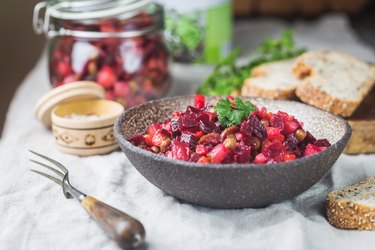
Versatile beets, a root vegetable, are good for you no matter whether you have them raw, cooked or juiced. Both the bulbous beet root and the leafy tops offer nutritional benefits with very low calories. Beets also supply phytonutrients that may have a protective effect on your circulatory and vascular systems.
Tip
Beets are good for you because of the dense nutrient content in both the root and the greens.
Video of the Day
Types of Beets
You'll find fresh beets in markets year-round, but their prime season is summer through fall. As the season progresses, beets tend to get bigger and are less tender.
Video of the Day
You are probably most familiar with red beets, but this root vegetable comes in other hues too, including purple, orange-gold and white. Chioggia beets, also known as Candy Cane beets, display a striped red-and-white flesh when you slice into them.
Calories and Macronutrients in Beets
The nutrient makeup of beets depends on which part you eat and whether or not you cook it. Raw and cooked beet roots have similar nutritional profiles, but beet greens and golden beets contain some different nutrients.
One raw beet is equivalent to 1/2 cup of cooked beets. You'll get roughly:
- 36 calories in each serving
- a gram of protein
- about 8 grams of carbohydrate
- no fat
Beet greens contain just:
- 9 calories in a 1-cup serving of raw greens and
- 19 in a half-cup of cooked
The cooked serving has 4 grams of protein and 4 grams of carbs, while the raw amount supplies less than a gram of protein and 2 grams of carbs — making either a good addition to your diet if you're counting carbs. Beet greens are also fat-free.
Read more: Can I Eat Beets Without Cooking Them?
Beets and Fiber
Beets are also healthy because so much of their carbohydrate content comes from fiber, an indigestible compound with numerous health benefits. You'll get 9 percent of the daily value for dietary fiber in a serving of raw beet root and 7 percent from cooked. Beet greens supply 6 percent of your fiber needs when raw, and the fiber content increases to 8 percent of the daily value when cooked.
Why is fiber so important? It contributes to digestive health by sweeping bacteria from your colon, keeping your bowel movements regular and reducing your risk for hemorrhoids and diseases of the colon, like cancer and diverticulitis.
In addition, fiber slows your body's absorption of glucose and helps maintain a healthy blood-sugar level — a plus for those with diabetes or pre-diabetes. A diet rich in fiber also keeps you feeling full longer, contributing to weight loss and maintenance.
Minerals in Beets
You'll find a healthy mix of minerals, including iron, calcium and magnesium, in a serving of beet root or beet greens. Of particular note, though, are the potassium, copper and manganese amounts in beets.
There's 6 percent of the daily value for potassium in a serving of beet root or greens, but the amount jumps to 14 percent when you cook the greens. Potassium is an electrolyte mineral that works with sodium to maintain fluid levels in the body. The standard American diet favors sodium over potassium, and the imbalance between the two can put you at risk for hypertension. Eating more vegetables like beets can help control your potassium and sodium levels naturally.
Beet root and greens supply about 7 percent of your daily needs for copper, a trace mineral that you need to metabolize iron from food. The daily value shoots up to 20 percent for cooked beet greens.
A serving of beet root, both raw and cooked, supplies 12 percent of the DV for manganese, which makes up many enzymes in the body, while cooked beet greens contain 16 percent of the DV for this micromineral.
Vitamins in Beet Root
The most notable vitamin in beet root is folate, and you'll get a rich amount no matter how you eat your serving. One raw beet provides 89 milligrams of folate, or vitamin B-9, which amounts to 22 percent of the daily value. A 1/2 cup serving of cooked beets supplies 68 milligrams of folate, or 17 percent of the DV.
Your body uses folate to produce DNA. Getting sufficient folate is especially vital for women in their childbearing years, because a deficiency can lead to fetal birth defects like spina bifida.
Folate also works with vitamin B-12 to lower homocysteine levels in the blood, helping to protect against heart disease.
Read more: Nutrients and Vitamins in Beets
Beet Greens Vitamins
Beet tops contain a different vitamin makeup than the root. These leafy greens are related to chard, and supply similar nutrients. You'll get 13 percent of the daily value for vitamin A in a serving of raw beet greens, and a full 31 percent if you cook them. Vitamin A is associated with the health of your eyes, skin and teeth.
You'll also get vitamin C in beet greens — 13 percent of the daily value when raw, and 20 percent cooked. Your body needs constant replenishment of vitamin C, which is water-soluble, to promote healthy skin and bones and assist in its absorption of iron.
Most outstanding among the vitamins you get from beet greens is vitamin K — a serving of either raw or cooked greens gives you even more than the daily value. Raw beet greens supply 127 percent of the DV, while cooking the greens boosts the percentage to a whopping 290. You need vitamin K for proper blood clotting and to support the health of your bones.
Read more: What Are the Benefits of Eating Beet Greens?
Beets and Phytonutrients
The pigments in red beets are powerful; women once used beet juice as a natural lipstick and blusher. Today, some manufacturers use beet root as a dye to replace synthetic coloring in processed foods. Because of this effect, beets can stain your hands and overpower the color of other foods. When you make beet juice or a raw beet salad, you should expect your drink or dish to turn a rich crimson, no matter what else you put in the mixture.
These pigments, however, also signal the presence of important phytonutrients in beets. Phytonutrients are compounds that help protect plants from pests and pathogens while they are growing, and may offer safeguards for human health, as well. Red, purple and golden beets all supply rich amounts of phytonutrients.
Of particular note — beets are among the few vegetables that contain phytonutrients known as betalains. Red and purple beets contain betacyanins, while golden beets supply betaxanthins. According to a review published in Nutrients in 2015, betalains have strong anti-inflammatory and antioxidant potential and may prove beneficial in the treatment of such conditions as arthritis and cancer.
Beets also contain nitrates, phytonutrients with links to cardiovascular health. Dietary nitrates convert in the blood and digestive system to nitric oxide, a powerful vasodilator. Nitric oxide increases the size of blood vessels, making blood flow more easily through the circulatory system. This has positive implications for individuals with vascular conditions.
In a study published in the journal Hypertension in 2015, participants aged 18 to 85 drank beet juice or a placebo every day for four weeks. In those who ingested beet juice, blood pressure decreased; the function of their endothelium — the cells lining their blood vessels — improved by 20 percent, and their arterial stiffness lessened. The researchers concluded that nitric oxide-rich beet juice shows promise as an ancillary treatment for high blood pressure and atherosclerosis, or hardening of the arteries.
Ways to Eat Beets
When buying fresh beets, look for rich color and firmness. Choose beets with the tops attached. You can also purchase beet tops in the greens section of the produce department, separated from the root. If you prefer to purchase beets that are already processed, choose frozen beets over canned, says Ohio State University, because fewer nutrients are lost in freezing.
Steaming beet root, reports OSU, preserves more of the folate and betalain content than other cooking methods. Reboot with Joe advises steaming them for no more than 15 minutes. You can also roast beets along with other root veggies, like parsnips, turnips and potatoes.
Beets work well with carrots as a raw salad. Shred the vegetables, then add shredded apple and chopped walnuts, and dress the mixture with olive oil and vinegar or lemon juice. You can also juice raw beets along with the vegetables and fruits of your choice, such as carrots, chard, tart apples and ginger.
Pickling or fermenting your beet roots creates a side dish rich in probiotics — friendly bacteria good for digestive health. Cover sliced or chopped beets with water, apple cider vinegar, salt and sugar, and let stand for eight hours at room temperature.
Use beet greens the way you would any other leafy green. If you prepare them raw as a substitute for chard or kale in a salad, chop them into pieces and let them marinate in their dressing to soften them.
To cook beet greens, either steam them or lightly sauté in a little olive oil with garlic and red pepper flakes for a quick and nutritious side. Those pretty red stems are also edible; slice into 2-inch pieces and cook them right along with the greens. You can also add beet greens to soups and stews.
Changes in Urine Color
When you start eating more red beets, you may notice that the potent pigments temporarily color your urine or stool. This isn't harmful, but it can be alarming if you mistake the deep red color for blood. Harvard Medical School says that "beeturia" only affects 10 to 14 percent of people and depends on what you ate with the beets. For those who are bothered by the discoloration, golden beets don't have the same effect, says the Cleveland Clinic.
- PBS: Discover the History of Beets
- My Food Data: Cooked Beet Greens, Raw Beet Greens, Cooked Beets, Raw Beets
- Mayo Clinic: Dietary Fiber
- University of Michigan Medicine: Minerals
- National Institutes of Health: Folate
- MedlinePlus: Vitamin A
- MedlinePlus: Vitamin C
- National Institutes of Health: Vitamin K
- Nutrients: The Potential Benefits of Beetroot Supplementation in Health and Disease
- Colin T. Campbell Center for Nutrition Studies: Nitric Oxide and Dietary Nitrate
- Hypertension: Dietary Nitrate Provides Sustained Blood Pressure Lowering in Hypertensive Patients
- Reboot with Joe: The Benefits of Beets
- Ohio State University: Maximize Your Nutrients from Beets
- Harvard Medical School: Urine Color and Odor Changes
- Cleveland Clinic: Technicolor Beets