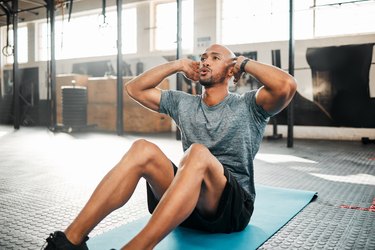
Sit-ups are an effective exercise to strengthen your abdominal muscles. But just like other muscle groups, your abdominals can develop soreness after being overworked after a difficult set of this exercise — particularly if you've been neglecting these muscles in favor of strengthening your arms or legs.
Sometimes, though, you might experience a type of pain during a sit-up that you know isn't your typical muscle soreness from a tough workout session. This could indicate issues including cramps, a strained muscle or gastrointestinal (GI) problems.
Video of the Day
So, if you're wondering, "Why does my stomach hurt when I sit up" or "Why does my stomach hurt after doing sit-ups," we'll dive deeper into the potential causes of stomach pain when doing sit-ups, how to get rid of stomach pain after sit ups and when to call your doctor.
Warning
In some cases, self-care measures can remedy your stomach pain, but if it's particularly severe or doesn't get better after one to two days, seek medical attention ASAP.
Muscle Strain
An abdominal muscle strain is usually due to an overuse injury — working your abs too often or too intensely — or poor form during core exercises like sit-ups, according to the Cleveland Clinic. A muscle strain is another way of saying your abdominal muscle has a tear in it. The resulting sensation can range from slight discomfort in mild strains to intense pain if the tear is severe.
Unlike cramps caused by other factors (more on that below), the pain from a strain tends to linger and is worse upon movement. In addition to pain, other possible symptoms of an abdominal strain include swelling, bruising and stiffness in your abdominal muscles, per the Cleveland Clinic.
If you suspect injury, rest the muscles and avoid further activity and ice the affected muscles for 15 to 20 minutes at a time, every hour, for up to four hours, per the Cleveland Clinic. If the pain doesn't go away, seek medical attention.
To prevent muscle strains, warm up and stretch your abdominal muscles before doing your sit-ups. Avoid overexertion by building up the strength of your abdominal muscles gradually, and make sure to focus on proper form during your core exercises, according to the Cleveland Clinic.
Muscle Cramps
Muscle cramps in the abdominal region usually occur in the area around or just below your rib cage, per Mount Sinai, but they can happen anywhere in the abdominal region. Your stomach muscles are particularly prone to cramping because they are so short and they tend to stay contracted after vigorous activity.
When stomach cramps during or after sit-ups occur, you may feel uncontrollable and painful spasms or twitches in the muscle, per Australia's Department of Health and Human Services Victoria. These cramps can last anywhere from a few seconds to 15 minutes or more, and may repeat before fully going away, according to the Cleveland Clinic. The pain from abdominal muscle cramps can be quite severe in some cases. Severe cramps can leave your muscles feeling sore and tender.
What causes stomach muscles spasms (cramps)? While experts aren't exactly sure, conditions such as dehydration, electrolyte deficiencies, eating too soon before you work out and muscle fatigue play a part in cramping stomach muscles, according to the American Academy of Orthopaedic Surgeons.
If your abs cramp when doing sit-ups. stop the exercise and massage the affected area until the cramp goes away, according to the Cleveland Clinic. Gently stretching your abdominal muscles can also help (refer to some stretches in the delayed-onset muscle soreness section, below).
While muscle cramps can be unpredictable, there are a few ways you can potentially prevent them from occurring in the first place, per the Cleveland Clinic:
- Stay properly hydrated.
- Avoid exercising in hot weather, especially when your muscles are already sore or fatigued.
- Work on flexibility/mobility on a regular basis.
- Regularly stretch muscles that you know are prone to cramping.
GI Issues
In some cases, the cramping you experience is the result of an underlying digestive issue. For example, you might have an intolerance to certain types of food that can lead to gas, bloating and pain, and sit-ups are only exacerbating the problem.
Some substances — such as caffeine, alcohol and aspirin — irritate your gastric lining, causing cramps, per Johns Hopkins Medicine. Sometimes, an underlying medical disease is the cause of your cramping. Common culprits include gastritis, ulcers and irritable bowel syndrome.
If you suspect a food might be causing the problem, try removing it from your diet. Common problem foods include dairy products, wheat products, beans and high-fiber vegetables. If removing these foods doesn't fix the problem, or if you have other symptoms including bloody stool, gas, bloating, belching or nausea and vomiting, talk with your doctor to rule out an underlying gastrointestinal disorder.
Delayed-Onset Muscle Soreness
If your stomach is sore after sit-ups, especially in the days after your workout, it may be due to delayed-onset muscle soreness (DOMS).
DOMS refers to the muscle soreness that typically occurs if you start a new exercise program, change it significantly or ramp up the intensity or duration, according to Baptist Health. Therefore, if you've been ignoring your abdominals and then bust out a hundred sit-ups during one exercise session, you'll likely experience DOMS in the next day or two.
Warm temperatures increase blood flow to sore muscles, which can relieve stomach pain after sit-ups, per Johns Hopkins Medicine. You can place a heating pad against your sore stomach muscles or soak in a hot bath — particularly a good idea if it's not just your stomach muscles giving you trouble. You could also use a peel-and-stick heating pad, which is thin enough to wear under clothes if you have to head to work or run errands.
There are also a couple of yoga poses that can gently stretch your stomach muscles to relieve soreness if your abs hurt after sit-ups.
1. Cobra Pose (Bhujangasana)
- Lie on your stomach with your legs together, the tops of your feet down and your hands under your shoulders.
- On an inhale, peel your chest away from the floor. Roll your shoulders back and down your spine as you straighten your arms as much as your flexibility allows.
- Be careful not to go too far too soon. Breathe deeply and maintain awareness of the feedback your body is providing to avoid stress or strain.
- Lower your chest back down to the floor in the starting position.
2. Bridge Pose
- Lie on your back. With your knees bent, place your feet flat on the floor, hip-width apart. Position your arms so they rest alongside the body, with the palms facing down.
- Inhale, press your feet into the floor and lift your hips up, rolling your spine off the floor. Push your arms and shoulders down into the floor to lift your chest up. You should feel a stretch in your stomach muscles.
- Hold for five breaths, exhale and release to the starting position.
Tip
An over-the-counter pain reliever can help you feel better temporarily. However, the Hospital for Special Surgery recommends the use of acetaminophen rather than ibuprofen, which can prevent your muscles from healing themselves. Talk to your health care provider before taking any medications.
As the saying goes, an ounce of prevention is worth a pound of cure. Next time you work on your abdominals — or any underexercised body part, for that matter — start the program gently. Allowing your muscles the time to adapt to the intense movements can decrease the chance of DOMS.
In your next workout, finish one full set of each exercise using proper form or decrease the number of repetitions you do during each set. Once your muscles have adapted to the exercise, increase the number of reps or sets.
- American Academy of Orthopaedic Surgeons: "Muscle Cramps"
- Cleveland Clinic: "Abdominal Muscle Strain"
- Department of Health and Human Services Victoria: "Muscle cramp"
- Cleveland Clinic: "Muscle Spasms"
- Johns Hopkins Medicine: "Gastritis"
- Baptist Health: "Why Do Muscles Get Sore Several Hours or Days After Working Out?"
- Johns Hopkins Medicine: "Ice Packs vs. Warm Compresses For Pain"
Is this an emergency? If you are experiencing serious medical symptoms, please see the National Library of Medicine’s list of signs you need emergency medical attention or call 911.