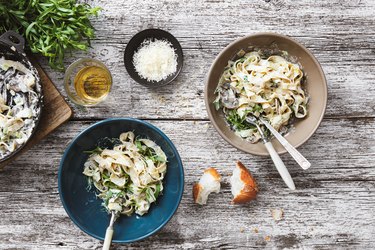
With your busy life, you might find it easier and faster to grab fast food on your way home from work. But this convenience comes at a price. Research has shown that homemade meals tend to be healthier than takeaway. You can spare yourself unwanted calories, carbs, saturated fat and sodium by preparing your own meals with fresh, healthy ingredients, possibly reducing your risk of hypertension, Type 2 diabetes and heart disease.
What’s the Difference in Nutrition?
Video of the Day
When comparing the nutritional value of fast food vs. home-cooked meals, the meals that you prepare yourself are frequently much healthier. Fast foods and restaurant meals may be high in salt, artery-clogging cholesterol and calories. By preparing your own dishes, you can control the ingredients, substituting sugar-free sweeteners or low-sodium options and including more vegetables and whole grains. Choosing healthy fats for your recipes will contribute to the health of your heart.
Video of the Day
You can also manage the portions you dish out — the larger-than-necessary serving size in most restaurants can lead to overeating. Instead of the 12-ounce steak you might order at a restaurant, you can enjoy a 3- or 4-ounce piece of meat and fill the rest of your plate with healthy veggies, cutting down on saturated fats and upping your fiber intake. Instead of sugar-laden desserts that tempt you at restaurants, you can serve fresh fruit or fruit compote to help meet your daily requirements.
Too Much Sodium
Another difference between fast food and homemade food involves sodium content. At home you're inclined to use less salt to season meals, but restaurants and fast-food outlets use generous amounts to enhance flavors. Food additives and preservatives also contain salt. Even if the pastries, donuts or bread you buy doesn't taste salty, you can bet the sodium content is high.
In fact, few realize how much salt is in the restaurant food they eat, as demonstrated by a study published in Appetite in 2017. Americans eat 89 percent too much salt, says Time. The recommended daily allowance (RDA) is 2,300 milligrams of sodium per day, which is about 1 teaspoon. Excessive salt intake causes water retention and can raise blood pressure, resulting in possible damage to the heart, blood vessels, brain and kidneys, according to the Harvard T.H. Chan School of Public Health.
Read more: Negative Effects of Fast Foods
Obesity in Children
Whether you eat out or bring fast food home to eat, those time-saving meals may be taking a toll on the health of your children. Obesity in children is a rising public health problem, carrying with it the risk of heart disease and Type 2 diabetes later in life.
A study of children in 85 schools compared children who never ate takeaway meals to those who ate one or more takeaway meals per week. The findings, published in 2018 in Archives of Disease in Childhood, showed that the groups eating takeaway were associated with higher calorie and saturated fat intake and lower protein and micronutrients. Additionally, the group that ate takeaway had higher total and LDL cholesterol levels and a higher fat mass index.
The conclusion of the study was that consumption of takeaway meals in children had potential long-term consequences for obesity and risk of coronary heart disease due to increased body fat and poorer-quality diets.
Food Allergies and Sensitivities
Many people have allergic reactions to different foods and spices. Even a trace amount of a food allergen can trigger a severe reaction. Francine L. Shaw, an inspector at Food Safety Training Solutions, observes cross-contact situations every day in restaurants, mostly due to food-service teams being improperly trained on safe food handling.
If you have food sensitivities or food allergies, you may be taking a risk by eating restaurant food. With an acute condition, such as celiac disease, even ordering gluten-free meals may still spell trouble if kitchen cooking methods allow cross-contamination. It's impossible to know for sure if your restaurant meal is actually peanut free or doesn't contain seafood.
The benefit of cooking at home is that you can ensure that your ingredients are clean and free of contaminants. When you're in control in your own kitchen, you can reduce the risk of adverse reactions.
Weight Loss
Not only are home-cooked meals healthier, but a single serving at a fast-food chain can cost you all the recommended calories you should consume in a day. Homemade meals typically supply fewer calories, which is helpful if you're trying to lose weight.
A 2015 examination of the cooking frequency and diet of Americans who had intentions of losing weight revealed that those who ate six to seven meals at home per week consumed an average of 170 fewer calories per day, 5 fewer grams of fat and 16 fewer grams of sugar compared to those who cooked dinner at home only once a week. The evidence, published in Public Health Nutrition, shows that people who cook dinner at home eat a healthier diet, whether or not they're trying lose weight.
Healthy Fast-Food Options
For those days when you just don't have the time to cook a meal or pack a lunch and fast food is your only alternative, look for the healthiest options. This means foods that offer a decent combination of macronutrients, especially protein, without excessive sugar, sodium and trans fat.
Opting for a takeaway salad is often a good choice. Wendy's offers a Mediterranean chicken salad that contains 430 calories, 14 grams of fat and 39 grams of protein, with the added bonus of 120 percent of your RDA for vitamin A. The drawback is the amount of sodium it contains — more than half your RDA, according to Fast Food Nutrition.
Bypass the sugary sweets at Starbucks for a healthier breakfast wrap. Starbucks' spinach, feta and cage-free egg-white wrap contains 290 calories, 10 grams of fat and 19 grams of protein. The wrap also contains 24 percent of your RDA for fiber, so it compares favorably to a less-filling muffin or doughnut.
Another option is Taco Bell's Chicken Burrito Supreme. With 340 calories and 17 grams of protein, it only contains 8 grams of fat and a moderate amount of carbs at 16 percent of your RDA. Again, the sodium content is high, nearly half your RDA.
- Science Direct: Appetite: Consumer Underestimation of Sodium in Fast-Food Restaurant Meals: Results From a Cross-Sectional Observational Study
- Harvard T.H. Chan School of Public Health: The Nutrition Source: Health Risks and Disease Related to Salt and Sodium
- TIME: Your Meal Has Six Times More Salt Than You Think
- FSR Magazine: Accommodating Food-Allergic Guests
- Archives of Disease in Childhood: Takeaway Meal Consumption and Risk Markers for Coronary Heart Disease, Type 2 Diabetes and Obesity in Children Aged 9–10 Years: A Cross-Sectional Study
- Cambridge University Press: Public Health Nutrition: Is Cooking at Home Associated With Better Diet Quality or Weight-Loss Intention?
- Fast Food Nutrition: Wendy's Whole Power Mediterranean Chicken Salad Nutrition Facts
- Fast Food Nutrition: Starbucks Spinach, Feta & Cage Free Egg White Breakfast Wrap Nutrition Facts
- Fast Food Nutrition: Taco Bell Fresco Burrito Supreme – Chicken Nutrition Facts