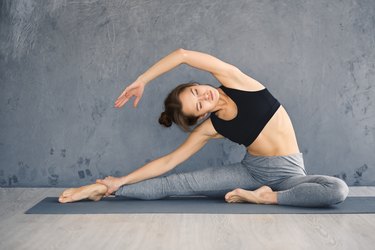
Most people have heard that it's important to stretch before a workout, but many people might be tempted to skip it. But don't! The moves don't have to be complicated or time-consuming, as these examples of warmup and cool down exercises show. The type of stretching also matters.
According to the American Heart Association, warm-ups increase blood circulation, oxygen demand and the range of motion in your joints, which better prepares you for activity. It can also help reduce your risk of injury.
Video of the Day
Video of the Day
A cool-down gradually decreases body temperature and reduces the risk of blood pooling in your working muscles and tissues. Examples of warm-up and cool-down exercises vary, from dynamic movements to gentle stretching and breathing.
Add Some Stretches
While you've likely heard that it's important to stretch before a workout, the type of stretching also matters. According to Dartmouth-Hitchcock, static stretching, where the body stays in one position, isn't ideal as a warm-up.
Instead, include dynamic stretches that involve movement, such as straight leg marching during your warm-up. These stretches are only held for two to three seconds, and target multiple muscle groups at the same time.
Static stretches, which are held for 30 to 45 seconds, typically target one muscle group at a time. Include these stretches in your cool down to increase flexibility in your warmed up muscles.
Be Specific With Your Routine
During your warm-up activities, choose exercises that mimic as close as possible the activity and movements that you'll be doing. For example, if you run, play tennis or spar in boxing, perform warm-ups that are in the standing position.
This recommendation is based on the SAID principle, which stands for "specific adaptation to imposed demands." as explained by the American College of Sports Medicine.
This means that your body adapts and improves what you train it to do, according to physical therapist Tony Ingram.
A study published in the April 2013 issue of Journal of Strength and Conditioning Research showed that passive stretching to improve flexibility has no carryover to specific movement patterns, such as lunging and extending your hips in a standing position.
Examples of Warm-Up Exercises
Dynamic warm-ups often move more than one joint or muscle group. These movement patterns can be quick and rhythmic, such as lateral leg swings, swinging arm circles and standing hip circles, or they can be slow and rhythmic, such as tai chi and modern dance movements.
Dynamic warm-ups can also mimic movement of a specific sport skill, for example, a lateral lunge and ground reach, body-weight squats, medicine ball swings and single-leg hops.
Always maintain rhythmic breathing that can help you control the force and coordinate your movements.
Try These Cool-Downs
Cool-downs involve exercises that slow down your heart rate, blood flow and nervous system activity. These could include gentle stretches, breathing exercises based on yoga or tai chi and walking at a brisk pace for five to 10 minutes.
These exercises don't need to be sports specific, but they should address the entire body rather than specific muscles. You can even use some of the warm-up exercises to wind you down.
Cool-down exercises include Sun Salutation, qi gong breathing, supine torso twists and lateral side bends. You may even want to dance freestyle to your favorite song as part of your cool-down.
- Journal of Strength and Conditioning Research: "Improvements in Hip Flexibility Do Not Transfer to Mobility in Functional Movement Patterns"
- American College of Sports Medicine: "Bust Through Training Plateaus (and Boredom) with these Programming Swaps"
- American Heart Association: "Warm Up, Cool Down"
- Dartmouth-Hitchcock: "Dynamic Stretching for Athletes"
- YouTube.com: Qigong 14 Movements
- YouTube.com: Yoga for Beginners
- Human Kinetics: Types of Stretches